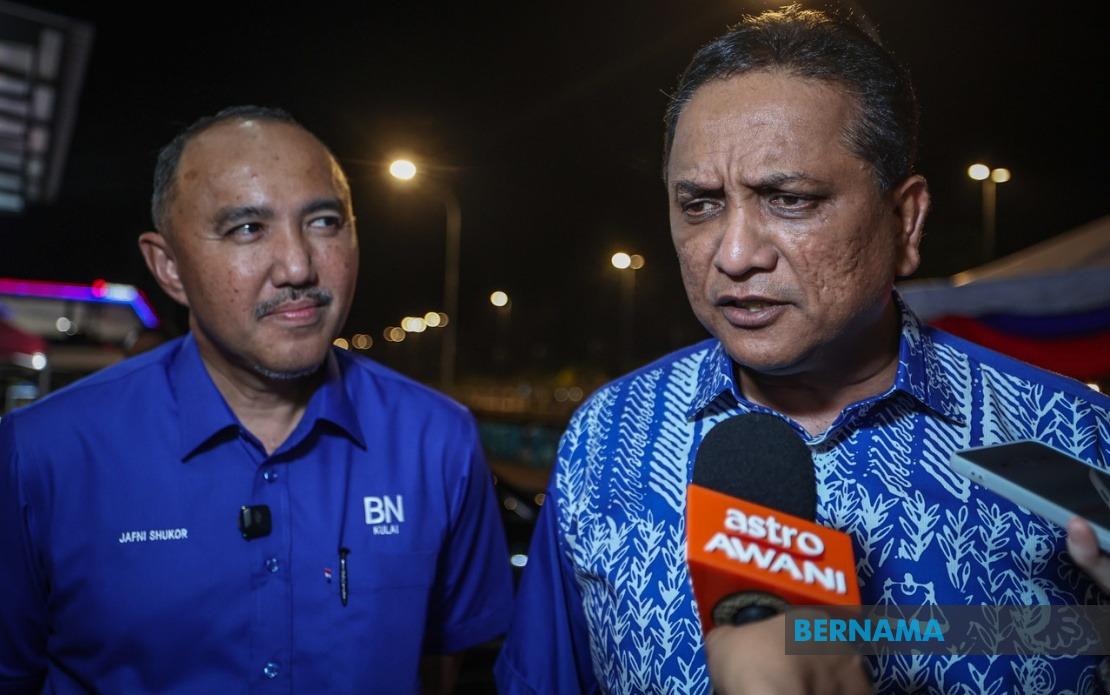
JOHOR BAHRU — A senior UMNO leader has forcefully dismissed suggestions that the Regent of Johor, Tunku Mahkota Ismail, has wielded excessive influence over the state administration, characterizing such claims as significantly overblown and lacking substantive foundation. The remarks come amid heightened political tensions within Johor as the state approaches its election cycle, scheduled for polling on July 11 following nomination day on June 27.
Datuk Seri Reezal Merican Naina Merican, who holds a position on UMNO's Supreme Council, clarified that the Regent's outspoken approach to matters affecting Johor's development represents a legitimate exercise of authority rather than improper interference. He cautioned against misreading the Regent's decisive statements, arguing instead that such pronouncements should be understood as expressions of his constitutional obligation to safeguard the welfare and interests of Johor's residents. This distinction carries particular weight in Malaysia's system of constitutional monarchy, where Rulers occupy a defined institutional space with defined powers and responsibilities.
The UMNO official elaborated that every action and directive from Tunku Mahkota Ismail falls squarely within his legal prerogatives and duties as Regent, exercised for the benefit of the state and its people. He emphasized that the Regent's oversight of the Menteri Besar, the State Secretary, and broader state governance functions should not be misconstrued as transforming elected representatives into subordinate instruments of palace authority. Rather, these checks and balances represent a structural feature of Malaysia's constitutional arrangement, designed to ensure accountability and proper administration at the state level.
Reezal Merican emphasized that his experience within UMNO's highest deliberative body has provided no indication whatsoever that Johor's party apparatus operates as a palace-controlled mechanism. His assertion suggests that senior party leadership sees no fundamental conflict between the Regent's role and the Menteri Besar's executive authority. This positioning matters considerably, as it represents an attempt to contain what could otherwise escalate into a destabilizing institutional dispute during an election period when political sensitivities typically run highest.
The controversy has been amplified by the recent departure of Datuk Dr Mohd Puad Zarkashi, a former Speaker of the Johor State Legislative Assembly, who cited concerns about the Menteri Besar's position becoming subordinate to palace interests. Reezal Merican questioned Mohd Puad's motivations for introducing royal institution dynamics into partisan electoral competition, particularly given the proximity of voting and the potential for such claims to inflame factional divisions. His critique implies that Mohd Puad's exit from UMNO may reflect internal party disagreements rather than genuine constitutional concerns.
The broader context reveals ongoing tensions within Johor's political establishment regarding the proper scope of royal authority in a parliamentary system. While the Regent undoubtedly possesses constitutional powers, disagreement exists about where legitimate oversight ends and inappropriate intervention begins. Reezal Merican's intervention attempts to establish a narrative where the Regent's activism remains compatible with democratic governance and responsible ministerial authority, thereby heading off potential allegations that the state operates under de facto palace rule.
For Malaysian observers, this dispute illuminates persistent questions about power distribution between elected officials and constitutional monarchs at the state level. Although Malaysia's federal structure theoretically reserves significant autonomy to state governments, Rulers maintain considerable formal authority and deep cultural significance that can amplify their influence beyond strict constitutional mechanics. Johor's situation thus offers a microcosm of these broader tensions that periodically surface across the Malaysian federation.
The timing of these claims, arriving just as Johor enters its election cycle, raises questions about whether institutional frustrations are being weaponized for electoral advantage. By framing Mohd Puad's allegations as attempts to drag the Royal institution into partisan competition, Reezal Merican seeks to discredit the narrative that the Menteri Besar operates under palace constraints. This rhetorical maneuver aims to preserve party unity and institutional confidence during a critical political moment when electoral performance will shape Johor's governance for years ahead.
Regional implications extend beyond Johor's boundaries, as Southeast Asian monarchies and their governments navigate similar tensions between traditional authority and modern democratic governance. Malaysia's constitutional arrangement—whereby Rulers retain significant symbolic and practical power alongside elected executives—represents a particular regional model that other Southeast Asian nations observe with interest. How Johor's leadership manages these tensions may influence perceptions about the viability and stability of such hybrid systems throughout the region.
Reezal Merican's defense of current arrangements suggests that UMNO's central leadership remains committed to framing the Regent's role as consistent with responsible governance rather than as an obstacle to democratically accountable administration. Whether this narrative prevails likely depends on upcoming election results and the degree to which Johor's citizens perceive their government as genuinely responsive to their priorities. The resolution of these questions will substantially shape Johor's political landscape and test assumptions about the compatibility of royal oversight with elected representation in modern Malaysia.

