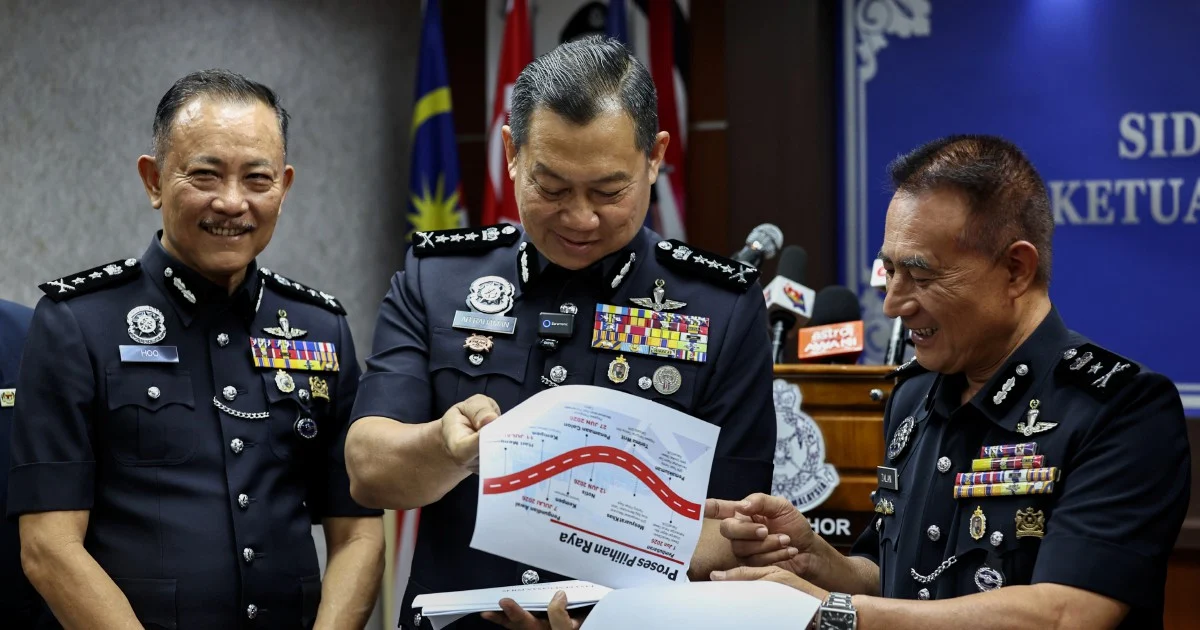
The Johor Police contingent has mapped out a comprehensive security framework for the forthcoming 16th Johor state election, stationing over 11,000 officers across the southern state to maintain public order and electoral integrity. A strategic review of the state has culminated in the identification of 39 geographical and operational hotspots that demand intensified police presence and active surveillance throughout the polling period.
This substantial deployment reflects established procedures and lessons gleaned from previous electoral cycles in Malaysia's most industrialised state. Johor, which accounts for a significant portion of the nation's economic output and housing some of the most densely populated urban centres outside the Klang Valley, requires carefully calibrated security responses to election-related tensions. The hotspots likely encompass areas with histories of contentious campaigning, volatile inter-party dynamics, or demographic concentrations that have previously witnessed election-day agitation.
The identification of specific flashpoint zones enables police to concentrate resources efficiently rather than spreading personnel thinly across the entire electoral landscape. By pre-emptively positioning officers in areas most susceptible to disorder—whether stemming from rival political operatives, unruly supporters, or criminal elements seeking to exploit election-day distractions—authorities aim to achieve a visible deterrent effect whilst maintaining responsive capabilities for rapid intervention should incidents materialise.
Johor's electoral landscape carries particular significance within Malaysia's broader political architecture. As the home of the United Malays National Organisation's traditional powerbase and increasingly a testing ground for opposition strategies, the state election typically generates animated political competition. The deployment of this magnitude underscores official recognition that maintaining electoral peace requires substantial investment in security infrastructure and personnel management.
The 11,000-officer contingent encompasses not merely frontline patrol units but encompasses specialist teams trained in riot control, intelligence gathering, and rapid response protocols. Their deployment across 39 identified zones necessitates careful coordination between district police commands, specialised units, and state-level operational coordination centres. Such orchestration demands weeks of advance planning, logistics coordination, and inter-agency communication.
Hotspot identification typically incorporates multiple analytical frameworks. Authorities examine historical incident data from previous elections, analyse demographic and socioeconomic profiles of constituencies, assess current political temperature through intelligence networks, and consult with local authorities regarding community-specific vulnerabilities. This multifaceted approach produces a risk-weighted map guiding resource allocation decisions.
The electoral environment in Johor carries distinct characteristics warranting heightened precautions. The state's substantial Indian and Chinese populations, alongside its Malay demographics, creates a complex communal tapestry where electoral contests occasionally activate dormant communal sensitivities. Additionally, Johor's status as an economic engine attracting migrant workers and comprising multiple urban centres introduces additional layers of complexity for maintaining order across dispersed geographical areas.
Police preparations extend beyond mere physical deployment to encompass public communication strategies designed to establish behavioural expectations and discourage potential troublemakers. Advance messaging regarding police readiness and consequence certainty forms an integral component of deterrence architecture. When prospective actors understand that security forces maintain heightened awareness and possess capacity for swift response, many recalculate cost-benefit calculations regarding participation in disorder.
The election's timing and electoral rules also influence security requirements. Johor's state election occurs within Malaysia's broader electoral calendar, potentially overlapping with heightened national political sensitivities or intersecting with other states' electoral cycles that fragment national political attention. The specific electoral system governing the 16th Johor assembly—the quantity and configuration of constituencies, the mechanism for translating votes into assembly seats—determines the competitive intensity across different geographical zones and influences authorities' risk assessments.
Practical implementation of this security framework requires careful calibration balancing multiple objectives. Authorities must maintain sufficient presence to deter and respond to genuine threats whilst avoiding excessive visibility that could alienate voters or create perceptions of heavy-handedness compromising electoral credibility. This equilibrium proves particularly delicate in democratic settings where perceptions of neutrality and institutional legitimacy remain paramount.
For regional observers and neighbouring Southeast Asian nations, Johor's electoral processes carry broader significance as indicators of Malaysia's institutional capacity to manage competitive politics peacefully. The state has historically demonstrated relatively stable electoral transitions, and the maintenance of this pattern through professional security management and mature political comportment enhances Malaysia's regional standing as a functioning democracy capable of conducting contested elections without descending into disorder.
The identification and resourcing of 39 specific hotspots reflects sophisticated understanding of contemporary Malaysian electoral dynamics and institutional learning from previous contests. By targeting resources strategically rather than adopting blanket approaches, Johor Police demonstrate evolution in security management philosophy emphasising intelligence-led, geographically calibrated responses. This approach maximises effectiveness whilst maintaining proportionality and respect for electoral processes that remain foundational to democratic legitimacy.
As Johor citizens prepare to exercise franchise rights, the substantial security presence ultimately aims at creating conditions enabling democratic participation to proceed unimpeded by violence, intimidation, or disruption. Whether this deployment successfully achieves that objective will provide important signals regarding the state's—and nation's—capacity for managing electoral competition within peaceful constitutional frameworks.

