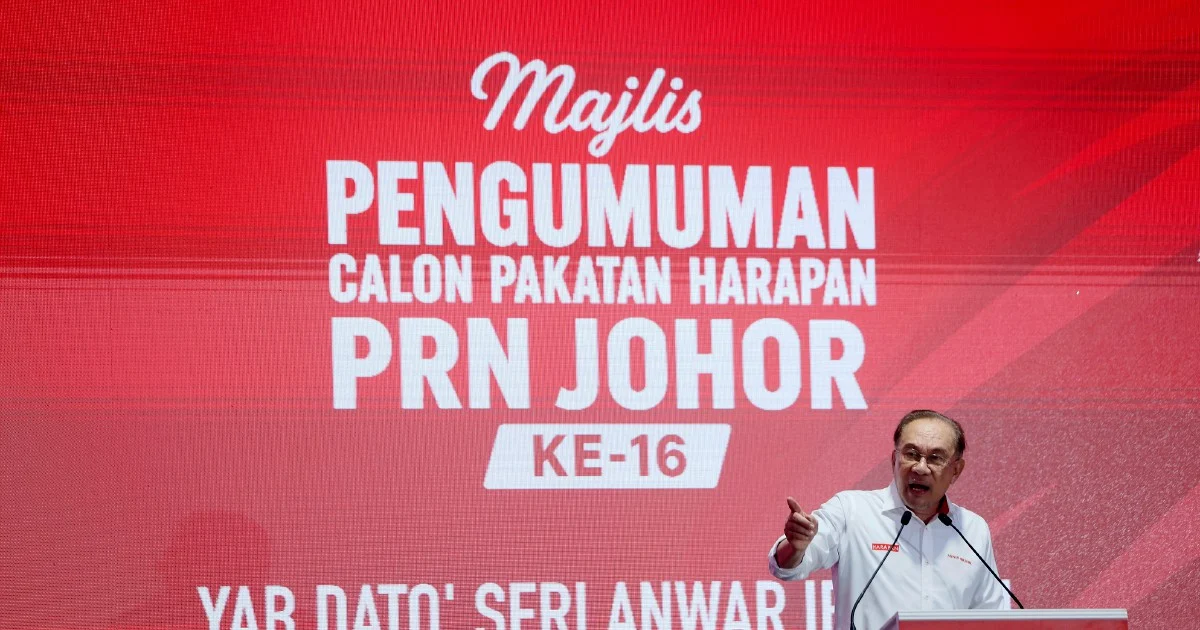
Prime Minister Datuk Seri Anwar Ibrahim has clarified the financial relationship between Johor and the federal government, revealing that the state has received more from Putrajaya than it has contributed in revenue. Speaking in Tangkak, Anwar emphasised that the federal administration transferred RM16 billion to Johor across a three-year period, whilst the state generated RM14 billion in income for the central government during the same timeframe. This RM2 billion variance underscores the redistributive role played by federal financing mechanisms across Malaysia's constituent states.
The disclosure comes amid ongoing scrutiny of federal fiscal allocations and how resources are distributed among states with varying economic capacities. Johor, as one of the nation's economically significant states with a substantial manufacturing and port sector, typically generates substantial federal revenue through income taxes, corporate levies, and indirect taxation. However, the federal framework requires wealthy states to receive allocations that account for developmental needs, infrastructure gaps, and service provision across less commercially developed regions.
Anwar's comments reflect the complex dynamics of Malaysia's fiscal federalism, where the central government collects revenue but redistributes it according to principles of national development and equity. The RM2 billion net transfer to Johor suggests that despite the state's economic contributions, federal policy prioritises channelling resources back to support state-level government operations, capital projects, and service delivery. This dynamic differs markedly from some developed federations where wealthier jurisdictions receive net negative transfers.
The three-year window examined by the Prime Minister spans a period marked by economic recovery following pandemic disruptions and the transition between federal administrations. During this phase, infrastructure investments, economic stimulus programmes, and sectoral support initiatives would have absorbed significant portions of federal allocations to states. Johor's share of these funds reflects both its population size—as the second-most populous state after Selangor—and its strategic importance to national economic corridors.
For Malaysian readers and policymakers, this disclosure carries implications for understanding federal-state fiscal relations and budget allocation transparency. It demonstrates that wealthy states do not necessarily experience net fiscal extraction by the centre, contrary to occasional political rhetoric suggesting unfair treatment of economically productive regions. Instead, the figures illustrate a deliberate policy of ensuring all states receive resources sufficient for governance and development, regardless of their revenue-raising capacity.
The announcement also provides context for debates surrounding state autonomy and fiscal devolution. Some political leaders periodically advocate for greater state retention of revenues or reduced federal allocations, arguing this would strengthen state finances and independence. Anwar's disclosure that Johor received RM16 billion against RM14 billion contributed invites scrutiny of how effectively these transfers translate into visible public goods and infrastructure improvements that benefit Johor residents.
Moreover, the timing of this statement may serve to address any concerns within Johor about federal treatment of the state. Anwar, who maintains close political ties to Johor, has reason to demonstrate that his administration treats the state fairly in fiscal matters. By quantifying the net transfer, he provides empirical grounding to claims that the federal government supports Johor's development agenda, even as the state remains a significant net contributor to national coffers through its economic output and tax base.
The RM14 billion revenue figure attributed to Johor requires interpretation, as it likely represents the state's direct contributions to federal accounts rather than its total tax collection. Many taxes collected in Johor ultimately flow to the centre, which then makes allocation decisions. The distinction between revenue source and federal expenditure is crucial: taxes collected in Johor but administered federally—such as income tax or corporate tax—may not be precisely attributed to the state in federal accounts, yet they represent part of Johor's economic contribution.
Understanding these patterns matters for Southeast Asian investors and businesses operating in Malaysia, as federal fiscal stability and transparent allocation mechanisms provide confidence in consistent policy frameworks. Johor's status as a net recipient of federal allocations, despite being a productive state, suggests the federal government prioritises maintaining healthy state finances even among economically stronger regions. This approach contrasts with more competitive federal systems where wealthy states receive minimal support.
The announcement also reflects broader economic trends affecting state finances across Malaysia. Post-pandemic recovery, inflation pressures, and evolving sectoral dynamics have influenced both revenue generation and allocation needs. States that previously relied on specific industries have needed federal support to fund workforce transitions and infrastructure modernisation. Johor's diversified economy—encompassing ports, manufacturing, tourism, and agriculture—positions it to benefit from federal programmes supporting these sectors.
Going forward, the relationship between federal allocations and state revenue contributions will likely remain subject to political attention, particularly as Malaysia addresses fiscal pressures and debt sustainability concerns. Transparency regarding these flows, as demonstrated through Anwar's disclosure, helps ground policy discussions in empirical reality rather than assumption. For Johor specifically, the continued inflow of federal resources depends on maintaining political alignment with Putrajaya and demonstrating effective utilisation of transferred funds.
The figures presented serve as a baseline for evaluating federal-state fiscal health and resource adequacy. As Malaysia navigates post-pandemic economic restructuring and pursues higher-income status, the allocation mechanisms and fiscal relationships between centre and states will require continuous evaluation. Johor's experience—receiving net transfers despite being economically productive—illustrates how Malaysia's federal system aims to balance equity with development imperatives across its constituent states.

