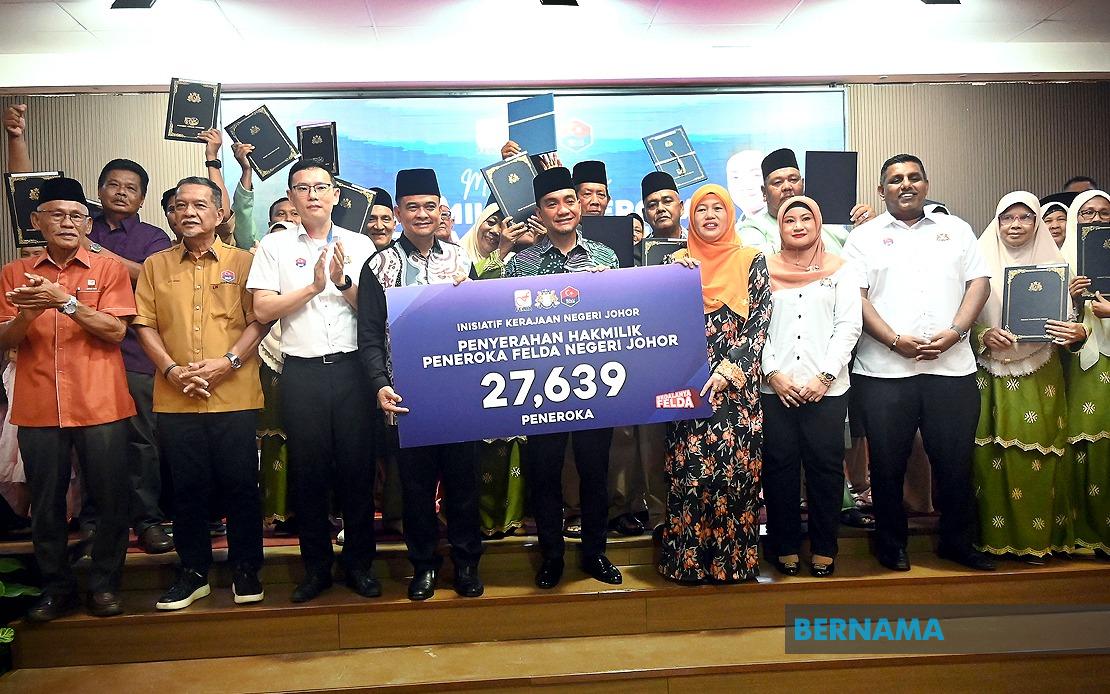
The Johor state government has brought closure to one of the most persistent grievances within Malaysia's Federal Land Development Authority (FELDA) scheme, completing resolution of 99.99 per cent of outstanding land title applications across the state. At a presentation ceremony held in Kluang, Menteri Besar Datuk Onn Hafiz Ghazi announced that 27,639 applications out of 27,642 have been successfully processed, with merely three cases remaining unresolved—a figure that represents the culmination of years of administrative effort to rectify a problem that had left countless rural families in legal limbo over their property rights.
The significance of this achievement extends far beyond simple bureaucratic completion. For FELDA settlers across Johor—encompassing communities in Kluang, Kota Tinggi, Mersing, and beyond—formal land titles represent far more than legal documentation. These certificates provide the foundation for financial security, enabling homeowners to use their properties as collateral for loans, to bequeath assets to their children with certainty, and to participate fully in the formal economy. The historical absence of clear titles had functionally relegated thousands of rural Malaysians to a precarious economic position, despite decades of labour and investment in their homes and plantations.
The immediate catalyst for this announcement was the presentation of land titles to 210 settlers from three districts during the ceremony, representing the latest tranche of beneficiaries from the broader resolution programme. These individuals, many of whom have resided on FELDA-allocated land for decades, finally received the formal documentation that establishes their ownership beyond dispute. The symbolic weight of this distribution reflects a broader state-level commitment to prioritising the welfare of agricultural communities that have long served as the backbone of Johor's rural economy.
Onn Hafiz framed the resolution within the context of the Johor government's rural development agenda, explicitly stating that FELDA settlements remain a priority for state administration. This positioning is noteworthy in Malaysian politics, as it signals recognition that rural development is not merely a peripheral concern but an integral component of comprehensive state governance. By linking land title resolution to broader rural development objectives, the Menteri Besar has articulated a vision in which property security serves as a prerequisite for sustainable rural prosperity, creating conditions for investment, entrepreneurship, and generational wealth accumulation within farming communities.
The near-total resolution of these applications also carries implications for institutional confidence in Malaysian property governance. Land titling systems, particularly in rural and scheme-based contexts, have historically suffered from administrative inefficiencies and bureaucratic bottlenecks that have frustrated ordinary Malaysians seeking basic legal certainty. The Johor achievement demonstrates that sustained government commitment, coupled with adequate resource allocation, can successfully navigate and resolve even deeply entrenched administrative challenges that have accumulated over years or decades.
For the broader FELDA community across Malaysia, Johor's completion of this process establishes a precedent and potentially a model. Other states administering FELDA schemes now face implicit pressure to replicate similar resolution efforts, creating a potential cascade effect that could elevate the legal status and economic security of thousands of additional families nationwide. Should other states adopt comparable programmes, the cumulative impact on rural household financial stability and intergenerational wealth transfer could be substantial.
The involvement of Johor Agriculture, Agro-based Industry and Rural Development Committee chairman Datuk Zahari Sarip in the ceremony underscores the cross-departmental coordination required to execute such a programme. Successful resolution required not merely administrative processing but substantive coordination between land authorities, agricultural agencies, and state-level governance structures. This administrative architecture suggests that similar complex problems affecting rural populations might be tackled through comparable whole-of-government approaches that integrate expertise and resources across traditionally siloed departments.
The three remaining unresolved applications, while statistically negligible, warrant attention as potential edge cases that may require individualised problem-solving. Complex or disputed claims, incomplete documentation, or other complicating factors likely account for these outliers. The Johor government's stated commitment to continued attention suggests that even these final three cases will eventually receive resolution, though they may require more extensive investigation or negotiation than standard applications.
Socioeconomically, the implications for affected settlers are profound. With formal title now in hand, these individuals can access financial services, obtain mortgages for home improvements or business expansion, and plan long-term asset strategies with confidence. For younger family members and future generations, secure property ownership creates platforms for economic mobility and wealth accumulation that extend far beyond the original settler generation. The resolution thus represents not merely a technical bureaucratic achievement but a transformative intervention in the economic life prospects of thousands of rural Malaysians.
The timing and prominence of this announcement also reflect political calculation regarding rural constituencies' expectations and engagement. In Malaysian electoral politics, rural voters represent a significant demographic bloc whose support remains consequential for coalition governance. By demonstrating tangible delivery on a longstanding grievance affecting organised communities—FELDA settlers maintain considerable internal cohesion and communication networks—the Johor government reinforces its claim to responsive governance and commitment to rural welfare, messaging that resonates across the rural electorate more broadly.

