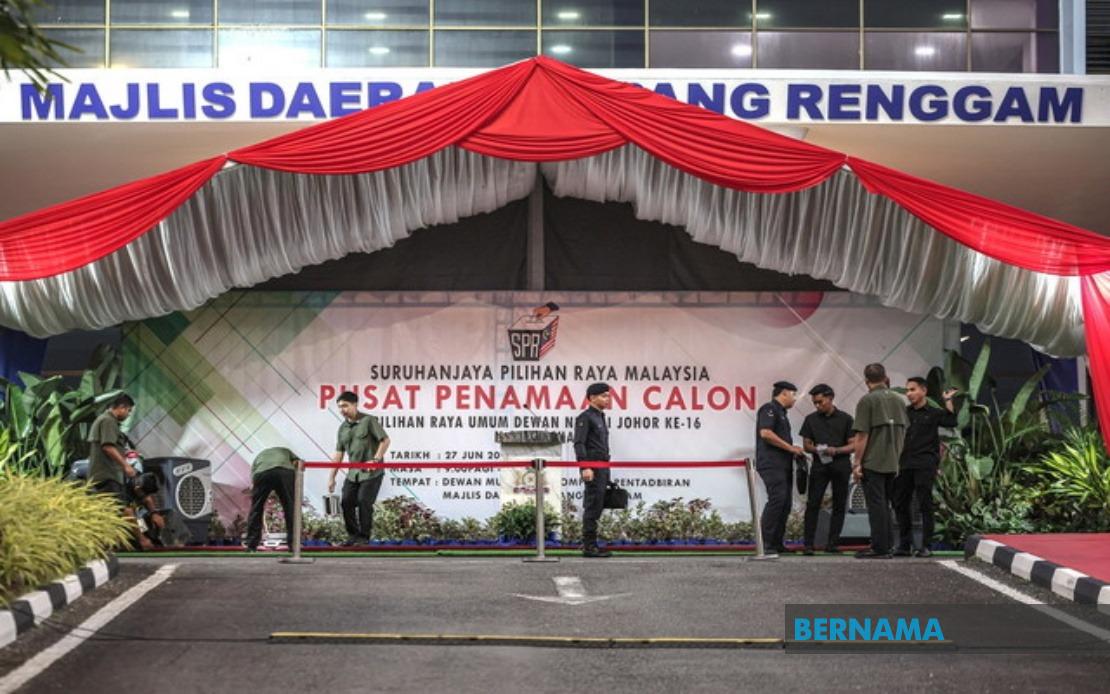
The 16th Johor State Election moved into its crucial nomination phase on June 27 when all 56 nomination centres unlocked their doors simultaneously at 9 in the morning. Within that solitary hour—stretching until 10am—political hopefuls and their supporting teams were required to lodge nomination papers with returning officers stationed at each respective centre. The compressed timeframe underscored the administrative precision demanded of Malaysia's electoral machinery, leaving no room for last-minute submissions or procedural delays.
The submission protocol itself accommodated flexibility in how candidates could approach the process. Electoral rules permitted candidates to deliver nomination documents either personally alongside their proposer and seconder, or through just two of those three parties, or even by a single representative bearing the required paperwork. This graduated approach acknowledged the practical realities of campaign schedules and logistical constraints across Johor's geographically dispersed districts. Once the returning officers completed their verification assessments, the verified candidate list would transition the election cycle into its formal public phase.
With candidate registration closed, the Election Commission triggered the campaign period proper—a 14-day window of intense political activity stretching until 11.59 on the evening of July 10. During this fortnight, competing parties and their candidates would canvass voters, conduct rallies, disseminate manifestos, and mount the persuasion machinery that characterises Malaysian electoral contests. The compressed timeline, while standard for state elections, concentrates political messaging and voter engagement into a relatively brief but decisive window.
The nomination day itself attracted significant grassroots enthusiasm, with party supporters assembling from as early as 6.30 in the morning outside various centres. These early gatherings, though informal, reflected the genuine political engagement animating the Johor electorate. The visible presence of partisan crowds underscored how state elections, despite lower profiles than federal contests, continue to mobilise ordinary Malaysians and activate local political networks and loyalties.
Weather considerations loomed over proceedings, with Malaysia's Meteorological Department issuing mixed forecasts for the nomination day morning. Johor Bahru, Muar, Batu Pahat, Kota Tinggi, Pontian, Tangkak and Kulai faced probable rainfall, potentially complicating travel to nomination centres and candidate movements throughout the day. By contrast, Segamat, Kluang and Mersing were anticipated to remain dry. The afternoon outlook proved more ominous, with thunderstorms predicted across most districts including Johor Bahru, Segamat, Kluang and Kota Tinggi, raising questions about whether outdoor campaign activities would commence immediately after nominations closed.
Security arrangements reflected the seriousness with which Malaysian authorities approach electoral integrity. Police personnel, supported by the People's Volunteer Corps—locally known as RELA—established protective cordons around nomination centres and orchestrated traffic management schemes in surrounding areas. These measures aimed to prevent disruptions, maintain orderly flows of candidates and supporters, and eliminate any possibility of untoward incidents that might compromise the election's credibility or safety.
The electoral geography underlying the 16th Johor State Election encompassed a substantial franchise. The Election Commission registered 2,727,926 eligible voters across Johor, a figure comprising 2,703,175 ordinary civilians, 12,041 military personnel and their spouses, and 12,710 police personnel and their spouses. This voting population represented the democratic foundation upon which the state's political leadership would be determined—a constituency whose preferences would be tested in the coming weeks.
The electoral calendar had been crystallised with two intermediate milestones before the main event. Early voting was scheduled for July 7, enabling military and police personnel, along with others entitled to vote ahead of polling day, to cast ballots at designated locations. This staggered approach recognised the operational demands placed on uniformed services during general polling activities. The principal polling day itself was fixed for July 11, when the general electorate would proceed to ballot boxes across Johor's state constituencies.
For Malaysian political observers, particularly those monitoring developments in Johor—traditionally a PAS stronghold that saw a significant Pakatan Harapan showing in 2023—the unfolding contest carries implications extending beyond state boundaries. Johor results often signal broader political currents within the Malay-Muslim heartland and provide barometric readings of voter sentiment regarding governance, economic management, and intercommunal relations. The composition of candidates fielded by Umno, Pakatan Harapan, PAS, and other contesting parties would shape the ideological and programmatic contest over the coming two weeks, ultimately reflecting voter choices about Johor's political direction and Malaysia's evolving electoral landscape.

