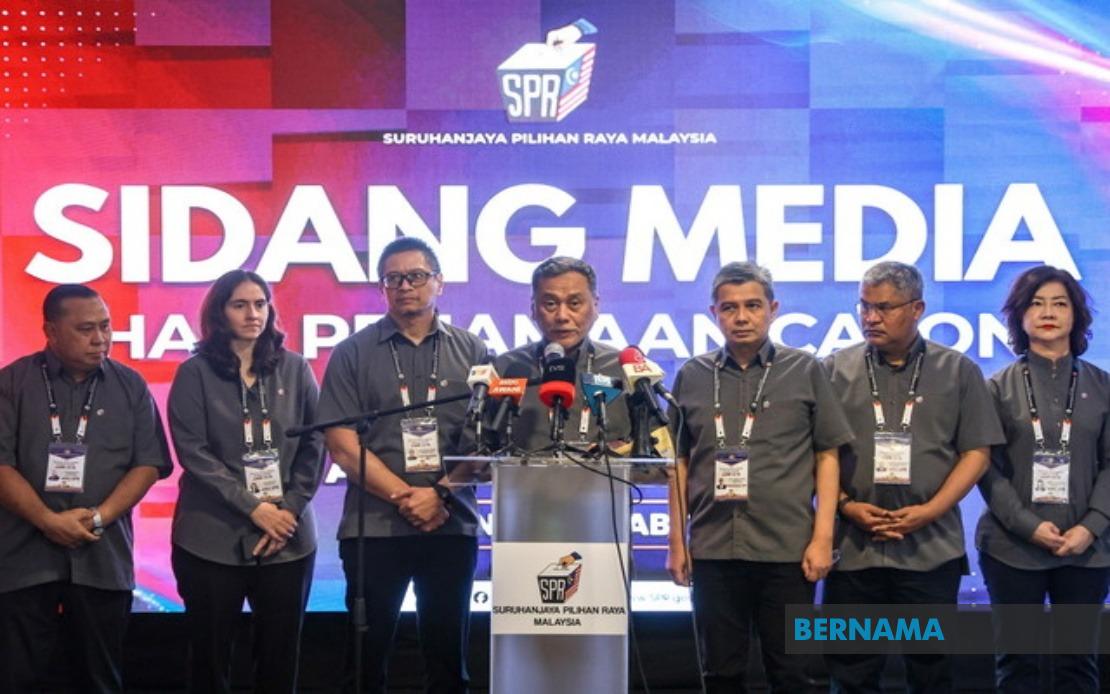
The Election Commission confirmed on June 27 that 172 candidates representing 11 political parties and independent contenders have qualified to stand in the 16th Johor state election following the completion of nomination proceedings across all 56 nomination centres. The acceptance of all 172 nomination papers without any disqualifications marks the formal beginning of the campaign period for what represents a significant electoral contest in one of Malaysia's most politically important states. EC chairman Datuk Seri Ramlan Harun announced the results at a press conference in Johor Bahru, confirming that no submissions were rejected after the nomination deadline closed at 10 am.
The candidate pool reflects the increasingly diverse political landscape in Johor, with the composition revealing substantial differences in party backing and organisational capacity. Barisan Nasional and Pakatan Harapan each fielded 56 candidates, demonstrating equal competitive positioning across all state constituencies. Perikatan Nasional presented 33 candidates, positioning itself as the third major force, while Parti Bersama Malaysia nominated 15 candidates. Smaller players in the field included MUDA with four candidates, Parti Orang Asli Malaysia and Parti Sosialis Malaysia each with single representatives, and six independent candidates who chose to contest without party affiliation.
Gender representation among the candidates shows that 138 are male and 34 are female, reflecting ongoing gender disparities in electoral candidacy across Malaysian political parties. While the proportion of female candidates has gradually increased over successive election cycles, the 19.8 per cent female representation still falls below parity and remains an area where Malaysian political organisations continue to face criticism from civil society advocates. This gender composition will be scrutinised by observers monitoring progress toward more balanced political representation.
The contest configuration across the 56 seats demonstrates highly varied levels of electoral competition. Fourteen seats will witness straight fights between two candidates, the simplest competitive scenario. However, the majority of contests will involve greater fragmentation: 27 seats feature three-cornered battles between three contenders, twelve seats will see four candidates vying for position, and three seats will present voters with five competing options. This variation in candidate numbers significantly influences campaign dynamics and voter choice calculations, as constituencies with more candidates typically see lower winning vote thresholds and increased strategic voting considerations.
Johor's electoral significance extends beyond its status as one of Malaysia's most populous states. The state has traditionally served as a political bellwether, with its election results often foreshadowing broader national trends. As a longstanding Barisan Nasional stronghold that has nonetheless shown signs of electoral volatility in recent years, the contest carries implications for understanding contemporary Malaysian political realignment. The relatively balanced candidate deployment by BN and PH, combined with PN's substantial third-force presence, suggests all major coalitions view the state as competitively contested territory requiring substantial resource commitment.
The participation of smaller parties and independent candidates reflects broader fragmentation within the Malaysian political ecosystem. Parti Bersama Malaysia's inclusion with 15 candidates suggests continued efforts by newer political entities to establish foothold status in state elections. The presence of identity-focused parties like Parti Orang Asli Malaysia highlights niche political mobilisation efforts, while Parti Sosialis Malaysia's participation maintains its tradition of selective electoral interventions. These smaller actors rarely expect to secure seats but use elections for political positioning and messaging purposes.
The completion of nominations without any disqualifications indicates that the Election Commission processed all submissions within acceptable legal parameters. This stands in contrast to some previous elections where candidates faced last-minute technical rejections due to documentation issues or other procedural matters. The clean acceptance rate suggests improved administrative efficiency or alternatively that political parties invested greater care in nomination submission compliance.
For Malaysian and Southeast Asian observers, Johor's election dynamics warrant attention as signals of democratic health and political competition quality. The state's economic importance as a manufacturing hub and logistics centre means electoral outcomes influence policy directions affecting broader regional competitiveness. The campaign period ahead will reveal whether Johor voters respond primarily to established coalition identities, alternative political platforms, or increasingly localised and candidate-specific considerations that characterise modern electoral behaviour in Malaysia.
The candidate nominations set the stage for what will likely be an intensive campaign period as all major parties mobilise resources to secure Johor's 56 seats. The multiplicity of contests across different competitive configurations means that campaign messaging will require careful calibration to address both state-level policy concerns and local constituency-specific issues. Voter turnout patterns will also bear watching, as electoral participation rates in Johor have fluctuated across recent cycles, reflecting broader patterns of electoral engagement in Malaysia's urban and semi-urban constituencies.

