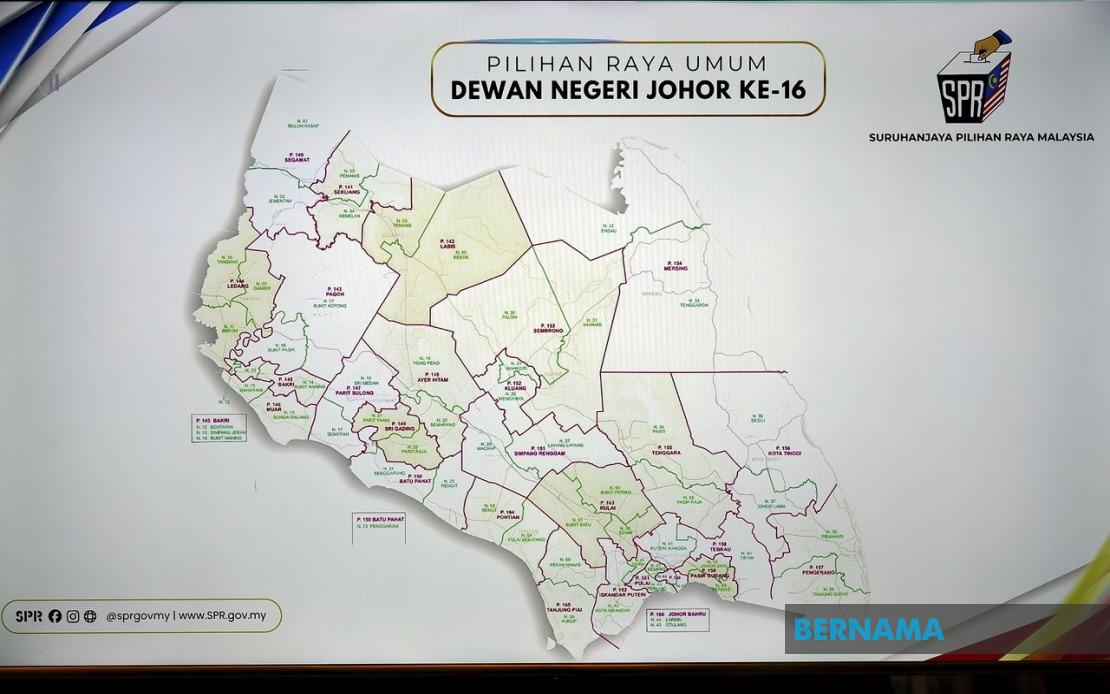
Johor's political arena is set to ignite tomorrow as the 16th state election officially commences with nomination day, marking the beginning of what observers expect to be one of the most contested polls in the peninsula's southern state. The Election Commission has scheduled a two-hour nomination window from 9 am to 10 am at designated centres throughout Johor, during which candidates across all 56 state assembly seats will formally register their candidacy. Once the screening process concludes, the official roster of contenders will be made public, revealing the complete picture of who will compete when voters head to the polls on July 11, with an earlier voting window opening on July 7 for those eligible to cast ballots ahead of the main election day.
Approximately 2.73 million people have been registered to participate in this electoral exercise, according to the Election Commission's latest figures. This electorate encompasses more than 2.7 million ordinary voters alongside 12,041 military personnel and their spouses, and 12,710 police officers and their spouses. The size of the Johor electorate underscores the political significance of the state, which remains a crucial battleground for competing coalitions seeking to consolidate or expand their influence in Peninsular Malaysia's largest state by area.
Pakatan Harapan has committed to a comprehensive campaign strategy by fielding candidates in all 56 constituencies, demonstrating its intention to contest every seat available. The coalition's distribution reflects its internal balance, with Parti Keadilan Rakyat contributing 20 candidates, Parti Amanah Negara fielding 19, and the Democratic Action Party presenting 17. This proportional arrangement mirrors the coalition's broader power-sharing framework while allowing each component party to maintain a significant presence across Johor's diverse constituencies.
Barisan Nasional, traditionally the dominant force in Johor politics, is mounting an equally comprehensive response by presenting candidates across the entire electoral map. The coalition has allocated 36 seats to its largest component, the United Malays National Organisation, positioned 16 candidates from the Malaysian Chinese Association, and nominated four representatives from the Malaysian Indian Congress. The composition reflects Johor's demographic composition and signals BN's determination to defend its 2022 performance, when it secured 40 of 56 seats and maintained firm control over the state government.
Perikatan Nasional, the third major coalition, is pursuing a selective strategy rather than blanket coverage. The Pan-Malaysian Islamic Party is contesting 11 seats, Bersatu has registered 16 candidates, and the newly-formed Malaysian Indian People's Party is fielding five nominees. This targeted approach suggests PN is focusing its resources on constituencies where it believes it has competitive advantage, likely reflecting both resource constraints and strategic calculations about where it can realistically pose threats to incumbent administrations.
Beyond the three major coalitions, several smaller political parties are entering the competition. The Malaysian United Democratic Alliance, which made headlines by winning a state seat in the 2022 election, is fielding four candidates as it attempts to replicate or expand its presence. The Socialist Party of Malaysia is presenting a single nominee, while Parti Bersama Malaysia is making its debut in Johor electoral politics by contesting 15 seats. The participation of these smaller entities adds unpredictability to outcomes, particularly in closely contested constituencies where their vote share could prove decisive.
The Election Commission has issued specific procedural reminders to ensure smooth nomination processes and prevent last-minute disruptions. Prospective candidates are being advised to verify their nomination forms early at either the Returning Officer's Office or the State Election Office, allowing time to rectify any administrative errors before the submission deadline. The commission is similarly urging candidates to settle their required deposit payments promptly and retain receipts as documentation when presenting nomination papers, reducing the likelihood of technical rejections that could eliminate candidates from contention.
Concurrent with the electoral machinery's activation, the Malaysian Anti-Corruption Commission has issued stern warnings about conduct standards throughout the campaign period. The MACC has reminded all candidates and parties to scrupulously avoid violations under the MACC Act 2009 and the Election Offences Act 1954 as amended in 2012. To enforce compliance and respond to public concerns, the anti-corruption body has established five round-the-clock operations rooms stationed in Tampoi, Batu Pahat, Kluang, Segamat, and Mersing, providing citizens with direct reporting channels for suspected corruption or abuse of power allegations throughout the election period.
The dissolution of the Johor State Legislative Assembly on June 1 formally triggered this electoral cycle, ending the tenure of the administration that has governed the state since the 2022 election. That previous contest resulted in a decisive result favoring Barisan Nasional, which captured 40 seats and secured the largest mandate. Pakatan Harapan won 12 seats, Perikatan Nasional secured three, and Malaysian United Democratic Alliance gained one seat. Tomorrow's nomination day will reveal whether any parties have adjusted their strategies or candidate selections in response to shifting political dynamics over the intervening two years.
The upcoming election assumes particular importance within Malaysia's broader political landscape, as Johor represents one of only a handful of states where multiple coalitions maintain realistic prospects of governing. The state's economic significance, its position as a gateway to Singapore, and its substantial population make it strategically valuable to all three major coalitions. Success or failure in Johor could reverberate across Malaysian politics, influencing calculations about coalition viability and shifting dynamics within the peninsular political arena. Tomorrow's nomination proceedings will set the stage for what many observers anticipate will be a fiercely competitive campaign culminating in the July 11 polling day.

