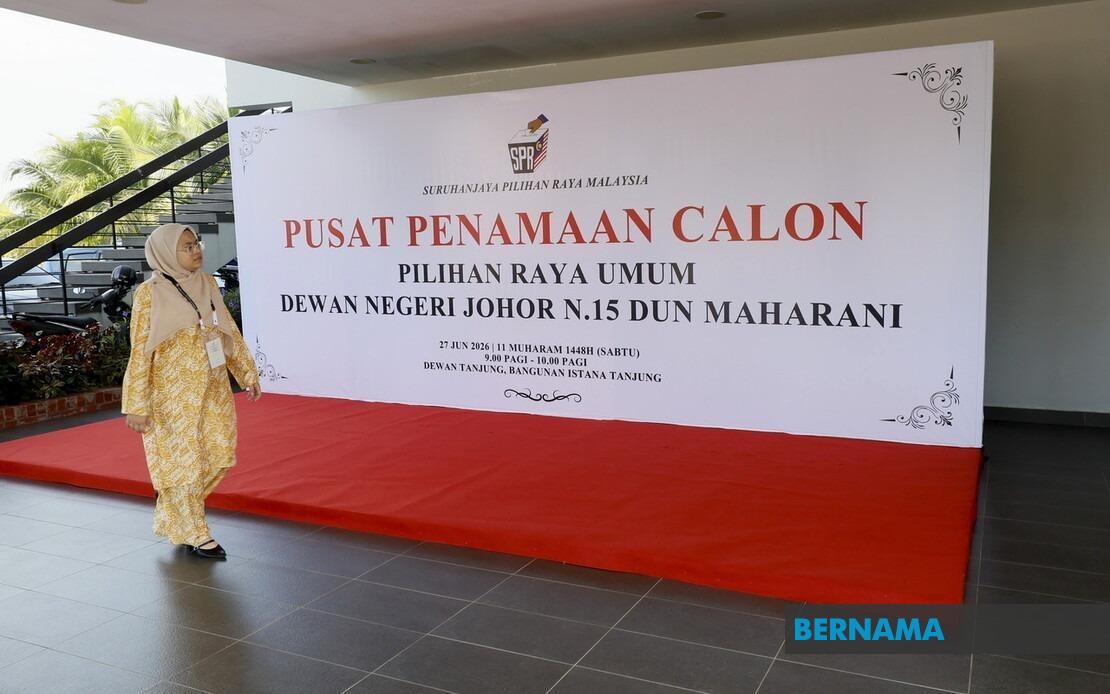
The countdown to Johor's political showdown has begun in earnest, as the state formally opened its electoral campaign on June 27 with nomination day celebrations unfolding simultaneously across 56 nomination centres. The process represents a critical juncture in Malaysian politics, particularly for Southeast Asia's most economically significant state, and sets the stage for a pivotal contest that will reshape the region's political landscape through July 11.
Prospective candidates had a narrow one-hour window starting at 9 am to lodge their nomination documents with Returning Officers, a procedural requirement that typically generates considerable pageantry at nomination centres as party faithful mobilise to demonstrate grassroots support. The deadline at 10 am marked the point beyond which no late submissions would be accepted, ensuring the Election Commission could proceed with announcing which candidates had met all eligibility requirements. This compressed timeline represents standard practice in Malaysian electoral administration, yet the intensity surrounding this particular election reflects deep-seated uncertainties about which coalitions will command the state assembly after ballots are counted.
The Election Commission has allocated a 14-day campaign period running from nomination day through 11.59 pm on July 10, providing contenders with two weeks to traverse Johor's sprawling geography, from urban Johor Bahru to rural constituencies where traditional allegiances remain potent. Early voting will occur on July 7, accommodating voters unable to participate on the main polling day, while July 11 marks the culmination of this electoral cycle that commenced when the State Legislative Assembly was dissolved on June 1. This structured timeline reflects careful planning intended to maintain electoral momentum while affording all registered voters opportunity to participate.
Several hundred prospective candidates had already signalled their intentions by paying mandatory election deposits before nomination day, with 593 nomination forms purchased and 133 candidates confirming participation through deposit payments as of the day before nominations opened. This level of preliminary engagement suggests competitive races across multiple seats, indicating that numerous constituencies will feature contests involving more than token opposition presence. The volume of candidate registrations underscores genuine competition rather than predictable outcomes in most areas, a development that potentially reshapes political dynamics across the state.
The electoral contest encompasses 2,727,926 registered voters comprising a diverse cross-section of Johor society: 2,703,175 ordinary voters form the bulk of the electorate, while 12,041 military personnel and their spouses plus 12,710 police personnel and spouses represent smaller but strategically important voter blocs. Understanding this voter composition matters significantly for campaign strategies, as security personnel constituencies frequently demonstrate distinctive voting patterns reflecting institutional considerations and organisational dynamics. The substantial overall voter population underscores Johor's demographic significance within Malaysia's federal structure.
Pakatan Harapan has committed to competing across all 56 seats through a tripartite alliance that allocates 20 seats to PKR, 19 to Amanah, and 17 to DAP, reflecting careful negotiation among coalition partners to balance representation while maximising electoral impact. This comprehensive contest strategy contrasts with previous elections where certain partners ceded ground to avoid splitting anti-establishment votes. The inclusion of Amanah and DAP alongside PKR demonstrates the coalition's intention to project a unified front rather than fragment support across competing platforms.
Barisan Nasional maintains its traditional structure through UMNO's 36 candidate allocations alongside MCA's 16 and MIC's four, preserving the historic racial and communal representation formula that has anchored the coalition since its inception. UMNO's numerical dominance within the Barisan framework reflects Johor's role as a Malay-Muslim majority state where the party possesses entrenched organisational machinery and traditional support networks. The consistent Barisan strategy of full-state contestation demonstrates confidence that the coalition remains electorally viable despite recent challenges in other states.
Perikatan Nasional's configuration reveals the coalition's strategic complexity: PAS contests 11 seats, Bersatu fields 16 candidates, Malaysian Indian People's Party contributes five, and Pejuang provides one competitor, together accounting for 33 seats across the landscape. This arrangement illustrates how Perikatan has evolved beyond its initial PAS-Bersatu core to incorporate additional political players seeking alternative platforms. The specific allocation patterns suggest attempts to balance Islamist representation through PAS with Bersatu's multiethnic positioning while incorporating Indian-oriented and ultra-nationalist perspectives.
New entrants and smaller parties inject additional dynamism into the contest: MUDA contests four seats, PSM fields one candidate, and remarkably, Bersama makes its electoral debut by fielding 15 candidates across Johor constituencies. Bersama's significant initial footprint suggests either accumulated momentum from nascent party-building efforts or substantial financial capacity enabling widespread candidacy. The participation of these newer political entities reflects shifting voter willingness to consider alternatives beyond the traditional three-coalition framework, potentially fragmenting vote distributions across constituencies and creating unpredictable outcomes.
Logistical arrangements reflect the scale and complexity of administering an election affecting nearly 2.73 million voters across a geographically extensive state. The Election Commission deployed 4,832 police personnel to maintain order, manage traffic around nomination centres, and enforce restrictions on campaign-related noise including musical instruments and vehicle-mounted loudspeakers. Nineteen major roads faced closures and diversions near nomination sites, requiring coordination between security forces and local authorities to prevent gridlock while enabling voters and candidates to access centres. The Malaysian Meteorological Department's forecast of morning rain and afternoon thunderstorms added weather-related variables that organisers monitored throughout nomination day.
Johor's political composition before dissolution provided crucial baseline data: Barisan Nasional controlled 40 of 56 seats, Pakatan Harapan held 12, Perikatan Nasional possessed three, and MUDA claimed one. These numbers indicate that despite Barisan's strong position, the opposition blocs collectively held significant representation that positions them credibly to challenge incumbent dominance. The distribution suggests Johor constituencies exhibit competitive characteristics across diverse areas, from urban centres where Pakatan performance traditionally strengthens to rural constituencies where Barisan maintains advantages.
The commencement of this election cycle carries implications extending beyond Johor's borders, as the state's political direction influences federal dynamics and shapes how coalitions navigate ongoing shifts in Malaysian electoral behaviour. With multiple competing blocs vying across all 56 constituencies and newer parties entering the arena, voters will encounter expanded choice that potentially reflects broader societal questioning of established political arrangements. The election will reveal whether traditional coalition structures retain their historical grip on Johor or whether the state follows patterns of political volatility observable elsewhere in Malaysia.

