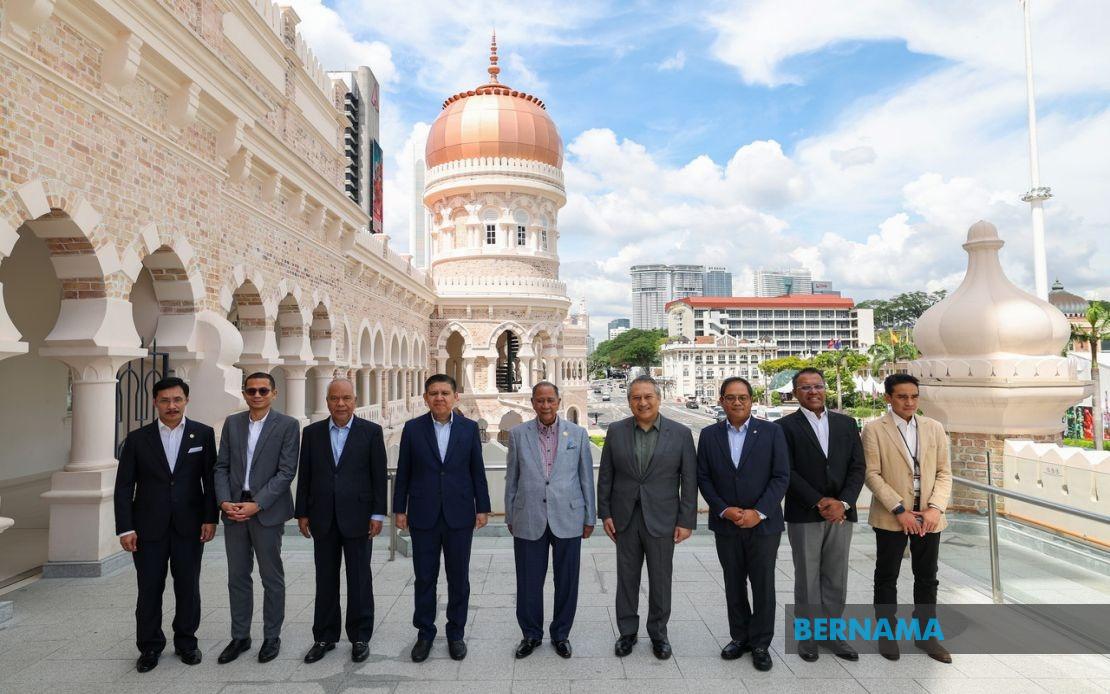
The Sultan of Kedah, Al Aminul Karim Sultan Sallehuddin Sultan Badlishah, made a significant visit to the Sultan Abdul Samad Building in Kuala Lumpur on June 24, examining the heritage landmark's restoration and its newly accessible galleries documenting Malaysia's capital city. The royal visit underscores the importance of preserving the building's historical legacy as it reopens to the public following extensive conservation work.
Arriving at approximately 10.30 am, the Sultan was greeted by Khazanah Nasional managing director Datuk Amirul Feisal Wan Zahir, alongside other senior executives including chief corporate officer and general legal adviser Datuk Mohamed Nasri Sallehuddin and head of real assets Selvendran Katheerayson. The delegation's presence reflected the significance Khazanah Nasional places on the occasion, demonstrating institutional commitment to the preservation initiative.
During his tour, the Sultan explored the Confluence Hall, which contains an exhibition tracing Kuala Lumpur's origins and evolution. Think City senior manager Mariana Isa provided detailed briefings on the gallery's displays, walking His Royal Highness through the capital's development narrative. This hall serves as an educational centrepiece for visitors seeking to understand how a colonial trading settlement transformed into a modern metropolis.
The royal itinerary continued through the Visionary Hall, showcasing architectural models and multimedia installations depicting future urban development scenarios for the capital. These interactive exhibits offer visitors contemporary perspectives on how heritage conservation intersects with modern city planning—a particularly relevant concern for Southeast Asian urban centres balancing historical preservation with rapid growth and development pressures.
Following the interior galleries, the Sultan proceeded to the building's iconic balcony overlooking the Porte Cochere, the ceremonial entrance that historically served Malaysia's colonial and early independence administrators. This location holds profound symbolic weight, as it overlooks the space where pivotal moments in the nation's transition to independence unfolded.
The visit also included a stop at the School of Hard Knocks, a social enterprise operated by Royal Selangor that provides vocational training and employment opportunities. This component of the tour reflected broader concerns about heritage buildings serving contemporary community needs beyond mere preservation and tourism, integrating social purpose with historical conservation.
Following a light luncheon, the Sultan departed the building at approximately 1.15 pm, concluding a visit that lasted roughly three hours. This extended engagement suggested genuine engagement with the conservation project rather than a ceremonial formality.
Khazanah Nasional's managing director emphasised the visit's significance for the organisation's heritage preservation mission. Amirul Feisal stated that the royal visit represented formal recognition of efforts extending beyond structural conservation to encompass broader historical documentation and contextualisation. The initiative aims to position the building as an educational resource illuminating Kuala Lumpur's, Selangor's, and Malaysia's developmental trajectory across multiple time periods.
Since opening its doors to the public on February 2, the Sultan Abdul Samad Building has welcomed approximately 200,000 visitors, indicating substantial public interest in accessing the nation's heritage sites. This visitor volume suggests Malaysians and international tourists demonstrate considerable appetite for understanding the country's political and administrative history through preserved architecture.
The building's restoration marked a significant milestone following His Majesty Sultan Ibrahim, King of Malaysia, officiating the completion of Phase One conservation work on January 31. The eleven-month restoration programme operated under the Khazanah Heritage Fund initiative, demonstrating institutional investment in preserving critical national monuments.
Originally constructed as the Secretariat Building during the colonial era, the Sultan Abdul Samad Building functioned as the administrative nerve centre of Malaysia's governance apparatus. Its historical resonance stems partly from a pivotal 1957 moment when the Union Jack flag was lowered and the Federation of Malaya flag was raised for the first time—a symbolic act of independence that transformed the building's significance within national consciousness.
The conservation effort represents a significant undertaking within Malaysia's broader heritage preservation landscape. As Southeast Asian nations grapple with rapid urbanisation and development pressures, maintaining iconic buildings while adapting them for contemporary public engagement presents ongoing challenges. The Sultan Abdul Samad Building's transformation into an accessible cultural venue demonstrates one approach to balancing historical authenticity with modern usability and educational value.
For Malaysian and regional readers, this initiative reflects evolving attitudes toward heritage conservation beyond mere nostalgia. The building now functions as a platform for understanding how nations construct historical narratives, how physical spaces embody political transitions, and how institutions can steward cultural memory while remaining economically and socially relevant.

