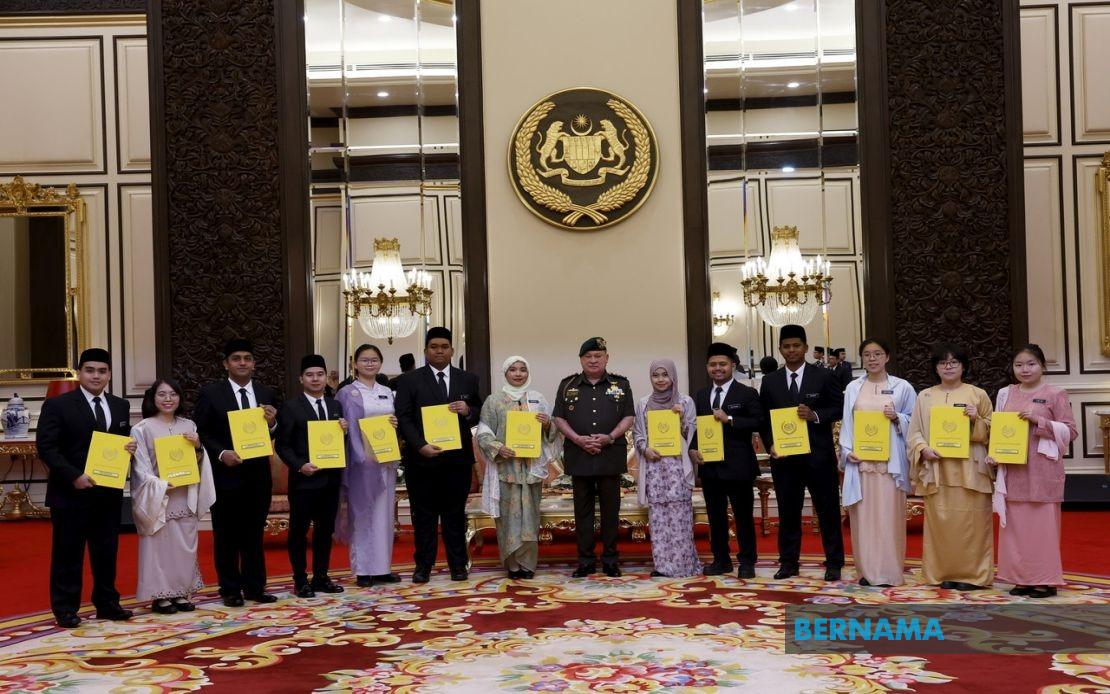
His Majesty Sultan Ibrahim, King of Malaysia, has conferred the 2026 Yang di-Pertuan Agong Scholarships upon 14 recipients at a formal investiture ceremony held at Istana Negara in Kuala Lumpur on June 24. The recipients represent a carefully selected cohort of high-achieving Malaysians chosen through a rigorous selection process to pursue advanced postgraduate research at premier educational institutions. The ceremony underscored the Crown's commitment to nurturing Malaysia's intellectual capital and supporting the nation's knowledge-based development agenda through strategic investment in human capital.
The scholarship allocation reflects a balanced approach to advanced learning, with seven recipients undertaking doctoral programmes and an equivalent number pursuing Master's (Research) qualifications. This distribution acknowledges the varying pathways available for aspiring researchers and academics, recognising that both doctoral and master's-level research contribute meaningfully to national innovation and scholarship. The split between different levels of study demonstrates a nuanced understanding of how Malaysia's research ecosystem benefits from talent at multiple postgraduate tiers.
Geographically, the scholarship recipients will pursue their studies across a diverse range of institutions. Four awardees will conduct their research at leading universities located overseas, positioning themselves within the global academic community and exposing Malaysian scholarship to international standards and methodologies. The remaining ten scholars will undertake their postgraduate work at local research universities, strengthening domestic research capacity and ensuring that advanced academic expertise continues to develop within Malaysian institutions. This balance between international exposure and domestic research strengthening reflects a strategic approach to developing Malaysia's competitive position in regional and global academia.
The BYDPA represents Malaysia's most generous government scholarship offering, distinguished by its exceptional financial support relative to other public sector scholarship programmes. This distinction makes the award particularly significant for recipients, as it removes substantial financial barriers to pursuing advanced research and enables scholars to concentrate fully on their academic pursuits without the distraction of financial hardship. The magnitude of funding attached to the scholarship signals the government's serious commitment to identifying and supporting Malaysia's finest emerging researchers and academics.
The ceremony attracted senior government officials including Tan Sri Wan Ahmad Dahlan Abdul Aziz, the Director-General of the Public Service, and Tan Sri Dr Azmi Rohani, the Comptroller of the Royal Household at Istana Negara. The presence of these high-ranking dignitaries emphasised the symbolic importance placed upon the scholarship programme and the recipients' achievements. Such formal recognition at the highest ceremonial levels reinforces to recipients and the broader public the significant esteem in which advanced research and postgraduate achievement are held within Malaysia's governance structure.
Wan Ahmad Dahlan, addressing reporters following the investiture, highlighted the BYDPA's distinctive standing within Malaysia's scholarship landscape. By characterising it as the most prestigious government scholarship offering and noting its superior funding levels compared to competing programmes, he underscored why selection as a BYDPA recipient constitutes a remarkable honour. This positioning helps potential applicants and the general public understand that not all government scholarships carry equal weight, and that the BYDPA represents the apex of state-sponsored postgraduate support.
For Malaysia's academic and research communities, the regular conferment of these scholarships serves multiple strategic functions. It identifies and invests in the nation's most talented scholars, creating a pipeline of highly qualified researchers who will shape Malaysia's intellectual contributions for decades to come. Many recipients will eventually return to Malaysian institutions or the civil service, leveraging their advanced training to strengthen local research capabilities and institutional quality. The scholarship thus functions as a long-term investment in national research infrastructure and expert capacity.
The geographic split between domestic and international study placements reflects contemporary thinking about how nations can best utilise limited scholarship resources. Sending select scholars abroad exposes them to cutting-edge research methodologies, international networks, and global academic standards, which they subsequently bring back to enhance Malaysian institutions. Simultaneously, maintaining ten recipients within the local system ensures that resource investment strengthens domestic institutions directly. This dual-track approach maximises the return on scholarship expenditure while building a cohesive research community spanning local and international contexts.
For aspiring researchers across Malaysia, particularly those from modest backgrounds, the existence of such comprehensive scholarship support democratises access to advanced education. The BYDPA's generous funding means that financial capacity becomes less determinative of whether talented individuals can pursue doctoral or master's research. This accessibility potentially unlocks research talent that might otherwise remain underdeveloped due to economic constraints, expanding the pool of potential contributors to Malaysia's knowledge economy and addressing regional disparities in research talent development.
The 2026 cohort of BYDPA recipients joins a continuing lineage of scholars supported through this prestigious scheme. As they progress through their respective programmes, they will contribute to advancing knowledge in their respective disciplines while simultaneously serving as role models and mentors for subsequent generations. Their eventual career trajectories—whether in academia, research institutions, or the civil service—will demonstrate the tangible benefits of targeted scholarship investment in developing Malaysia's intellectual workforce and maintaining competitive advantage in the knowledge-based economy.

