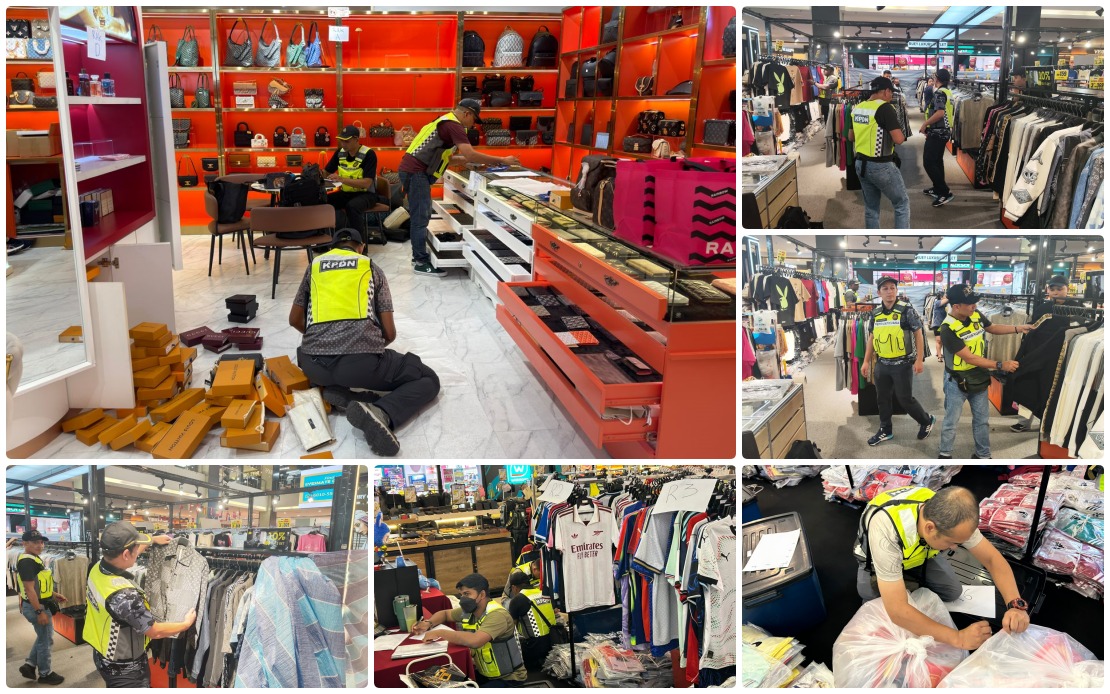
The Ministry of Domestic Trade and Cost of Living (KPDN) has dismantled a major counterfeit goods distribution network following coordinated raids across three premises in Johor Bahru on June 15. The enforcement operation resulted in the seizure of suspected fake branded merchandise valued at RM600,000, marking a significant victory in the ministry's ongoing battle against intellectual property violations that continue to plague Malaysia's retail landscape.
Datuk Azman Adam, the enforcement director-general of KPDN, disclosed details of the operation which was executed by the Putrajaya Enforcement Division after a month-long investigation. The raiding team uncovered a sophisticated operation wherein traders were offering various categories of goods bearing the trademarks of established international brands without authorisation from the registered trademark owners. The scale of the discovery suggests this was not merely a small-scale operation but rather an organised distribution channel supplying goods to multiple retailers across the state.
The seized merchandise encompassed a diverse range of luxury items typically targeted by counterfeiters seeking to maximise profit margins. Among the confiscated goods were clothing, handbags, wallets, belts, and perfumes, all displaying counterfeit trademark applications. The breadth of product categories indicates the operation had developed a comprehensive counterfeiting supply chain rather than specialising in a single product type. Beyond the physical goods, enforcement officers also secured relevant business documentation that will prove crucial in establishing the extent of the distribution network and identifying upstream suppliers.
According to Azman's statement, investigators determined that reasonable grounds existed to believe that violations of Section 102(1)(c) of the Trademark Act 2019 had occurred. This particular offence relates to possessing, controlling, or maintaining counterfeit goods with the intention to trade them, a serious breach of Malaysia's intellectual property protections. The preliminary verification conducted by representatives of the complainant provided sufficient evidence to proceed with formal investigations and detentions.
Four individuals, including the premises owner and caretaker, were apprehended to assist authorities in their investigation. Their involvement in managing business operations made them key persons of interest in determining the operational structure and supply chain of the counterfeit distribution ring. The detention of management-level individuals suggests investigators are pursuing a comprehensive strategy to dismantle the entire operation rather than simply removing inventory from circulation.
The legal consequences facing those involved in counterfeit goods trafficking are substantial and escalate considerably upon repeat offences. Individual offenders convicted under the relevant section face a maximum fine of RM10,000 per counterfeit item or imprisonment up to three years for first-time violations. Should conviction result, repeat offenders encounter significantly harsher penalties, including fines reaching RM20,000 per item or imprisonment extending to five years. Corporate entities bear even more formidable penalties, with initial convictions attracting fines of RM15,000 per item that double to RM30,000 per item for subsequent offences.
The counterfeit goods trade represents a persistent challenge for Southeast Asian economies, with Malaysia particularly vulnerable given its position as a transit hub and consumption market. These operations undermine legitimate businesses, erode consumer trust, distort market competition, and generate revenue for organised criminal networks. The sophistication demonstrated in this Johor Bahru operation, including distribution through supermarkets and onward supply to other traders, reflects how counterfeiters have evolved beyond street-level peddling to infiltrate organised retail channels where consumers may be unaware of authenticity concerns.
Consumer protection remains a central concern underlying such enforcement actions. Individuals purchasing counterfeit goods may face health and safety risks, particularly with perfumes, cosmetics, and clothing that bypass quality control standards. The deception inherent in counterfeiting violates consumer rights and wastes household expenditure on substandard products. For Malaysian shoppers, the prevalence of counterfeit goods in retail environments necessitates heightened vigilance and awareness of where genuine merchandise is procured.
KPDN's commitment to intensified enforcement operations signals a more aggressive stance against intellectual property violations across Malaysia's trading landscape. The ministry has pledged not to show leniency toward any party engaged in counterfeiting activities or distribution of infringing goods. This determination reflects recognition that counterfeit operations, if left unchecked, proliferate rapidly and expand their reach into mainstream retail channels, ultimately compromising market integrity and consumer confidence.
The investigation into this Johor Bahru operation will likely yield intelligence regarding upstream suppliers and downstream distribution networks. Such enforcement successes typically provide leads enabling authorities to pursue related cases and identify interconnected criminal enterprises operating across state and national boundaries. Given the transnational nature of counterfeit goods trade, collaboration between Malaysian authorities and international partners will be essential to tracing the origin of the fake merchandise and preventing future shipments from entering local markets.
For consumers and legitimate retailers in Malaysia and the broader Southeast Asian region, this enforcement action demonstrates that authorities maintain capacity to detect and dismantle organised counterfeiting operations. However, the monthly-long investigation required to identify this single network underscores the resource-intensive nature of such enforcement. Sustained vigilance, continued investment in investigation capabilities, and public awareness campaigns remain essential components of any comprehensive strategy to combat the counterfeit goods epidemic affecting regional consumer markets.

