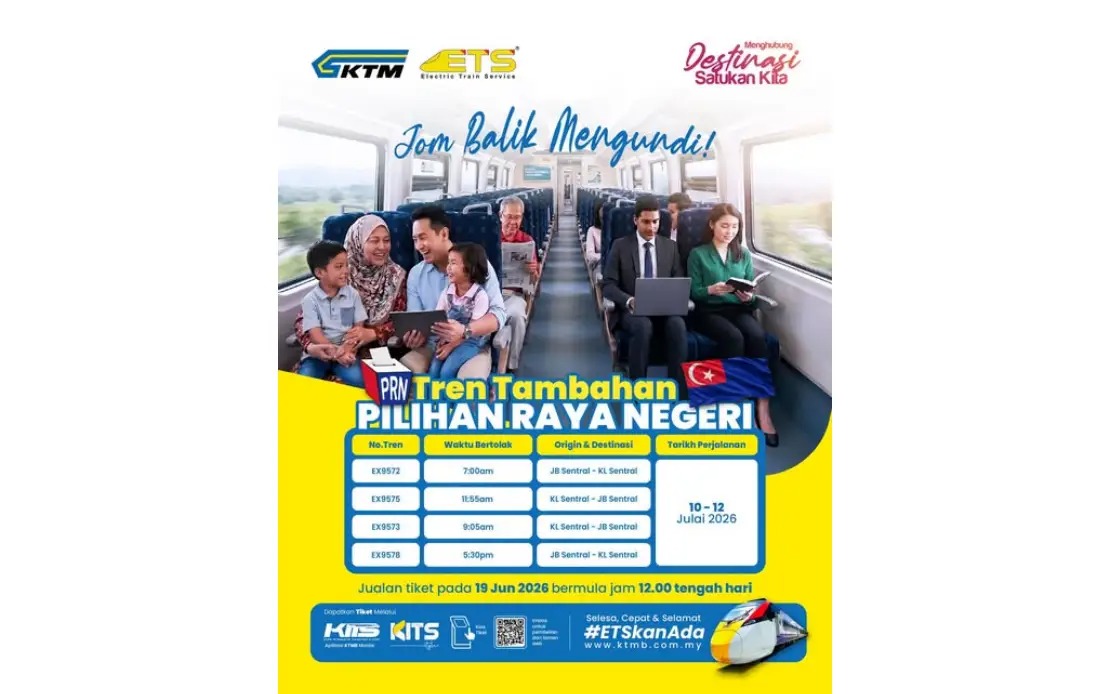
Malaysia's railway operator Keretapi Tanah Melayu Berhad (KTMB) is stepping up transport capacity ahead of the Johor state election by deploying additional ETS services on southern routes. The announcement, made via the company's social media channels, underscores the logistical demands placed on public transport infrastructure when voters travel home to cast ballots in regional contests. With polling day set for July 11, KTMB is positioning itself to ensure that eligible voters can reach polling stations without the usual constraints of regular service schedules.
Ticket reservations opened at noon on June 19, with the booking window covering the critical three-day window from July 10 through 12. This timeframe captures voters arriving the day before the election and those departing immediately after—a pattern typical during state-level contests when many eligible voters must journey between their residential addresses and registered polling districts. The availability of advance booking slots reflects KTMB's preparation for anticipated surge demand during this politically significant period.
Prospective passengers have multiple avenues for securing their seats, reflecting KTMB's multi-platform digital strategy. The KTMB Mobile application offers direct access to the booking system, while the KITS Style platform provides an alternative portal. The rail operator's official website, online.ktmb.com.my, maintains a conventional online reservation option, and physical ticket kiosks across the network remain available for those preferring traditional counter service. This layered approach acknowledges varying levels of digital literacy among Malaysia's travelling public.
The Johor state election emerged following the dissolution of the State Legislative Assembly on June 1, with the Election Commission subsequently announcing July 11 as polling day. This timeline creates a compressed electoral cycle that necessitates coordinated logistics from multiple service providers. For KTMB, the challenge involves balancing regular commuter demand with the exceptional movements generated by voters. The rail operator's proactive scheduling reflects broader recognition within Malaysia's transport sector that election periods require strategic planning.
For residents of Johor who have relocated for work or study but retain voting rights in the state, ETS services represent a cost-effective and reliable transport option compared to road-based alternatives. The express train network, which links the southern peninsula with central Malaysia, effectively functions as a mobility corridor during electoral periods. By augmenting capacity, KTMB reduces potential transport bottlenecks that might otherwise frustrate voters attempting to fulfil their democratic participation.
The decision to publicise the initiative through social media channels demonstrates how Malaysian public agencies increasingly engage directly with citizens through contemporary communication platforms. Rather than relying solely on traditional press releases, KTMB's Facebook announcement reaches younger demographics and tech-savvy voters who habitually check social platforms for service updates. This communication strategy proves particularly valuable during time-sensitive situations where rapid information dissemination influences decision-making.
Election-related transport provision extends beyond mere commercial operation—it constitutes a facilitation of fundamental democratic rights. When citizens encounter practical barriers to voting, whether through inadequate transport options or information asymmetries, overall electoral participation can suffer. KTMB's supplementary services acknowledge this relationship between infrastructure provision and democratic engagement, positioning the railway operator as an enabler of broader civic participation rather than simply a commercial transport entity.
The announcement also carries implications for rival transport modes. Ride-sharing services, intercity buses, and private vehicles typically experience elevated demand during election periods, with surge pricing potentially pricing some voters out of travel options. KTMB's regulated fare structure, anchored to published tariffs regardless of demand fluctuations, offers a predictable cost baseline that benefits middle and lower-income voters for whom transport expenses significantly impact household budgets. This affordability dimension addresses equity concerns inherent in election-related mobility challenges.
From a broader transport planning perspective, KTMB's willingness to deploy extra capacity during electoral periods demonstrates responsiveness to situational demand patterns. Malaysian transport authorities increasingly recognise that public services must adapt to exceptional circumstances rather than maintain rigid scheduling. The Johor election represents a known, predictable demand spike—unlike emergencies—allowing operators to plan resource allocation methodically. This capability strengthens overall transport system resilience and public confidence in institutional planning competence.
Looking forward, the accessibility demonstrated during the Johor election may establish expectations that KTMB will similarly enhance capacity during future state-level contests. Voters who experience smooth, well-organised electoral travel may become more reliable participants in subsequent elections, while those encountering transport difficulties may view logistical frustration as evidence of systemic indifference. KTMB's current initiative thus invests in electoral participation patterns that may extend well beyond July 11, potentially elevating engagement during subsequent polls across the peninsula.