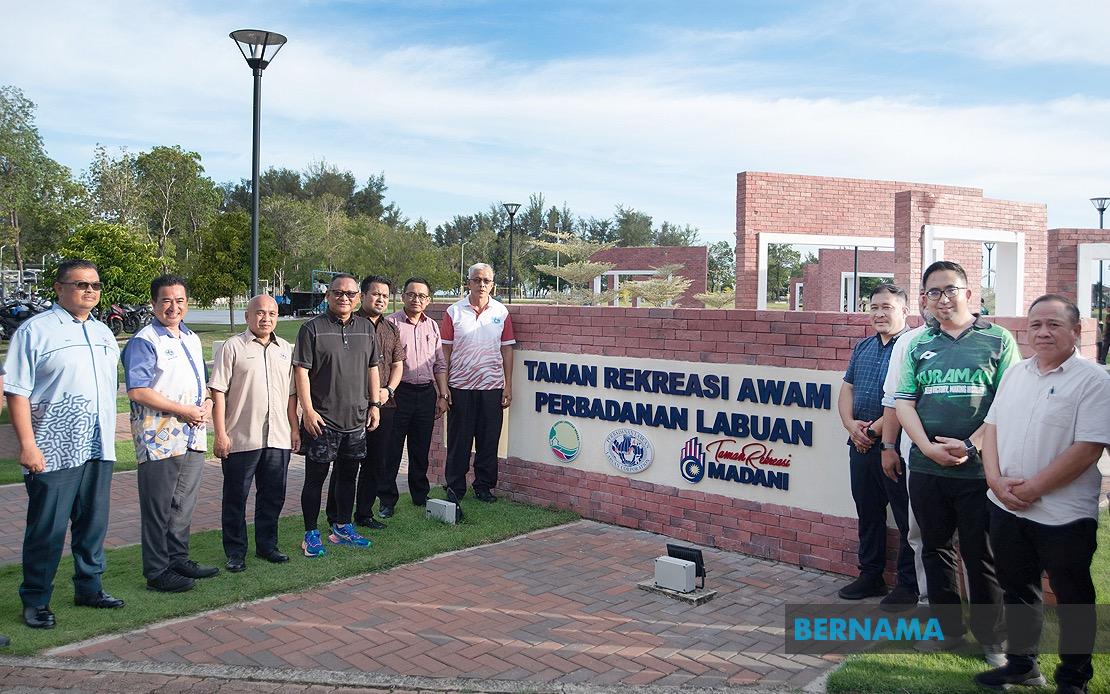
Labuan has taken a significant step towards building a healthier and more active community with the official opening of the Labuan Public Recreation Park at Tanjung Purun, a central location that marks a remarkable transformation of the town's recreational landscape. The RM495,382 upgrade, undertaken as part of the broader Madani Recreation Park initiative, has converted what was once a neglected public space into a modern leisure destination designed to serve residents across all age groups and fitness levels.
Rithuan Ismail, chief executive officer of Labuan Corporation, emphasised that the park's development represents a deliberate policy shift towards creating inclusive public spaces that prioritise community health and social cohesion. Rather than functioning merely as a collection of exercise facilities, the park has been conceptualised as a gathering place where Labuan residents can engage in physical activity while simultaneously strengthening neighbourhood bonds and fostering a sense of belonging. This holistic approach to public recreation reflects evolving thinking about how well-designed spaces contribute to overall quality of life beyond simple fitness metrics.
The project's origins trace back to recognition of significant untapped potential in the downtown area. The former LDA Field had languished as an underutilised public asset despite occupying prime real estate in Labuan's town centre. Multiple factors contributed to its decline: inadequate night-time illumination discouraged evening use when temperatures were more comfortable, the range of available recreational facilities remained limited compared to modern expectations, and ageing casuarina trees created genuine safety hazards that further deterred public access. The National Landscape Department, operating under the Ministry of Housing and Local Government (KPKT), identified the site in 2024 as ideal for the Madani initiative given its strategic downtown position and the absence of complex land ownership disputes that often complicate such projects.
The selection process itself demonstrates careful planning. Labuan Corporation recognised that location, accessibility, and land availability were equally important as financial investment when determining which projects would generate sustainable community benefits. The Tanjung Purun site satisfied all these criteria, offering convenient access for residents across the municipality and sufficient dimensions to accommodate comprehensive recreational facilities. These practical considerations proved instrumental in transforming a previously marginal public space into one of Labuan's preferred evening destinations.
The completed facility now encompasses several complementary features designed to accommodate diverse recreational preferences and age groups. An 800-metre jogging track provides distance runners and walkers with a measured circuit, while concrete seating areas enable elderly residents and parents supervising children to rest and observe activities. Outdoor fitness equipment has been installed to support strength training and exercise routines without requiring expensive gym memberships, directly supporting Labuan Corporation's stated commitment to accessible community health. The park's design incorporates welcoming landscaping elements that enhance the aesthetic appeal, making the space attractive for leisure visits rather than appearing purely utilitarian.
Expansion plans reveal Labuan Corporation's ongoing commitment to enriching the recreational offering. Three dedicated courts for pickleball and sepak takraw are expected to be operational by the end of 2024. These additions respond to demonstrated community interest in organised sport and reflect the growing popularity of pickleball throughout Malaysia and Southeast Asia. The inclusion of sepak takraw courts maintains cultural continuity while introducing modern sporting infrastructure, a balance that resonates with diverse demographic segments within the Labuan community. These facilities will position the park as a hub for both casual recreation and more structured competitive activities.
The timing of the park's opening carries particular significance for Malaysian small towns and federal territories seeking to enhance public amenities with limited budgets. The RM495,382 investment, while substantial, represents a measured capital commitment that delivers visible, immediately usable infrastructure rather than speculative development projects. For other municipalities across Malaysia and Brunei, the Labuan model demonstrates how strategic selection of underutilised downtown locations, combined with practical facility design and subsequent community engagement, can generate meaningful health and social outcomes. The project's success may influence budgeting and planning approaches elsewhere in the region.
Community stewardship emerges as a critical factor in the project's long-term viability. Rithuan Ismail's explicit call for public participation in maintaining the facilities acknowledges that modern infrastructure requires ongoing care and respect to deliver sustained value. Parks in tropical climates face particular maintenance pressures from weather exposure, heavy usage, and environmental factors. Labuan Corporation's emphasis on community responsibility suggests recognition that purely top-down management approaches often prove insufficient; genuine sustainability requires residents to view facilities as shared community assets deserving protection and respect.
The park's establishment addresses broader public health imperatives across Malaysia. Rising obesity rates, sedentary lifestyles exacerbated by desk-based work, and limited free recreational options particularly affect lower-income residents who cannot afford private gym memberships or sports clubs. By providing free, accessible, well-designed public recreation infrastructure in the town centre, Labuan Corporation removes practical barriers that prevent residents from adopting more active lifestyles. This democratisation of recreational access carries implications extending beyond individual fitness to encompass public health expenditure and long-term community wellbeing.
The Tanjung Purun park also illustrates how thoughtful urban planning can revitalise downtown areas and reinforce civic pride. Before the upgrade, the site exemplified urban decay—visible deterioration discouraging legitimate public use while potentially inviting anti-social behaviour. The transformation to a clean, well-lit, welcoming public space signals municipal investment in downtown vitality, potentially encouraging complementary development of nearby commercial and residential areas. This ripple effect, where single quality improvements catalyse broader neighbourhood improvement, has been observed in successful urban renewal projects throughout East Asia.
Looking forward, the Labuan Public Recreation Park represents both accomplishment and baseline for continued development. The completion of pickleball and sepak takraw courts later in 2024 will expand the facility's appeal and capacity to host community events and informal tournaments. Future iterations might incorporate other features responsive to community feedback—perhaps covered areas for monsoon seasons, additional seating suitable for social gatherings, or programming that activates the space through regular community events. Labuan Corporation's demonstrated commitment to gradual enhancement suggests the facility will evolve based on actual usage patterns and resident preferences rather than remaining static.
The opening ceremony itself served practical purposes beyond ceremonial formality, introducing residents to the facility's various components and encouraging initial trial use. For Labuan residents previously lacking convenient, quality recreational infrastructure, the park offers immediate benefits that should be apparent during evening hours when Malaysians typically seek outdoor activity to escape daytime heat. Whether the facility achieves its aspirational goals of fostering community cohesion and promoting healthier lifestyles will depend substantially on how residents embrace and maintain the space during the crucial months following opening.

