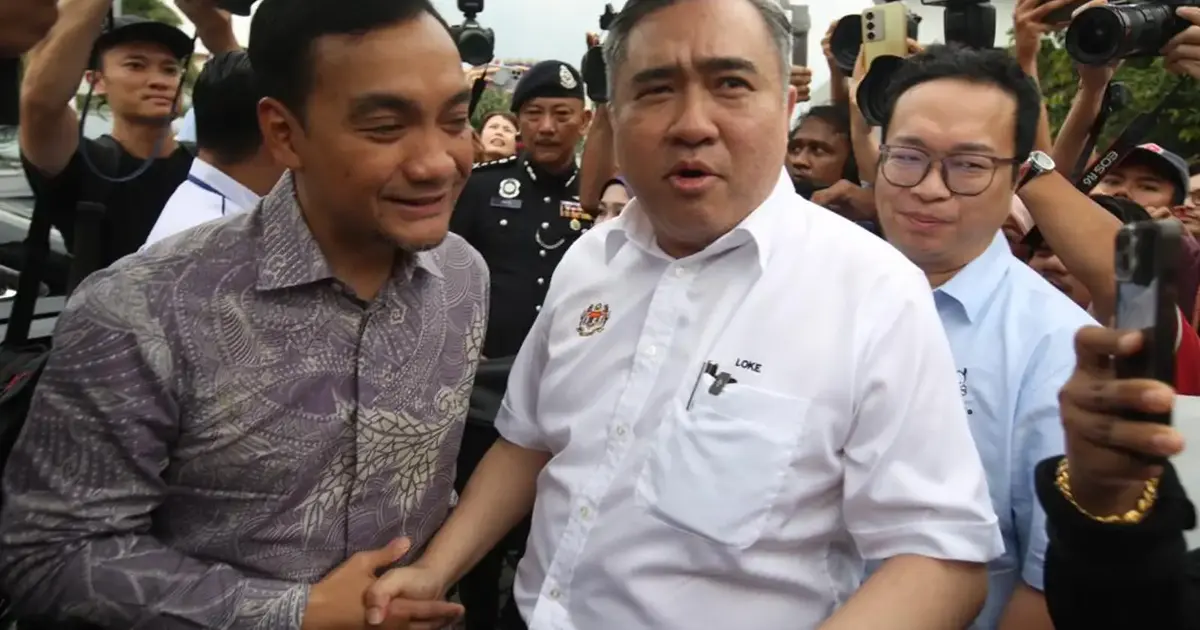
The inaugural face-to-face encounter between Transport Minister Anthony Loke and Johor Menteri Besar Onn Hafiz Ghazi unfolded with careful civility, revealing the delicate balance both leaders are attempting to maintain following their recent public disagreement on social media. Despite the friction that had characterised their earlier online exchange, the two political figures demonstrated sufficient restraint to preserve the veneer of professional courtesy, signalling that deeper institutional cracks have not yet formed between the federal and state administrations.
The tone of the gathering remained markedly formal, with neither party allowing the previous dispute to dominate proceedings. However, Onn Hafiz seized the opportunity to make a pointed remark during his address, obliquely referencing the circumstances of the event itself. By noting that he had felt compelled to rearrange his official schedule in response to receiving a last-minute invitation from the transport ministry, the Johor leader managed to lodge a subtle protest without resorting to open confrontation. Such calculated commentary serves as a reminder of the underlying friction whilst maintaining the appearance of cooperation.
The event, organised under the auspices of the transport ministry, provided the official platform for this carefully choreographed reunion. The venue and formal structure ensured that any exchange would remain bounded by protocol and audience expectations, effectively preventing the kind of spontaneous tension that might otherwise have surfaced. This arrangement reflects broader diplomatic practice wherein adversarial political actors maintain public composure through structured settings.
Onn Hafiz's comment about schedule disruption carries particular weight in Malaysian political culture, where the allocation of time and resources serves as a tangible marker of respect and consideration. By highlighting that he had to accommodate what he characterised as inadequate notice, the Johor MB was signalling that the transport ministry's approach fell short of the deference typically extended between senior officials. This measured rebuke, delivered within a public setting, allows Onn Hafiz to register displeasure whilst technically remaining cordial.
The earlier online disagreement that prompted this eventual meeting had generated considerable attention within political circles and among observers of federal-state relations. Such digital-era disputes often carry particular intensity precisely because social media permits rapid, unfiltered exchanges that traditional channels might have moderated or suppressed entirely. The shift from acrimonious online messaging to in-person civility underscores how Malaysian political figures continue to distinguish between different communication forums and the expectations governing each.
For Malaysian readers, this episode illuminates the complex dynamics shaping governance across multiple administrative levels. The relationship between federal transport authorities and state governments directly affects infrastructure development, public transportation initiatives, and resource allocation affecting millions of commuters. When tensions emerge between these levels of government, implementation of shared priorities becomes significantly more complicated. The cordial appearance maintained at this meeting, therefore, has practical implications beyond mere theatrical courtesy.
Onn Hafiz's position as Johor Menteri Besar grants him substantial autonomy within the state, particularly regarding matters touching on state interests and development agendas. Johor, as the second-most populous state and a major economic hub in Malaysia, carries considerable political weight. Transport and infrastructure decisions affecting the state require cooperative engagement between federal and state authorities, making deterioration in their working relationship potentially damaging to constituent welfare.
Anthony Loke's portfolio encompasses nationwide transport policy and regulation, responsibilities that intersect constantly with state-level concerns. The transport minister's ability to execute federal initiatives depends partly on state government cooperation and acquiescence. Divergence between these leaders could create implementation bottlenecks, delayed approvals, or competing policy directions that confuse stakeholders and waste administrative resources. The maintenance of professional relations, therefore, transcends personality clashes and touches on substantive governance capacity.
The international and regional context also shapes these dynamics. Southeast Asian observers of Malaysian politics often interpret federal-state friction as indicators of broader political stability and institutional health. When senior officials demonstrate capacity to move past disagreements and maintain functional relationships, this signals institutional resilience. Conversely, escalating feuds between government figures can unsettle investor confidence and suggest systemic dysfunction. Both Loke and Onn Hafiz appear mindful of these perceptions, motivating their commitment to surface-level amity.
Looking forward, whether this display of civility reflects genuine resolution or temporary containment remains uncertain. The subtle jab embedded in Onn Hafiz's remarks about the scheduling suggests that underlying grievances persist beneath the polished exterior. Future interactions between these officials will reveal whether they have genuinely moved past their disagreement or merely agreed to conduct their dispute through more muted channels. For now, both have chosen the path of diplomatic restraint, prioritising institutional continuity over personal vindication.
The episode illustrates a broader pattern in Malaysian politics wherein senior officials frequently navigate competing pressures between maintaining public unity and advocating partisan positions. The increasing visibility of political communication through social media occasionally disrupts these carefully managed equilibriums, creating moments of unexpected transparency. However, traditional instincts toward preserving formal courtesy often reassert themselves, as evidenced here. Whether such restraint ultimately serves democratic accountability or merely obscures deeper institutional tensions remains an open question deserving scrutiny from engaged observers.