Spiritual renewal and the concept of positive transformation dominated Maal Hijrah 1448H commemorations held throughout Malaysia on June 17, with participants across the nation reflecting on how hijrah—the principle of migration and positive change—can strengthen Islamic communities and foster better governance. The celebrations, which took place in multiple venues with approximately 5,000 attendees gathered in the capital, reflected a deliberate emphasis on the relationship between individual spiritual growth and collective social responsibility.
The nationwide observance operated under the overarching theme "MADANI Dihayati, Ummah Diberkati"—roughly translated as "MADANI Lived, Ummah Blessed"—positioning Maal Hijrah as more than a historical commemoration but as a framework for contemporary nation-building. Throughout the various ceremonies, speakers and religious scholars explored how the spiritual principles embodied in the Prophet Muhammad's hijrah journey more than 1,400 years ago remain relevant to modern challenges of governance, social cohesion and ethical leadership.
Deputy Prime Minister Datuk Seri Fadillah Yusof and Minister in the Prime Minister's Department (Religious Affairs) Dr Zulkifli Hasan attended the main Kuala Lumpur ceremony, lending political weight to the religious observance and signalling government recognition of the occasion's importance to Malaysia's multicultural Islamic community. Their presence highlighted the administration's view that religious commemoration and national development priorities intersect meaningfully.
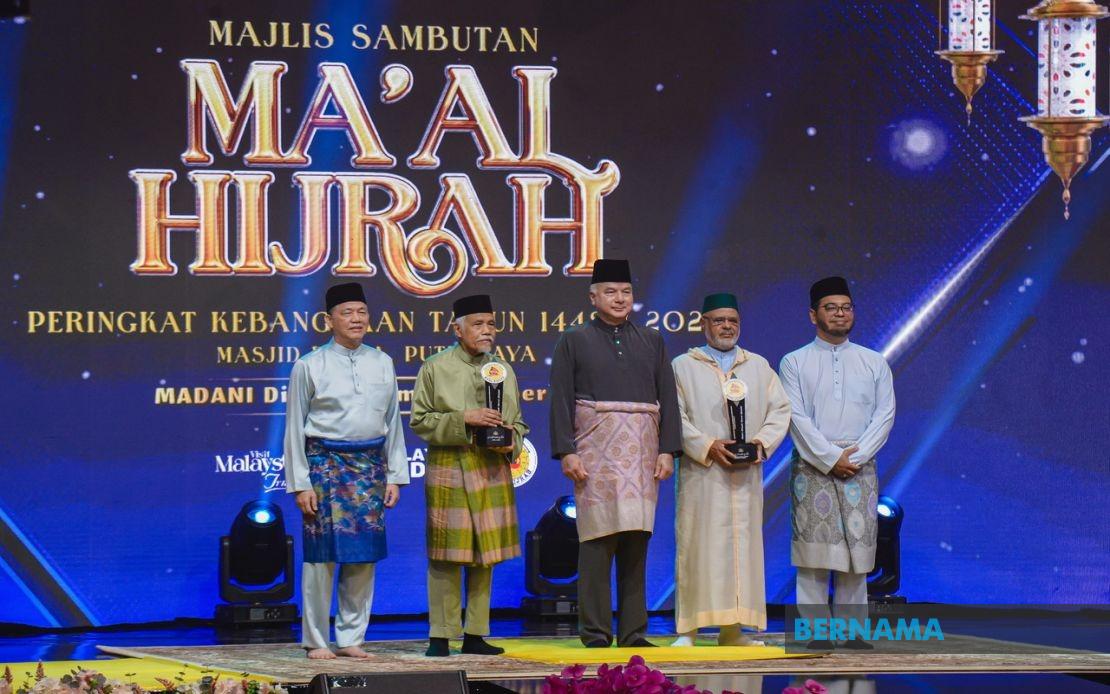
The centrepiece of the celebration involved honouring individuals who embody the hijrah spirit through contributions to Islamic scholarship, community leadership and social welfare. Sultan Nazrin Shah, Sultan of Perak, presented the National Tokoh Maal Hijrah Award to Prof Emeritus Datuk Dr Osman Bakar, rector of the International Islamic University Malaysia (IIUM), recognising his intellectual leadership in Islamic higher education and his role in shaping generations of Muslim scholars and professionals across Southeast Asia.
Complementing the national award, the International Tokoh Maal Hijrah Award went to Dr Ahmad Al-Raysuni, a distinguished Moroccan scholar of Islamic jurisprudence, acknowledging the global dimension of Islamic learning and Malaysia's engagement with broader Muslim intellectual traditions. This dual-award approach underscored the celebration's framing of hijrah as a universal principle transcending national boundaries while remaining deeply rooted in local contexts.
Regional celebrations demonstrated how the Maal Hijrah message resonates beyond the capital. In Sabah, approximately 1,000 participants gathered for the state's commemoration, where Chief Minister Datuk Seri Hajiji Noor welcomed guests including Tun Musa and his wife Toh Puan Faridah Tussin. The Sabah event honoured community leaders including former Sabah Islamic Religious Affairs Department director Datuk Ag Sharin Alimin and former deputy state secretary Datuk Masnah Matsalleh, recognising their decades of service to institutional governance and Islamic affairs administration.
The awards process extended beyond prominent national figures to include grassroots educators and custodians of Islamic knowledge. In a separate ceremony, Ahmad Samsuri presented the Tokoh Maal Hijrah Award to 95-year-old Quranic teacher Jusoh @ Muda Ismail, honouring the lineage of Quranic scholarship represented through his mentorship under the late renowned scholar Tuan Guru Haji Mat Lintar. This recognition of elderly knowledge-keepers reflected the celebrations' emphasis on intergenerational transmission of Islamic values and the dignity accorded to those who dedicate their lives to religious education.
The gender-inclusive nature of the awards, with both male and female categories, indicated deliberate efforts to acknowledge women's contributions to Islamic community life and institutional development. This approach aligns with broader discussions within Malaysian Islam about balancing traditional gender roles with recognition of women's intellectual and administrative capabilities.
Spiritual programmes formed the backbone of the celebrations, featuring Quranic recitations, scholarly lectures and theological discussions exploring hijrah's philosophical dimensions and contemporary applications. These elements transformed the occasion from ceremonial commemoration into an active engagement with Islamic principles, inviting participants to personally reflect on their own spiritual journeys and societal responsibilities.
For Malaysian readers and Southeast Asian observers, these celebrations signify the continued centrality of Islamic concepts in national discourse and governance. The emphasis on quality leadership resonates in a region where governance challenges, institutional accountability and ethical decision-making remain ongoing concerns. By positioning hijrah as fundamentally about positive change and principled migration toward better conditions, Malaysian Islamic leadership frames religious observance as integral to development aspirations rather than tangential to them.
The participation of both federal and state-level officials, combined with awards recognising scholarship, community service and religious education, demonstrates an integrated approach to Islamic engagement in Malaysia. Rather than compartmentalising religion into separate spheres, these celebrations envision Islamic principles as offering guidance for public administration, institutional excellence and community building—a vision that extends relevance beyond Muslim audiences to the broader multicultural society navigating shared governance challenges.
As Malaysia's Islamic community continues navigating modernisation, demographic change and regional integration, Maal Hijrah observances like those held in 1448H serve as periodic reminders of foundational principles. The emphasis on ummah unity and principled leadership offers a counter-narrative to sectarianism and corruption, while the honouring of educators, administrators and scholars across generations reinforces the value of knowledge accumulation and institutional stewardship in building resilient, ethically grounded communities.