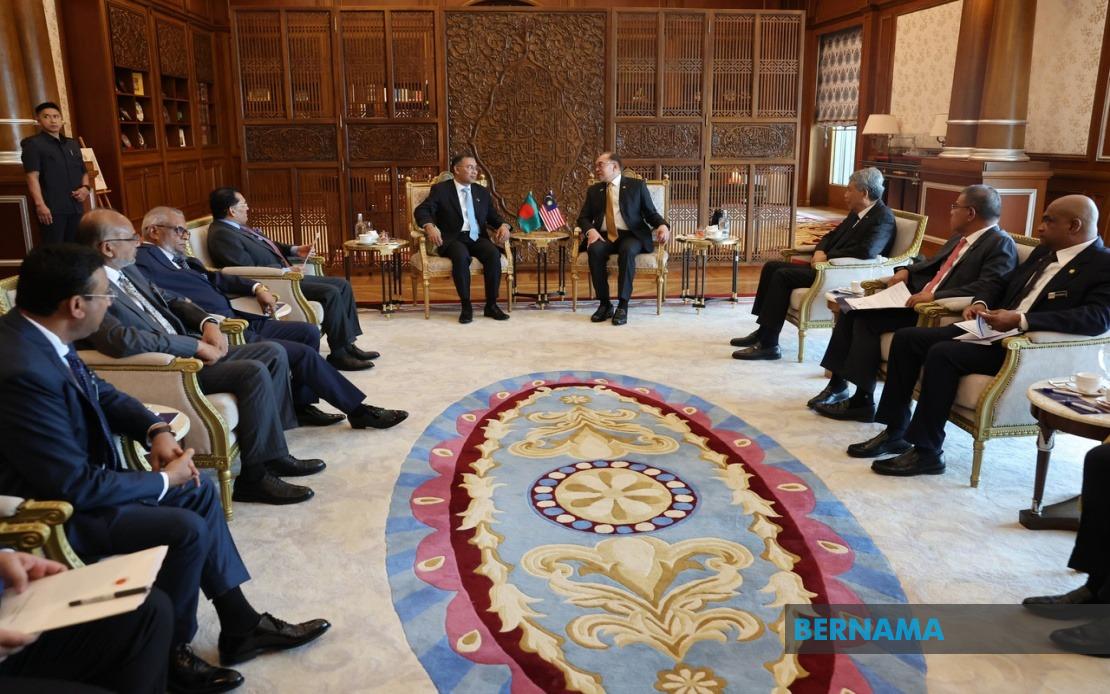
Prime Minister Datuk Seri Anwar Ibrahim and Bangladesh Prime Minister Tarique Rahman have committed Malaysia and Bangladesh to intensifying their collaborative response to the protracted Rohingya refugee crisis, with both nations pledging to channel their efforts through established ASEAN institutional frameworks. The two leaders outlined their shared resolve during a joint press conference at Putrajaya on June 22, underscoring that the humanitarian challenge facing hundreds of thousands of stateless Rohingya requires coordinated regional action rather than isolated bilateral responses. Their statements reflect growing recognition that the scale of displacement in Southeast Asia demands sustained diplomatic engagement with Myanmar authorities, the country of origin whose internal policies have driven successive waves of refugee outflows since 2017.
The Rohingya question remains one of the region's most vexing humanitarian and geopolitical issues, with Bangladesh hosting the world's largest concentration of Rohingya refugees in sprawling camps while Malaysia has absorbed tens of thousands in urban centres. Tarique's emphasis on ensuring "safe, dignified and sustainable repatriation" signals Bangladesh's primary concern: creating conditions permitting refugees to return voluntarily rather than pursuing indefinite warehousing in camps. Malaysia, confronting its own integration challenges and public sentiment around irregular migration, shares Bangladesh's interest in a genuine resolution rather than perpetual management of the displacement.
Anwar's explicit reference to enlisting the "good offices" of both nations' foreign ministers indicates a deliberate diplomatic strategy to elevate the issue beyond humanitarian discourse into the formal architecture of regional relations. By routing engagement through ASEAN mechanisms, Malaysia and Bangladesh are attempting to harness the bloc's collective standing with Myanmar, though ASEAN's history on the matter reveals the limits of consensus-based pressure. The bloc's principle of non-interference has historically constrained its ability to influence Myanmar's internal policies, a reality that shapes realistic expectations for what such coordination can achieve in practice.
The bilateral talks that preceded the public statements addressed a broader spectrum of Malaysia-Bangladesh relations, with both countries identifying strategic sectors for deepened partnership. Trade and investment, human resource development, semiconductors, energy, agriculture and education emerged as priority areas, reflecting complementary economic interests. Bangladesh's growing manufacturing base and Malaysia's technological capabilities and capital markets suggest genuine scope for mutually beneficial engagement, though realising such potential requires consistent follow-through beyond ceremonial commitments at leadership level.
The 2025 trade figures underscore Bangladesh's increasing significance in Malaysia's commercial landscape. At RM12.18 billion in bilateral trade, Bangladesh ranked as Malaysia's second-largest trading partner in South Asia after India and positioned itself as the 28th largest trading partner globally. Malaysia's export portfolio, heavily concentrated in petroleum products valued at RM10.08 billion, reveals Malaysia's role as an energy supplier to Bangladesh's rapidly industrialising economy. Conversely, Bangladesh's textile, apparel and footwear exports totalling RM2.10 billion reflect the country's enduring strengths in labour-intensive manufacturing, sectors facing intense global competition and rising wage pressures.
Tarique's visit marks his first official bilateral trip abroad since assuming office in February 2026, a symbolic choice that underscores Bangladesh's interest in strengthening its relationship with Malaysia specifically. The selection of Malaysia as an inaugural destination carries diplomatic weight, suggesting the Bangladesh Prime Minister views the relationship as sufficiently important and promising to merit priority attention. For Malaysia, receiving Tarique signals Anwar's commitment to deepening ties with a significant neighbour whose trajectory will influence broader South Asian dynamics affecting Southeast Asia.
The formal instruments exchanged during the visit—a Memorandum of Understanding on Cultural Cooperation and two Exchanges of Notes on Counter-Terrorism Research and Investment Promotion—represent incremental institutionalisation of bilateral ties. Cultural cooperation agreements provide soft power dimensions often overlooked in commercial partnerships, facilitating people-to-people exchanges and mutual understanding. The counter-terrorism research partnership reflects shared security concerns, particularly relevant given transnational militant networks and trafficking routes connecting the two nations. Investment promotion initiatives address Malaysian firms' interest in accessing Bangladesh's market and labour, while Bangladesh investors eye Malaysia's developed infrastructure and financial services sector.
The Rohingya dimension of the bilateral engagement carries particular weight for Malaysia's domestic political economy. Public opinion regarding refugee populations has grown increasingly fraught, with competing narratives about burden-sharing, labour market competition and security concerns. Anwar's framing of the issue as requiring regional solutions through ASEAN rather than unilateral Malaysian absorption signals political awareness of domestic sensitivities while maintaining Malaysia's humanitarian commitments. This balancing act reflects the inherent tension between international obligations and domestic political constraints that characterise Malaysia's approach to irregular migration and refugee questions.
Bangladesh's emphasis on Myanmar's involvement in solutions represents perhaps the most challenging dimension of the collaborative framework. Without meaningful political transformation in Myanmar or genuine willingness to address the root causes of Rohingya persecution, repatriation remains largely theoretical. The military-dominated Myanmar government has shown limited inclination to facilitate return or address discrimination, complicating regional diplomatic efforts. Malaysia and Bangladesh's commitment to engagement "through ASEAN mechanisms" implicitly acknowledges that direct bilateral pressure has limited efficacy, necessitating broader regional leverage—itself constrained by ASEAN's consensus-based decision-making.
The timing of this bilateral engagement coincides with Malaysia's ongoing chairmanship of ASEAN in 2026, providing a platform for elevating the Rohingya question within regional deliberations. Anwar's demonstrated interest in utilising Malaysia's ASEAN position to advance humanitarian causes suggests the Rohingya issue will receive elevated attention during Malaysia's tenure. Whether such attention translates into concrete progress toward repatriation remains contingent on shifting circumstances within Myanmar and broader geopolitical developments affecting ASEAN cohesion on the matter.
Looking ahead, the Malaysia-Bangladesh cooperation on Rohingya resolution will require sustained political commitment beyond the rhetorical flourishes typical of summit-level statements. Implementation through foreign ministry channels demands consistent diplomatic engagement, technical coordination on refugee data and repatriation logistics, and continuous communication with Myanmar authorities. The expanded bilateral agenda across trade, investment and security cooperation provides broader relational depth that can support such sustained effort, as successful collaboration on commercial matters builds trust facilitating difficult negotiations on humanitarian questions.

