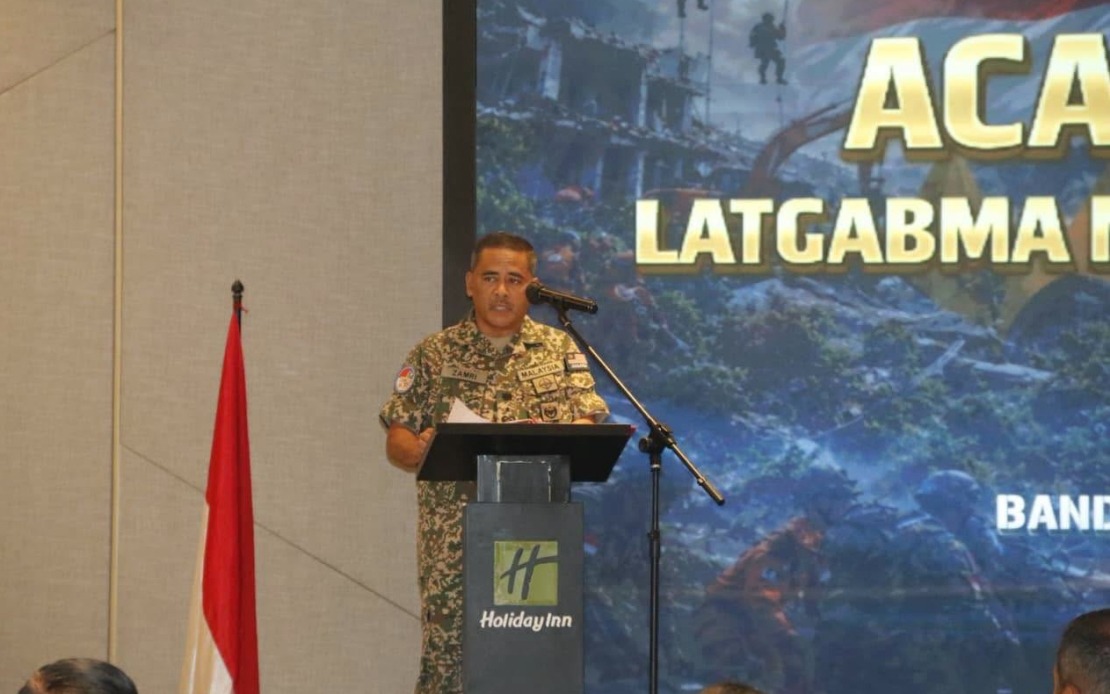
The Malaysian Armed Forces and Indonesia's TNI have deepened their defence relationship through the 12AB/2026 Malaysia-Indonesia Joint Combined Exercise, a 13-day operation currently underway in Lampung, Sumatra. Involving 719 participants drawn from defence and civilian agencies across both nations, the exercise represents a continuation of bilateral military engagement that stretches back four decades, underscoring the enduring strategic partnership between Southeast Asia's two largest Muslim-majority democracies. The initiative reflects how regional security cooperation has evolved beyond traditional border management to encompass a broader spectrum of shared challenges.
Brigadier General Datuk Zamri Othman, Commander of the 1st Infantry Brigade and chief of the MAF Exercise Planning Group, characterised the drill as far more than routine military activity. Instead, he framed it as concrete expression of the deep fraternal bonds and mutual strategic confidence that underpin Malaysian-Indonesian relations. The exercise tests integrated operational concepts spanning land, maritime, and air domains, creating genuine opportunities for military personnel from both countries to deepen familiarity with each other's procedures and organisational cultures. This dimension of trust-building proves particularly valuable in an increasingly complex security environment where rapid, coordinated responses often prove decisive.
The contemporary security landscape facing Malaysia, Indonesia, and the wider region has grown markedly complicated in recent years. Beyond traditional interstate tensions, both nations confront an expanding array of non-traditional threats: sophisticated maritime crime networks operating across the Straits of Malacca, transnational smuggling operations, persistent terrorism, state-sponsored cyber intrusions, and the ever-present danger of natural disasters. Brig Gen Zamri emphasised that these multifaceted challenges demand substantially strengthened defence cooperation between the two countries, moving beyond symbolic gestures toward concrete capability-building and operational integration. The exercise serves precisely this purpose, creating mechanisms through which armed forces can refine joint responses to scenarios they may encounter in actual emergencies.
The LATGABMA MALINDO DARSASA programme itself carries considerable institutional weight within the bilateral relationship. Initiated in 1984, the exercise has operated on a triennial rotation through the Malaysia-Indonesia General Border Committee and the Malaysia-Indonesia Joint Training Committee, with previous iterations hosted alternately across both nations. The most recent edition took place in Pekan, Pahang in 2023, where organisers had structured the scenario around counter-terrorism operations. This rotation reflects a commitment to sustained institutional learning and the development of shared tactical and strategic concepts across the armed forces of both nations. By shifting focus to humanitarian and disaster response, the latest iteration signals evolving priorities within regional security thinking.
The selection of Bandar Lampung as the primary exercise location carried deliberate strategic reasoning rooted in geography and risk assessment. Lampung Province sits at the intersection of three active tectonic plate boundaries, rendering it one of Indonesia's most seismically volatile regions. This geological reality transforms the location from a mere backdrop into an ideal training environment where service personnel can rehearse responses to genuinely plausible natural disaster scenarios. Rather than conducting artificial exercises against contrived problems, the Malaysian and Indonesian militaries have anchored this year's programme in real historical experience, drawing explicitly upon the devastating earthquakes and tsunamis that have repeatedly struck southern Sumatra. Such grounding in authentic risk creates a more rigorous and ultimately more valuable preparation for actual contingencies.
The exercise structure itself reflects sophisticated thinking about how to integrate theoretical knowledge with practical capability-building. The academic phase, conducted through Staff Exercise sessions, focuses on ten distinct scenarios spanning the full spectrum of disaster response operations. These include initial emergency response protocols, mass casualty incident management, infrastructure damage assessment and repair, medical emergencies requiring field response, international assistance coordination, cyber attack response, information warfare, large-scale evacuation procedures, stabilisation operations, and transition toward normal governance. By examining each scenario in detail through structured academic discussion before moving to field operations, participating officers and soldiers acquire conceptual frameworks that guide their later practical training. This pedagogical approach ensures that Field Training Exercise phases build upon clear shared understanding rather than improvisation.
The Force Integration Training segment brings together military personnel from both nations alongside civilian agencies essential to comprehensive disaster response. Indonesian participants include staff from BASARNAS, the National Search and Rescue Agency, alongside disaster preparedness cadets, Red Crescent volunteers, and regional disaster management officials. Malaysian representation includes NADMA, the National Disaster Management Agency. This inter-agency approach reflects contemporary understanding that modern disaster response transcends military domains, requiring seamless coordination between defence personnel and civilian emergency management specialists. Joint training in rope work, rappelling, emergency medicine, and field hospital establishment occurs within integrated teams, building the muscle memory and interpersonal familiarity necessary for effective crisis response under genuine pressure.
Beyond security and life-safety training, the exercise incorporates Engineering Civil Action and Medical Civic Action components that carry direct benefit to affected communities in the training area. Malaysian and Indonesian personnel are conducting genuine rehabilitation work on two uninhabitable houses in Kampung Sukamaju and constructing concrete road infrastructure in Kampung Keteguhan. Simultaneously, medical teams operating from a community health centre are delivering free health screenings, providing optical assistance, and conducting blood donation programmes. These activities transcend public relations considerations, delivering tangible improvements to rural Indonesian communities while simultaneously providing training value to participating personnel. Such integration of humanitarian benefit with military training represents increasingly standard practice within multilateral defence exercises throughout Southeast Asia and beyond.
Cyber security constitutes a particularly significant innovation within this year's exercise framework, reflecting the growing integration of digital threats into military planning. The CyberEx segment exposes participants to contemporary cyber attack techniques including reconnaissance operations, credential compromise, man-in-the-middle attacks, spoofing, and information manipulation. By incorporating cyber defence training alongside physical disaster response capabilities, Malaysian and Indonesian military planners acknowledge that modern crises increasingly feature digital dimensions. Critical infrastructure attacks, coordinated information warfare, and coordinated cyber-kinetic operations represent genuine threats to both nations' security. Joint training in cyber defence builds common awareness of threat patterns and response protocols, facilitating more effective coordination during actual incidents.
The exercise composition reflects careful calibration toward balance and burden-sharing between the participating nations. Indonesian military personnel comprise the largest contingent at 463 individuals, with Malaysian defence personnel numbering 150, supplemented by representatives from Malaysian disaster management authorities. Indonesian civilian agencies contribute 79 participants, alongside 25 police personnel. This distribution ensures Indonesian hosting responsibilities remain substantial while maintaining meaningful Malaysian participation across military and civilian domains. The involvement of police forces from both nations represents an additional innovation, acknowledging that contemporary security challenges increasingly blur traditional distinctions between military and civilian law enforcement. Piracy, trafficking networks, and terrorism often require seamless integration of military and police responses.
For Malaysia specifically, the exercise carries particular significance given geographical realities and strategic interests. The Strait of Malacca, through which approximately one-third of global maritime trade transits, lies shared between Malaysia and Indonesia. Maritime security cooperation directly serves Malaysian national interests while building broader regional stability. The exercise's emphasis on search-and-rescue and humanitarian response capabilities directly addresses scenarios that could originate from maritime incidents within waters both nations patrol. Additionally, the integration of cyber defence training reflects Malaysian vulnerabilities to sophisticated cyber operations originating from state actors throughout the region and beyond. By developing joint cyber response capabilities with Indonesia, Malaysia reduces its own security exposure while building regional consensus on appropriate cyber norms.
The broader significance of this bilateral initiative extends beyond the immediate participants and locations. Malaysia-Indonesia defence cooperation carries profound implications for Southeast Asian stability at a moment when regional geopolitics have grown increasingly complicated. The deliberate, sustained commitment to joint exercises and institutional mechanisms for military-to-military engagement provides ballast against miscalculation during tense periods. Throughout the ASEAN region, where territorial disputes and resource competition periodically generate friction, the Malaysia-Indonesia relationship stands out for its institutional maturity and demonstrated commitment to peaceful resolution of differences. The LATGABMA MALINDO DARSASA exercise exemplifies this mature approach, channelling competitive instincts toward constructive cooperation in addressing genuine shared threats. As non-traditional security challenges proliferate throughout Southeast Asia, this model of bilateral cooperation through sustained institutional engagement deserves recognition and replication.