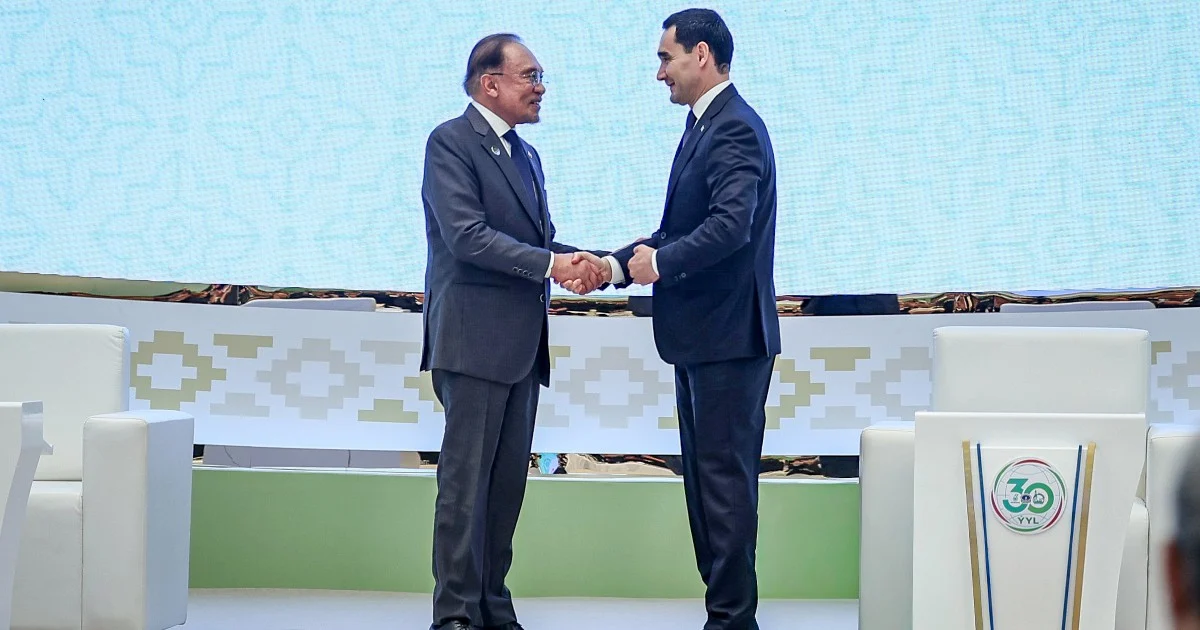
Malaysia and Turkmenistan have committed to a comprehensive deepening of bilateral relations spanning energy, trade, investment and multiple developmental sectors, cementing ties forged during Prime Minister Datuk Seri Anwar Ibrahim's recent official visit to the Central Asian nation. The agreement signals both countries' intention to move beyond traditional diplomatic courtesy toward concrete economic engagement that could reshape Malaysia's footprint in Central Asia's emerging markets.
The energy sector forms the cornerstone of this renewed partnership, reflecting Turkmenistan's position as one of the world's largest natural gas reserves and Malaysia's strategic importance in regional energy security. For Malaysian policymakers, engagement with Turkmenistan presents an opportunity to diversify energy sourcing and explore alternative supply routes that reduce dependence on traditional Middle Eastern suppliers. Turkmenistan's vast hydrocarbon wealth, coupled with its geographic positioning between Russia, Iran and China, positions it as a critical player in global energy geopolitics that Malaysia cannot afford to overlook.
Beyond hydrocarbons, the bilateral framework encompasses trade and investment collaboration that could unlock commercial opportunities for Malaysian enterprises seeking footholds in Central Asia. Turkmenistan's economy, whilst resource-dependent, has demonstrated resilience and offers untapped potential for Malaysian manufacturers, service providers and technology companies. The agreement acknowledges that sustained economic partnership requires diversified channels through which capital, goods and expertise can flow between the two nations, moving beyond extractive industries toward value-added sectors.
Transportation infrastructure represents another dimension of this cooperation that merits attention from regional observers. Improved connectivity between Malaysia and Turkmenistan could facilitate trade flows not merely between the two countries but across the broader Central Asian marketplace. Investment in transportation linkages, whether through air cargo capacity, shipping routes or overland corridors, creates network effects that benefit businesses throughout Southeast Asia seeking markets in the former Soviet republics. Malaysia's position as a regional logistics hub positions it advantageously to leverage improved Central Asian connectivity.
Educational collaboration outlined in the bilateral understanding reflects recognition that sustainable partnerships rest upon human capital development and cultural exchange. Malaysian universities and technical institutions have increasingly attracted Central Asian students, and formal cooperation frameworks could accelerate this trend. Scholarships, faculty exchanges and research partnerships between Malaysian and Turkmen institutions would generate diplomatic goodwill whilst advancing scientific collaboration on shared challenges including resource management and environmental sustainability in emerging economies.
Technology transfer and innovation cooperation hold particular significance given Malaysia's digital economy aspirations and Turkmenistan's modernization agenda. Turkmenistan has prioritized technological advancement as a pathway toward economic diversification, creating opportunities for Malaysian technology firms to establish regional operations and service delivery centers. The cooperation framework potentially opens doors for Malaysian expertise in telecommunications, digital governance and financial technology to support Turkmenistan's digital transformation initiatives.
From a geopolitical perspective, Malaysia's engagement with Turkmenistan reflects the country's broader strategy of maintaining strategic autonomy through diversified partnerships. As Southeast Asia navigates great power competition between the United States, China and Russia, Malaysia's cultivation of ties with Central Asian nations demonstrates commitment to a multi-directional foreign policy that prevents alignment with any single bloc. Turkmenistan's measured approach to international relations aligns with Malaysia's preference for pragmatic, non-ideological engagement based on mutual benefit.
The timing of Prime Minister Anwar Ibrahim's visit carries significance beyond ceremonial considerations. Malaysia's growing economic ambitions and regional leadership aspirations require the country to engage substantively with emerging markets across Eurasia. Turkmenistan, often overlooked in Southeast Asian analyses, represents precisely the type of underexploited market that can provide Malaysian businesses first-mover advantages before competition intensifies from other Asian states.
Implementation of the bilateral cooperation framework will prove critical to translating agreements into tangible outcomes. Malaysian enterprises require clarity regarding investment guidelines, regulatory frameworks and dispute resolution mechanisms that Turkmenistan can offer. Similarly, Turkmen stakeholders benefit from transparent Malaysian commitments and institutional mechanisms ensuring continuity regardless of political transitions. Establishing joint committees, business councils and cultural exchange organizations provides scaffolding upon which sustained cooperation can be constructed.
The energy component of Malaysia-Turkmenistan cooperation warrants sustained monitoring given regional energy dynamics. Turkmenistan's gas production capacity could become increasingly relevant to Malaysia as energy demand accelerates across Asia and traditional suppliers face production constraints. Exploring liquefied natural gas partnerships, pipeline infrastructure development or joint ventures in energy sectors demonstrates forward-thinking engagement with long-term regional energy security challenges.
Regional implications extend beyond bilateral considerations. Enhanced Malaysia-Turkmenistan cooperation contributes to building connectivity across the Indian Ocean-Central Asian axis, complementing infrastructure initiatives championed by China and other Asian powers. Malaysia's participation in this broader framework demonstrates that Southeast Asian nations possess agency in shaping regional architecture rather than remaining passive recipients of initiatives developed by larger powers.
Successfully deepening ties with Turkmenistan requires Malaysian policymakers to develop expertise regarding Central Asian markets, regulatory environments and business practices. Investment in diplomatic capacity, commercial intelligence and trade promotion agencies specializing in Central Asia becomes essential for translating political goodwill into sustained economic partnerships. The private sector similarly must develop strategic vision regarding Central Asian opportunities rather than viewing the region through conventional lenses emphasizing Middle East and Asia-Pacific markets.
Moving forward, Malaysia-Turkmenistan cooperation should establish measurable targets including trade volumes, investment commitments, educational exchange numbers and technology transfer initiatives. Without concrete metrics and accountability mechanisms, bilateral agreements risk remaining symbolic rather than transformative. The success of this partnership ultimately depends upon both governments' willingness to invest resources, institutional attention and sustained diplomatic effort toward converting stated intentions into functioning commercial and cultural relationships that benefit Malaysian and Turkmen citizens alike.

