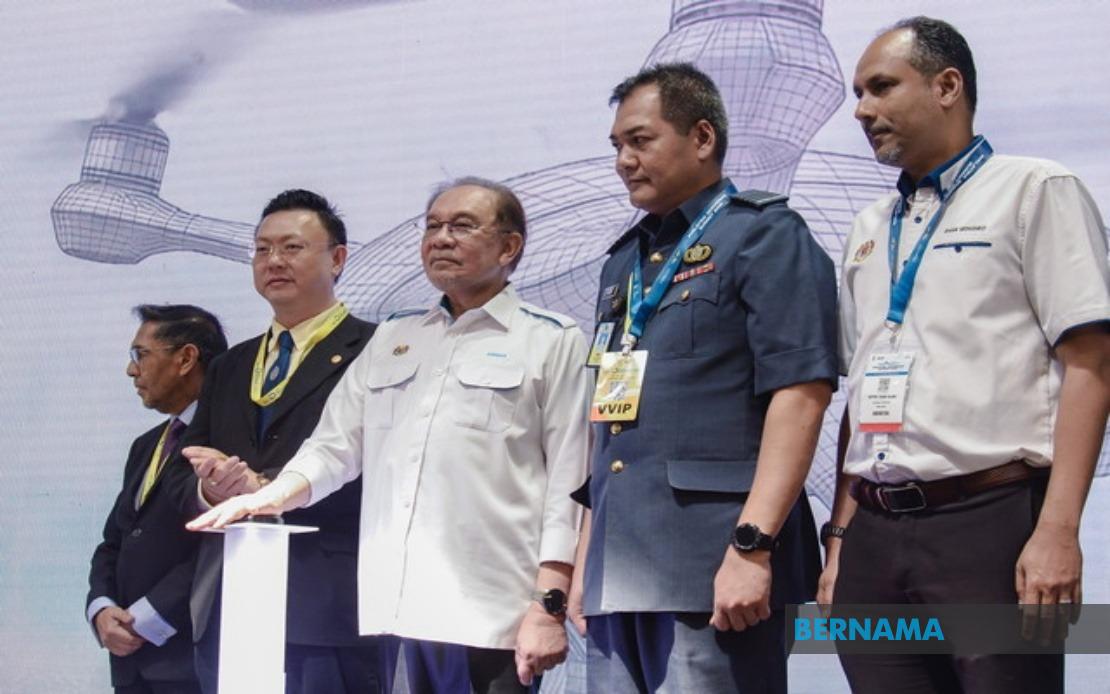
Prime Minister Datuk Seri Anwar Ibrahim has underscored the strategic importance of accelerating Malaysia's development in unmanned aerial vehicle (UAV) technology, positioning drone innovation as essential to strengthening the country's economic standing on the world stage. Speaking at the MyDrone Expo 2026 closing ceremony in Sepang, Anwar outlined a clear vision for harnessing the drone industry as a catalyst for productivity gains and sustained economic expansion, particularly as Malaysia seeks to maintain competitive advantage in an increasingly technology-driven global marketplace.
The Prime Minister identified drones as a convergence point where multiple technological frontiers intersect, notably artificial intelligence and broader digital transformation initiatives. This positioning reflects growing international recognition that UAV technology extends far beyond traditional military and aerospace applications. The interconnection between drone systems, AI capabilities, and digital infrastructure creates opportunities for synergistic development across multiple sectors, from agricultural productivity improvements to logistics optimisation and urban planning solutions. For Malaysia, this technological nexus represents both an innovation opportunity and a potential economic multiplier effect if the country can establish itself as a regional hub for UAV development and expertise.
The scale of opportunity underscores the urgency of Anwar's call for acceleration. Global projections indicate the worldwide UAV market will surpass USD55 billion by 2030, representing a compound annual growth trajectory that reflects shifting economic fundamentals across industrial and service sectors. Beyond raw market size, the low-altitude economy—the emerging ecosystem of drone-based services and operations—is increasingly becoming a magnet for venture capital, research investment, and talent concentration. Countries positioning themselves early in this transition stand to capture both the manufacturing value chains and the high-margin service provision opportunities that will characterise the sector's maturation.
The recent MyDrone Expo 2026 itself demonstrated tangible momentum within Malaysia's nascent drone ecosystem. The three-day event exceeded organisers' expectations by assembling more than 100 exhibition booths and drawing participants and industry representatives from 46 countries. This geographic diversity—spanning multiple continents—indicates that Malaysia's drone initiative is gaining international visibility and attracting genuine commercial and technical interest from established players and emerging competitors alike. The scale of attendance suggests growing confidence that Malaysia represents a viable market and development hub rather than merely a peripheral participant in global UAV advancement.
To capitalise on these emergent opportunities, the Prime Minister has directed comprehensive government mobilisation across multiple institutions. Cabinet ministers, policymakers, scientific research bodies, and regulatory agencies have received explicit instructions to provide full support to the drone industry ecosystem. This directive moves beyond rhetorical endorsement to concrete institutional commitment, signalling that drone development will receive prioritised resource allocation and streamlined administrative processes. Such whole-of-government alignment proves critical for emerging technology sectors, where regulatory uncertainty and fragmented policy frameworks often impede investment and business expansion.
Anwar articulated a deliberately inclusive vision of drone applications, extending support beyond traditional defence and aerospace sectors to encompass civil and commercial use cases. Agricultural applications represent a particularly promising near-term opportunity for Malaysia, where plantation productivity enhancement through precision agriculture and automated monitoring systems could deliver immediate economic benefits to a significant employer sector. The explicit identification of plantations as a priority application area suggests that government strategy aims to create visible success stories within established industries before expanding into more speculative technological frontiers. Such phased implementation approach reduces perceived risk for traditional industries considering technology adoption while building domestic technical capacity.
The government's commitment encompasses strengthening the foundational infrastructure essential for industry growth. Regulatory framework improvements will provide clarity and reduce compliance friction for businesses operating in the sector. Enhanced research funding will support innovation pipelines and technological advancement, particularly in addressing localised challenges or developing Malaysia-specific applications. Testing and certification systems will establish quality and safety standards that protect consumer interests while facilitating market confidence in Malaysian-developed UAV systems and services. Collectively, these infrastructure components constitute the institutional scaffolding upon which sustainable industry development depends.
Critical to long-term competitive advantage is the development of a robust talent pipeline spanning technical expertise, business acumen, and regulatory understanding. Anwar explicitly called for closer collaboration between private sector entities, government research institutions, and universities to build educational and training pathways comparable to those established in emerging fields like artificial intelligence and quantum computing. This institutional integration proves particularly important in technology sectors where academic research often precedes commercial application, and where bridging that gap requires sustained institutional partnership. Malaysia's existing infrastructure in AI and quantum computing education provides a proven model for scaling drone sector talent development across universities and research centres.
The private sector's role in this ecosystem transformation extends beyond simply adopting government-supported technologies. Industry players must actively contribute to ecosystem design, identifying skills gaps, supporting educational programme development, and creating graduate employment pathways that retain domestic talent within Malaysian institutions. The three-day expo itself served as a convening mechanism bringing together these diverse stakeholders, yet sustained momentum requires ongoing institutional structures that maintain collaboration between government, academia, and commercial interests beyond one-off events.
For broader Southeast Asian context, Malaysia's drone sector development holds regional significance. Success in establishing Malaysia as a UAV technology hub could attract regional investment, create gravitational pull for talent migration, and position the country as a node within broader Asian supply chains for drone manufacturing and services. Conversely, delays in policy implementation or regulatory obstacles could cede opportunities to more agile regional competitors, particularly Singapore, Thailand, or Vietnam, which are similarly investing in drone sector development. The competitive dynamics within the region thus amplify the urgency of Anwar's acceleration directive.
The convergence of government commitment, demonstrated market interest, and international engagement creates a potentially decisive moment for Malaysia's drone sector. Whether this moment catalyses sustained institutional support and investment, or represents a temporary apex of policy enthusiasm, will depend on consistent implementation of the regulatory, research, and educational initiatives Anwar has outlined. The coming months will prove crucial in translating political commitment into operational reality across government agencies, research institutions, and private sector participants.

