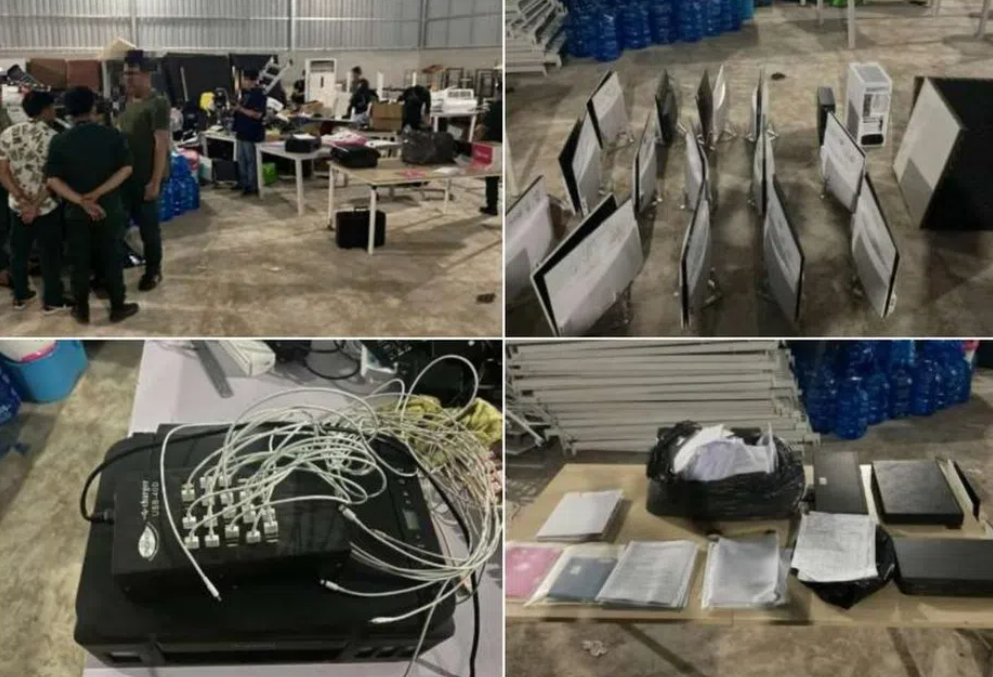
A Malaysian man's brief and unsuccessful foray into international organised crime has landed him in jail. Yip Chee Ming, 30, was sentenced on Friday to 16 months and two weeks' imprisonment after pleading guilty to membership in an organised crime syndicate based in Cambodia. His case reveals both the scale of cross-border scam operations in Southeast Asia and the sometimes-farcical reality of low-level criminal recruitment, where even criminals can find themselves surplus to requirements.
Yip's involvement with the scam operation was remarkably short-lived. Introduced to the scheme by a friend known only as Jason in October 2024, he agreed to travel to Phnom Penh to work as a scam caller. The syndicate leadership, including identified kingpin Tang Soon Wah, even flew both men to Cambodia to view the operation's headquarters—a five-storey compound with security guards posted outside. What appeared to be a professional criminal enterprise turned out to have limited patience for underperformers. Starting work on November 22, 2024, Yip was tasked with impersonating a bank officer to defraud Singaporean victims. He was offered compensation of US$1,800 monthly in cryptocurrency plus one per cent commission on successful victims. Despite receiving scripts and training, Yip could not convince a single person to fall for the scheme. By November 23, 2024—after just two days—he was fired.
The syndicate Yip briefly joined was part of a sophisticated criminal infrastructure spanning multiple countries. Operating from Phnom Penh between September 2024 and September 2025, the group orchestrated at least 528 reported scam cases targeting Singaporeans, resulting in losses totalling approximately S$52.5 million. This scale of operation underscores how Cambodia has become a regional hub for organised fraud, with international criminal networks exploiting the country's infrastructure and relative lack of regulatory oversight to conduct transnational crimes.
The structural hierarchy of the syndicate demonstrates the industrialised nature of modern scam operations. Leadership handled strategic direction and commission payments, supervisors managed daily operations, and trainers provided scripts and coaching on technique—including instruction on adopting convincing Singaporean accents to build credibility with victims. A separate division handled money laundering, converting scam proceeds into cryptocurrency to obscure the money trail. Court documents indicated at least 78 suspected members operated within this ecosystem, with individuals recruited from multiple countries including Malaysia, Singapore, and the Philippines.
Yip's arrest came as part of a broader regional crackdown. In September 2025, Singaporean and Cambodian authorities jointly targeted the syndicate, with Yip apprehended on September 9. He became one of twelve individuals charged as alleged members, joining nine Singaporean nationals and two other foreign nationals—Malaysian Muhamad Asyraf Anuar and Filipino Rizalyn Panganiban. The ages of the accused range from 25 to 39, suggesting recruitment spans relatively broad demographic categories. The coordinated operation highlights growing collaboration between Southeast Asian law enforcement agencies in combating organised crime, particularly scams that increasingly transcend borders and exploit vulnerabilities across multiple jurisdictions.
The crime type Yip participated in—government official impersonation scams—has become an escalating problem across the region. Despite an overall decline in scam cases in Singapore during 2025, government impersonation schemes more than doubled compared to 2024, surging from 1,504 recorded cases to 3,363. This represented the fifth most prevalent scam category, indicating the tactic's effectiveness and resilience despite public awareness campaigns. The sharp increase suggests criminals have refined their approach, possibly improving scripts, targeting techniques, or exploiting increased fear among citizens regarding government authority.
For Malaysian readers, the case carries particular significance. The involvement of Malaysian nationals in major transnational scam syndicates—whether as perpetrators like Tang Soon Wah's associates or victims of recruitment—indicates that sophisticated criminal networks actively recruit across the region. Malaysians represent a convenient source of manpower for Cambodian operations due to geographic proximity, shared visa accessibility, and established migration patterns. The relatively light outcome for Yip—compared to the potential five-year sentence for organised crime membership—may also reflect his marginal role and swift removal from the operation before causing financial harm.
Yip's failure to defraud anyone, while personally fortunate for his victims, raises uncomfortable questions about the prevalence of more competent operatives within such syndicates. The fact that at least 528 scams succeeded suggests many others proved far more effective at social engineering. The scripts provided and training on accent and tone indicate these operations deploy psychological manipulation techniques refined through repeated practice. Understanding why Yip failed where others succeeded could provide law enforcement insights into vulnerabilities in scammer methodology that might be exploited to disrupt these operations.
The Malaysian criminal justice system's handling of transnational organised crime participation remains an evolving area. While Yip was prosecuted in Singapore where most victims resided, Malaysia and other Southeast Asian nations increasingly grapple with how to address citizens recruited into international crime syndicates. The sentence reflects that even minimal participation in organised crime networks carries substantial penalties, a message particularly relevant given evidence of ongoing recruitment drives targeting working-age men in Malaysia and the region with promises of quick cash.
Broader patterns suggest the Phnom Penh-based operation represents only one node in an extensive regional network. Multiple syndicates operate across Cambodia, some with estimated hundreds of members. Law enforcement agencies across Southeast Asia have noted that as one operation is dismantled, others simply relocate or expand, suggesting the underlying economic drivers—poverty, unemployment, and demand for scammers' services—remain unaddressed. The scale of losses (S$52.5 million from 528 cases) indicates substantial economic impact, particularly on Singapore but with ripple effects across the region as money flows out of legitimate economies.
The implications for Southeast Asian cybersecurity and financial systems remain concerning. As scammers professionalise their operations and coordinate across borders, financial institutions and authorities must continually adapt detection and prevention strategies. The involvement of cryptocurrency in money laundering, as evident in this case, highlights how digital currencies complicate law enforcement's ability to trace and recover stolen funds. For regional policymakers, Yip's case serves as a reminder that transnational organised crime requires coordinated, sustained responses combining law enforcement action, financial system oversight, and public education about increasingly sophisticated fraud schemes.

