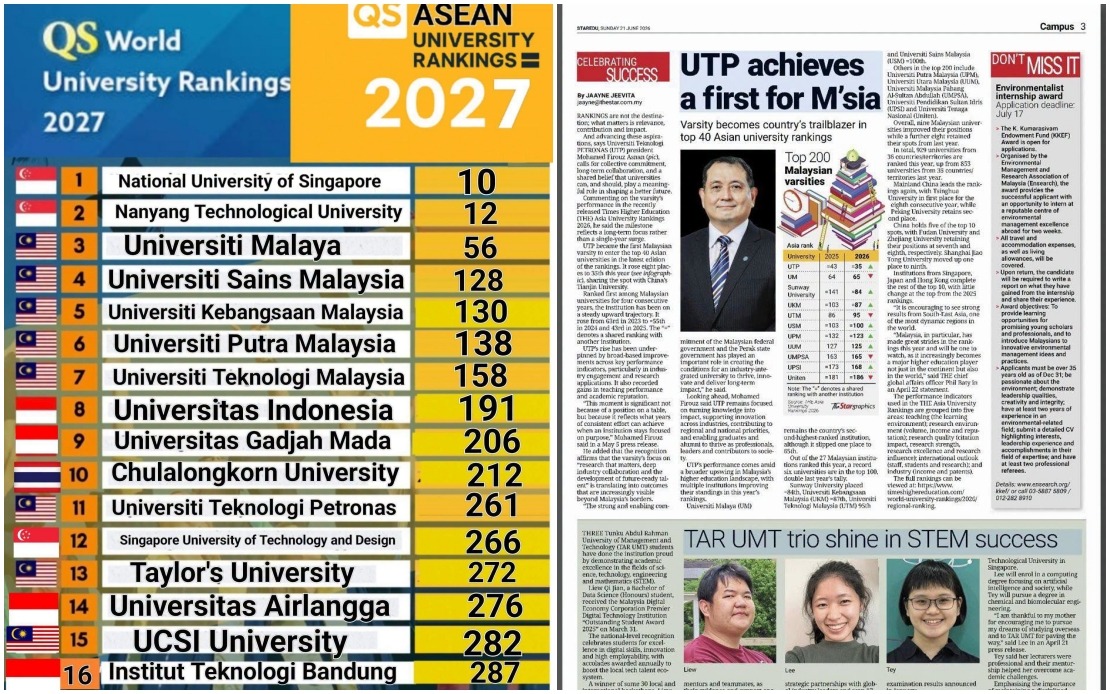
Malaysia's higher education sector is increasingly making its mark on the global stage, with domestic universities demonstrating substantial progress in prestigious international rankings that signal the nation's competitive positioning within the Asian education landscape. Higher Education Minister Datuk Seri Dr Zambry Abd Kadir has highlighted these achievements as validation of the country's capacity to establish itself as a destination of choice for students and scholars seeking quality education backed by rigorous research standards and innovative pedagogical approaches.
The standout success story centres on Universiti Teknologi Petronas, which has become the first Malaysian institution to penetrate Asia's top 40 universities according to the Times Higher Education Asia University Rankings 2026. The institution climbed eight positions from its 43rd ranking last year to reach 35th place, a trajectory that underscores the effectiveness of focused strategic investments in academic excellence and specialised research programmes. This breakthrough carries symbolic weight, as it demonstrates that Malaysian universities can compete directly with established regional powerhouses and international competitors.
Beyond individual institutional achievements, the broader ecosystem presents an encouraging picture of systemic improvement. The latest rankings reveal that 27 Malaysian universities secured positions across the Asia-wide assessment, reflecting deep institutional engagement with quality assurance and continuous institutional development. More significantly, six domestic universities now rank among Asia's elite 100 institutions, while 11 Malaysian universities occupy positions within the top 200 regionally—metrics that collectively suggest Malaysia is building a robust tier of competitive higher education providers rather than relying on isolated flagship institutions.
Zambry emphasised that while university rankings themselves should not be treated as the singular objective of higher education systems, they remain meaningful barometers of institutional quality, international reputation, and comparative competitiveness in an increasingly globalised education market. Rankings serve multiple stakeholder purposes: they provide prospective students with transparent quality signals, they attract research collaborations and talent from abroad, and they enhance institutions' capacity to secure funding and forge industry partnerships. For Malaysia specifically, improved rankings translate into tangible economic and soft-power benefits by positioning the nation as a credible alternative to established Western and Commonwealth education destinations.
The minister attributed these accomplishments to the sustained dedication of multiple constituencies within Malaysia's higher education ecosystem. Lecturers and academic staff have championed research productivity and innovative teaching methodologies; researchers have pursued intellectually rigorous investigations aligned with both fundamental knowledge expansion and practical application; students have elevated their engagement and achievement levels; alumni networks have strengthened institutional reputations through professional accomplishment; support staff have enabled operational excellence; and industrial partners have created pathways for translating academic research into economically valuable innovation. This collective mobilisation represents a cultural shift toward treating university excellence as a shared societal responsibility rather than an isolated institutional concern.
The roster of institutions receiving ministerial acknowledgement encompasses both Malaysia's traditional research-intensive universities and emerging specialised institutions. Universiti Malaya, as the nation's oldest and most research-prolific institution, continues to anchor Malaysia's academic standing. Sunway University exemplifies the capacity of private-sector higher education to achieve international-calibre performance. The network of public research universities—including Universiti Kebangsaan Malaysia, Universiti Teknologi Malaysia, Universiti Sains Malaysia, and Universiti Putra Malaysia—maintain their positions as knowledge generators across multiple disciplines. Newer institutions like Universiti Malaysia Pahang Al-Sultan Abdullah and Universiti Tenaga Nasional indicate that quality leadership extends beyond established establishments into younger, more specialised providers.
For Malaysia's regional standing, these rankings achievements acquire additional significance in the context of intensifying regional competition for educational market share and research talent. Southeast Asian nations are increasingly competing to attract international student enrolments and to position their institutions as hubs for regional research collaboration. Improved Malaysian rankings enhance the nation's capacity to attract doctoral candidates from across Asia, to participate in prestigious international research consortia, and to position itself as a credible bridge between global knowledge centres and the Southeast Asian region. This positions Malaysia advantageously against competitors such as Singapore, Vietnam, and Thailand who are similarly pursuing educational excellence strategies.
Zambry's public commendation of institutional achievements serves a dual function: it recognises genuine progress while signalling continued government commitment to higher education investment and policy support. In the Malaysian context, such ministerial statements carry weight in shaping public perception of the sector and in reinforcing societal valuation of academic pursuits. By framing rankings improvements as validation of national capacity rather than as isolated institutional victories, the minister constructs a narrative in which educational excellence becomes a shared national asset contributing to Malaysia's broader development objectives.
The trajectory toward enhanced international positioning creates opportunities for Malaysian universities to participate more substantially in global knowledge networks, to attract higher-calibre international academic staff, and to engage in cross-border research partnerships that elevate the sophistication of domestically conducted research. Institutions climbing international rankings typically experience enhanced recruitment of talented researchers from abroad, increased collaborative research output, and improved capacity to secure competitive international research funding. For Malaysia, such dynamics could translate into accelerated knowledge economy development and stronger technological capability across sectors from biotechnology to engineering and environmental science.
Looking forward, sustained advancement in international rankings will require continued institutional investment in research infrastructure, competitive remuneration packages for academic talent, support for postgraduate research programmes, and cultivation of research collaboration networks that extend beyond Malaysia's borders. The achievements recorded in the current ranking cycle represent progress, but consolidating and extending these gains demands persistent commitment from both institutional leadership and government support structures. The minister's statement can be interpreted as an implicit commitment to maintaining such supportive conditions.
The significance of Malaysia's improved standing extends beyond prestige considerations to encompass practical implications for students, researchers, and the nation's knowledge economy. International rankings influence student decision-making, particularly among international applicants evaluating competing destinations. Enhanced Malaysian rankings increase the pool of qualified global applicants, allowing universities to become more selective and to assemble more diverse student cohorts. This diversity enriches educational experiences through cross-cultural intellectual exchange and strengthens the networks that international graduates carry into their subsequent careers—networks that can generate long-term benefits for Malaysia through returning talent and international professional connections.

