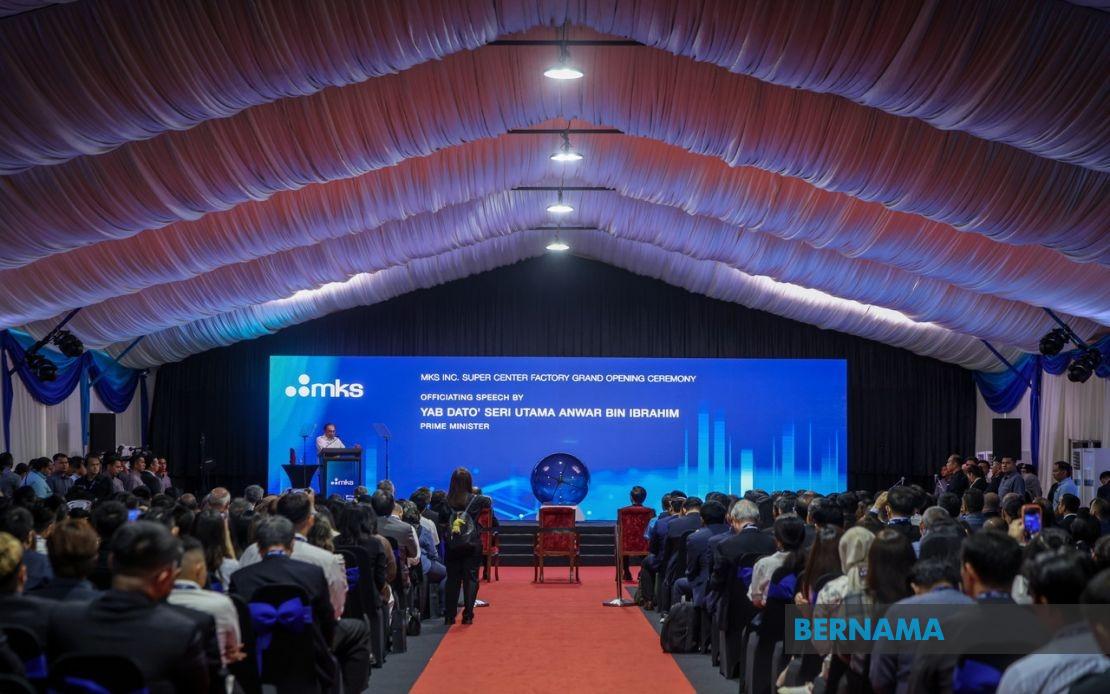
Prime Minister Datuk Seri Anwar Ibrahim has defended Malaysia's approach to international relations as a strategic asset that translates directly into economic gains, citing the nation's ability to maintain productive partnerships with countries on opposing sides of global power struggles. Speaking at the opening of the MKS Super Centre factory in Bandar Cassia Technology Park in Batu Kawan on June 20, Anwar framed Malaysia's independent and neutral foreign policy not merely as a diplomatic principle but as a competitive advantage in attracting investment and fostering business cooperation across diverse markets.
The Prime Minister elaborated on Malaysia's track record of engaging major powers without compromising its sovereignty or alignment. He highlighted recent interactions with the United States, noting that President Donald Trump's visit to Malaysia last year represented a significant diplomatic moment. He also referenced ongoing engagement with China, India, and more recently Russia, suggesting that Malaysia's willingness to work with all these nations simultaneously demonstrates the country's central position in global affairs. This multipolar engagement strategy, Anwar suggested, has tangible consequences for Malaysian enterprises seeking to expand internationally.
Anwar pointed to Petronas, the national oil and gas company, as a concrete example of how balanced diplomacy translates into commercial success. The state-owned energy giant has recently secured agreements in Turkmenistan, a development that reflects Malaysia's ability to operate effectively in markets where diplomatic access might otherwise be limited by geopolitical tensions. By maintaining friendly relations with both Western powers and non-aligned nations, Malaysia creates space for its companies to pursue opportunities that competitors from more ideologically aligned countries might struggle to access.
The Prime Minister's remarks come at a time when Southeast Asia faces increasing pressure to choose sides in the US-China rivalry and other geopolitical divides. Malaysia, under Anwar's leadership, has deliberately resisted such binary thinking, instead positioning itself as a pragmatic player willing to work with any nation that offers mutual benefit. This approach distinguishes Malaysia from some neighbours who have either moved closer to Washington's sphere or Beijing's, and Anwar's emphasis on the economic payoff from this stance suggests the government views neutrality not as a passive or fence-sitting position but as an active foreign policy choice with measurable returns.
The philosophy underlying Anwar's remarks reflects a broader Southeast Asian tradition of non-alignment that dates back to the region's post-independence era. However, the current geopolitical environment makes such balancing acts more difficult and more valuable simultaneously. China's economic and military rise, the United States' efforts to reassert regional influence, and the emergence of regional powers like India create complex terrain in which small and medium-sized economies must navigate carefully. Malaysia's insistence on maintaining its independence—and Anwar's public articulation of this principle—sends a signal to international investors that the country will not become a proxy in great power competition.
Anwar also emphasised Malaysia's willingness to take positions on contentious international issues while remaining open to engagement with all parties. This nuance is important: the Prime Minister is not suggesting that Malaysia adopts a stance of amoral relativism or refuses to speak on matters of principle. Rather, he is arguing that Malaysia can express its values and perspectives on global affairs without allowing disagreement to foreclose economic or diplomatic relationships. This flexibility in maintaining relationships despite policy differences is particularly valuable for multinational corporations and investors seeking stable, reliable environments in which to operate.
The timing of Anwar's comments at the MKS factory opening is deliberate, underscoring the connection between foreign policy and domestic economic activity. MKS, with its manufacturing presence in the Technology Park, exemplifies the kind of regional and international business activity that benefits from Malaysia's stable and accessible political environment. By highlighting this connection publicly, Anwar reinforces the government's commitment to creating investor confidence through both sound macroeconomic management and strategic positioning in global affairs.
For Malaysian businesses and investors, Anwar's reiteration of the neutrality principle offers reassurance that the government will not suddenly shift alignment in ways that might disrupt commercial relationships or market access. The consistency of this message—repeated across multiple platforms and occasions—builds predictability into Malaysia's foreign policy environment. Investors evaluating Malaysia against regional competitors will note that the country's commitment to non-alignment reduces the risk of sudden policy reversals driven by geopolitical realignment.
The presence of Penang Chief Minister Chow Kon Yeow and Deputy Minister of Investment, Trade and Industry Sim Tze Tzin at the event reflected the state and federal government alignment on economic development priorities. Penang, as one of Malaysia's primary manufacturing and technology hubs, has particular interest in policies that keep the state attractive to foreign direct investment. The combination of sound infrastructure, skilled labour, and predictable governance supported by a balanced international relations posture makes states like Penang competitive in attracting high-value manufacturing and technology operations.
Anwar's framing of neutrality as economically productive challenges the Western narrative that countries must choose alignment over independence. For other Southeast Asian nations navigating similar pressures, Malaysia's experience offers a potential alternative model, though the success of such an approach depends on consistent implementation and the absence of acute crises that force choosing sides. By articulating this vision publicly and by pointing to concrete economic outcomes, Anwar is making the intellectual and practical case that independence and engagement are complementary rather than contradictory principles.

