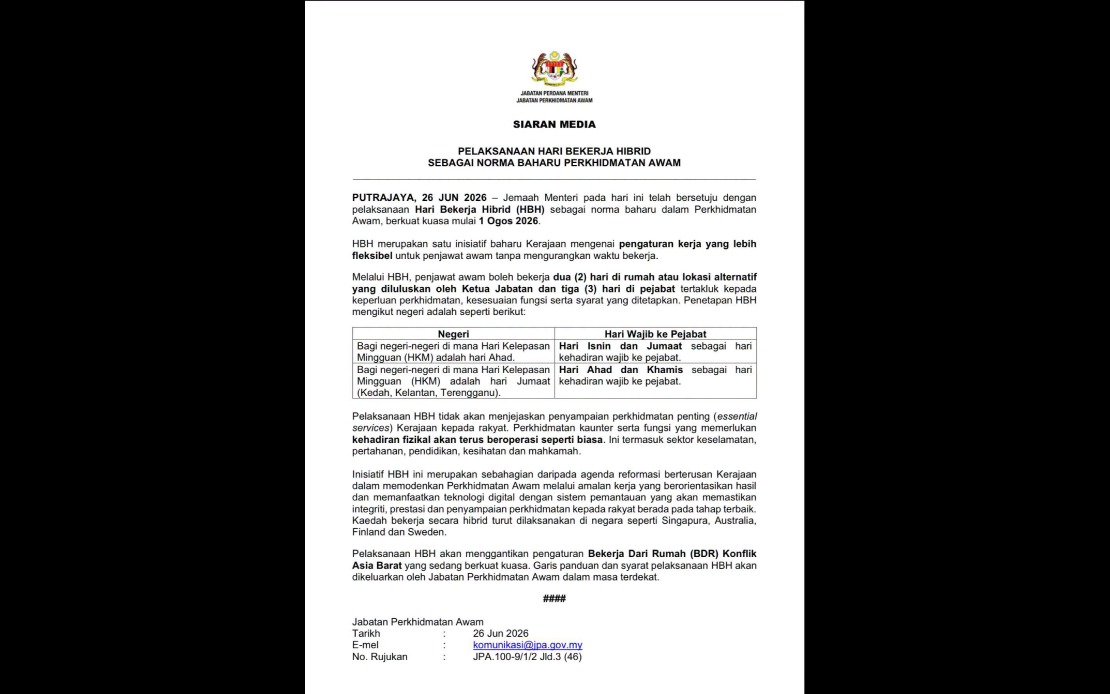
Malaysia's Cabinet has formally endorsed a hybrid work day arrangement that will fundamentally reshape how the nation's civil service operates, with the new structure taking effect from August 1. The Public Service Department (PSD) confirmed the decision, marking a significant departure from the previous work-from-home protocols that have governed public sector employment practices since the onset of the pandemic. This initiative represents one of the most substantial shifts in Malaysian public service working arrangements in recent years, reflecting a deliberate attempt to balance workforce flexibility with operational efficiency across government departments and agencies.
Under the new hybrid framework, civil servants will divide their weekly schedules between remote and office-based work, with two designated days permissible for working from home or alternative locations approved by their departmental leadership, while maintaining a mandatory three-day physical presence at their offices. The arrangement remains contingent upon several qualifying factors, including the nature of service delivery requirements, the functional suitability of individual roles, and compliance with departmental protocols established by each ministry and agency. This layered approach acknowledges that not all government positions can accommodate remote work equally, requiring department heads to assess which staff members and functions are compatible with flexible arrangements.
The PSD has explicitly stated that the hybrid work day scheme will supersede the existing work-from-home arrangement, consolidating various dispersed remote work policies into a single, standardized government-wide framework. This consolidation aims to create consistency across the public sector while introducing what the department characterizes as greater organisational flexibility without diminishing the total hours that civil servants contribute to their roles. The emphasis on preserved working hours suggests the government views this initiative not as a reduction in labour input but rather as a reconfiguration of where and how that labour is deployed throughout the week.
Critical to the implementation strategy is the PSD's assurance that essential public services will remain unaffected by the transition to hybrid arrangements. Counter services, security operations, defence functions, educational institutions, healthcare facilities, and judicial systems will continue standard operations without disruption, with staff in these sectors maintaining their current work patterns as necessitated by public demand and operational necessity. This carve-out recognizes that sectors directly serving the public cannot easily adopt remote work models and require consistent on-site presence to fulfill their constitutional and legal obligations to citizens.
The government has implemented specific attendance requirements based on states' established weekly rest day schedules, reflecting Malaysia's diverse religious and cultural calendars. In states observing Sunday as the weekly rest day—the majority of Malaysian states—Monday and Friday have been designated as compulsory office attendance days, effectively bracketing the working week. Conversely, in Kedah, Kelantan, and Terengganu, where Friday functions as the weekly holiday, Sunday and Thursday have been mandated as office attendance days. This geographic differentiation demonstrates careful consideration of existing state-level practices and demonstrates the government's commitment to harmonizing the national policy with established regional arrangements.
The PSD has positioned the hybrid work initiative as integral to a broader modernization agenda for Malaysia's public sector, emphasizing the transition toward results-based management systems and accelerated digital technology adoption. Rather than measuring productivity through physical office presence, the framework implicitly endorses outcomes-focused assessment methodologies and digital collaboration tools that enable effective work regardless of physical location. This philosophical shift aligns with global management trends and suggests the government views the public service as requiring contemporary approaches to remain competitive and efficient in an increasingly digital operational environment.
To safeguard implementation integrity, the PSD has committed to establishing monitoring mechanisms designed to ensure that performance standards, service delivery quality, and organizational integrity are maintained throughout the transition. These oversight systems will presumably track attendance patterns, work output metrics, and customer satisfaction indicators across departments, providing data-driven feedback on whether the hybrid arrangement is achieving its intended objectives without degrading public service quality. The willingness to implement formal monitoring reflects the government's recognition that significant organizational changes require structured evaluation frameworks.
International precedent provides additional legitimacy to Malaysia's approach. The PSD's statement explicitly references hybrid work adoption in Singapore, Australia, Finland, and Sweden—jurisdictions spanning different geographic regions, governance systems, and economic development levels. This international framing suggests that Malaysia is not pioneering this arrangement but rather joining established global practice, reducing perceived risk and aligning the nation with recognized best practices among developed and regionally significant economies. The reference to Finland and Sweden, particularly, invokes Nordic governance models that Malaysian policymakers frequently cite as exemplars of efficient public administration.
For Malaysia's workforce and broader economy, the hybrid work day policy carries several implications. The arrangement potentially enhances quality of life for civil servants by reducing daily commuting requirements and offering schedule flexibility, which may improve retention rates and employee satisfaction. However, it also creates potential coordination challenges for departments managing mixed remote and office-based teams, requiring enhanced digital infrastructure and communication protocols. Private sector observers may view this government initiative as validating hybrid models more broadly, potentially accelerating similar arrangements across Malaysia's corporate landscape.
The transition timeline provides government departments with approximately five weeks to prepare operational adjustments, reconfigure digital infrastructure, and communicate new expectations to affected staff members. This compressed implementation window suggests the government prioritized rapid policy activation over extended preparatory phases, potentially generating initial operational friction as departments adapt established procedures. The PSD has promised detailed implementation guidelines in the coming weeks, which will clarify specific protocols, technology requirements, and departmental responsibilities in greater specificity than the initial policy announcement provides.
Looking forward, the success of Malaysia's hybrid work day arrangement will likely influence broader public service reform discussions and potentially serve as a model for other government initiatives. The policy's effectiveness in maintaining service standards while providing workforce flexibility will receive close scrutiny from civil society observers, government efficiency advocates, and international governance analysts. How Malaysian departments navigate the practical challenges of hybrid coordination—including cybersecurity, file management, and team cohesion—may establish important precedents for future public sector modernization efforts throughout Southeast Asia.

