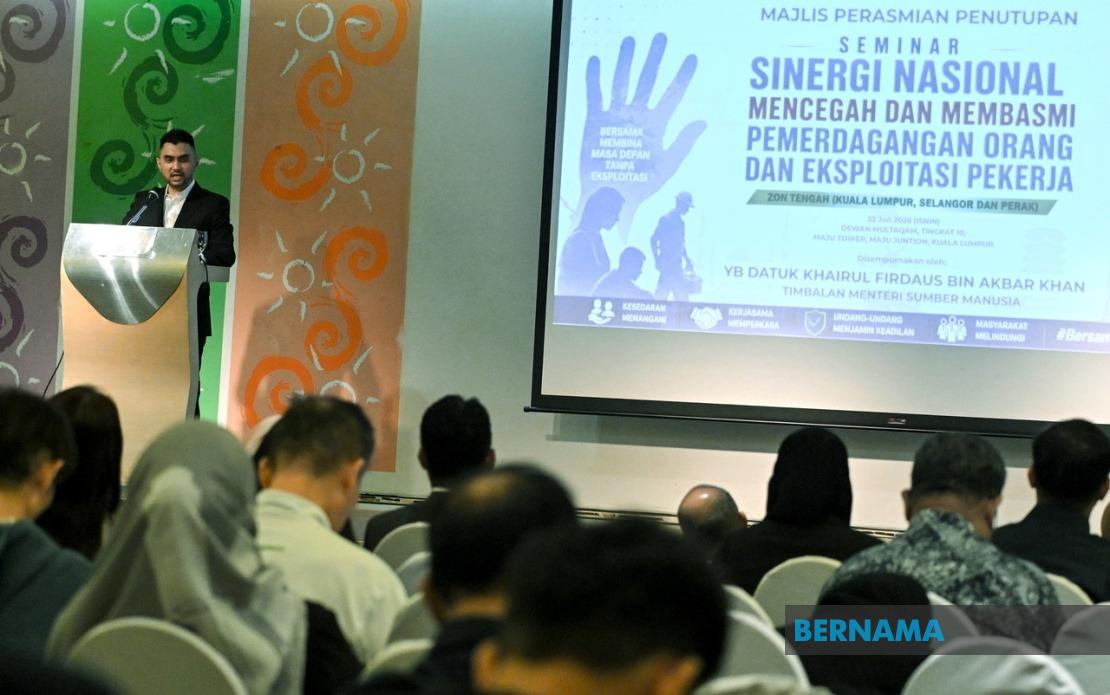
The number of people rescued from human trafficking and labour exploitation in Malaysia has declined markedly over the past three years, according to data presented by Deputy Human Resources Minister Datuk Khairul Firdaus Akbar Khan. Figures from the Peninsular Malaysia Manpower Department reveal that rescue operations pulled 70 victims from exploitation in 2023, a number that fell to 10 the following year. The trend has continued into 2025 and beyond, with authorities identifying 17 victims in that year and only four through May 2026, painting a picture of improving conditions in the nation's fight against trafficking networks.
The government credits this downward trajectory to intensified enforcement activities and prevention initiatives rolled out across the country. Speaking at the closure of the National Synergy Seminar on Preventing and Eradicating Human Trafficking and Labour Exploitation in the Central Zone, held in Kuala Lumpur, Khairul Firdaus highlighted the coordinated approach that has yielded these results. From January through May 2026 alone, authorities conducted 386 labour-related enforcement operations nationwide, spawning 311 investigation files that are now being pursued through the justice system.
Yet despite these encouraging numbers, senior government officials remain cautious about declaring victory. Khairul Firdaus acknowledged that the falling statistics may mask a deeper reality—that many cases of trafficking and labour abuse go unreported and therefore invisible to official records. The minister's candid admission that "there may be things that we do not see" reflects the challenge facing enforcement agencies across Southeast Asia, where victims often remain hidden within informal economies, isolated from support networks, and fearful of authorities. This sobering perspective suggests that Malaysia's actual trafficking problem could be significantly larger than the rescue figures suggest.
The government's commitment to tackling forced labour aligns with Malaysia's obligations under protocols ratified through the International Labour Organisation, positioning the country within a global framework addressing modern slavery. This international dimension underscores why Malaysia's efforts matter beyond its borders—the nation serves as both a destination and transit point for trafficking victims from neighbouring countries, particularly migrant workers from Bangladesh, Myanmar, and the Philippines. By strengthening domestic enforcement, Malaysia contributes to disrupting regional trafficking networks that often operate across multiple countries.
The National Synergy Seminar series represents a key pillar of this preventive strategy, functioning as a nationwide consciousness-raising campaign designed by the Peninsular Malaysia Manpower Department. The Central Zone programme was the third iteration of these regional seminars, following earlier events in the North Zone at Sungai Petani, Kedah on May 18 and the South Zone at Kluang, Johor on June 8. These gatherings serve dual purposes: disseminating knowledge about trafficking indicators and exploitation mechanisms to frontline workers, enforcement personnel, and community stakeholders, while simultaneously creating platforms for participants to exchange intelligence and collaborative strategies.
The scale of participation across these seminars demonstrates significant institutional mobilisation around the issue. Nearly 1,000 participants attended the three regional seminars, representing a cross-section of government agencies, NGOs, employers, and civil society representatives. This broad engagement reflects recognition that human trafficking cannot be solved through enforcement alone—prevention requires awareness among businesses, migrant worker communities, and ordinary citizens who might encounter signs of exploitation in their workplaces or neighbourhoods. By creating these spaces for dialogue, the government signals that combating trafficking is a shared responsibility extending far beyond departmental boundaries.
For Malaysia's business community and employers, these developments carry important implications. The enforcement operations and investigation procedures now underway set precedents for labour standards compliance, particularly among sectors reliant on migrant labour such as construction, domestic work, agriculture, and manufacturing. Companies operating in these fields face increasing scrutiny, and the 311 active investigation cases suggest that violations are being pursued systematically. This creates both compliance pressures and opportunities—businesses that implement robust labour practices and worker protections gain competitive advantage and reduced regulatory risk.
The regional context adds another layer of significance to Malaysia's efforts. Neighbouring countries including Thailand, Indonesia, and the Philippines grapple with similar trafficking challenges, often with more limited resources for enforcement and victim support. Malaysia's data-driven approach and systematic seminar series offer a model that other Southeast Asian nations might adapt. The ILO protocols that guide Malaysian policy represent international consensus on best practices, and visible commitment to implementing these standards strengthens Malaysia's standing within regional labour and human rights discussions.
However, the sharp decline in rescued victims raises questions about underlying causes that merit closer examination. Are trafficking networks adapting to enforcement pressure by operating more covertly? Are potential victims becoming more isolated and harder to reach? Or does the decrease genuinely reflect successful prevention? These questions underscore the importance of the government's cautious tone—raw statistics alone cannot capture the complexity of modern trafficking, which increasingly relies on debt bondage, digital exploitation, and psychological coercion rather than physical confinement.
Moving forward, sustained attention to this issue will depend on maintaining the momentum established through these seminars and enforcement operations. The government's commitment to the ILO framework provides long-term institutional direction, but implementation requires consistent funding, trained personnel, and coordination across agencies that sometimes operate with competing priorities. For Malaysian employers and workers, understanding trafficking dynamics and reporting mechanisms becomes increasingly important as enforcement intensifies and awareness campaigns reach wider audiences.

