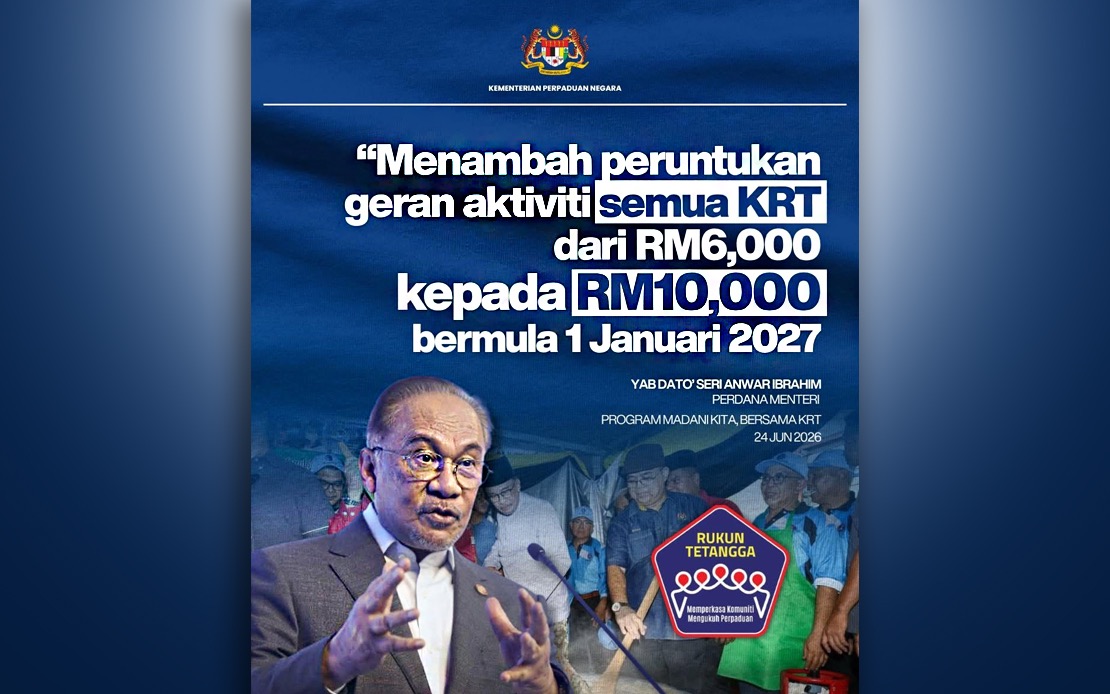
Nearly 8,600 neighbourhood watch organisations across Malaysia stand to significantly enhance their community programmes following the government's decision to raise their annual operational grants by 67 per cent. During the MADANI KITA programme in Dataran Segamat, Johor, Prime Minister Datuk Seri Anwar Ibrahim unveiled the decision to increase the annual KRT grant from RM6,000 to RM10,000, with disbursements commencing on January 1, 2027. The announcement underscores the administration's strengthened commitment to bolstering grassroots institutions that have quietly shaped social cohesion across the nation for more than half a century.
National Unity Minister Datuk Aaron Ago Dagang characterised the funding enhancement as recognition of the KRT's indispensable contribution to Malaysia's social fabric. These neighbourhood watch associations, operating across diverse communities, have served as vital platforms for fostering intercommunal understanding and collaborative problem-solving at the local level. The ministry views the increased allocation as a strategic investment in Malaysia's foundational strength: the bonds of neighbourliness that transcend ethnic, religious and socioeconomic boundaries. By channelling additional resources to these grassroots movements, the government signals its belief that sustainable national unity originates not from top-down directives but from genuine community engagement at neighbourhood level.
The scale of KRT's current reach illustrates why this funding boost carries substantial implications for Malaysian society. Approximately 250,000 members actively participate in KRT activities nationwide, collectively touching the lives of more than 12 million citizens through their initiatives. Over the preceding twelve months alone, these neighbourhood associations orchestrated more than 100,000 community activities, ranging from social welfare programmes to educational initiatives and local security patrols. This extensive network demonstrates that KRT operates as one of Malaysia's largest volunteer-driven systems for grassroots mobilisation, yet has historically operated on modest budgets that constrained their capacity to implement comprehensive programmes.
With the additional RM4,000 per unit annually, KRT associations gain meaningful financial breathing room to expand their core functions. The ministry identifies several priority areas where enhanced funding should translate into tangible community benefits: organising inter-community unity activities, implementing neighbourhood security initiatives, conducting educational programmes, supporting local economic development ventures, expanding welfare assistance, and strengthening volunteerism networks. The increased allocation essentially recognises that effective grassroots organising requires sustainable funding to move beyond ad-hoc initiatives toward structured, long-term community development projects that address local needs comprehensively.
The timing of this announcement within the broader MADANI policy framework is strategically significant. Malaysia's MADANI agenda emphasises prosperity, resilience, inclusivity and social wellbeing as pillars of national development. KRT organisations, as neighbourhood-based platforms bringing together Malaysians regardless of background, embody these principles concretely. By elevating their resource base, the government demonstrates that Malaysia's development strategy prioritises strengthening social infrastructure alongside economic and physical infrastructure. This reflects a mature understanding that national progress depends fundamentally on communities where people genuinely know and trust their neighbours, cooperative problem-solving occurs organically, and collective action happens naturally.
For Southeast Asian observers, Malaysia's investment in grassroots community structures offers an instructive model. Many regional nations struggle with social fragmentation and mistrust in diverse societies. KRT's existence and expansion demonstrate that intentional institutional design supporting neighbourhood-level organising can sustain social cohesion across multicultural contexts. The funding increase validates the long-term value of maintaining such structures even when their contributions appear intangible compared to visible infrastructure projects. This represents a strategic choice to address the region's underlying social vulnerabilities through patient institutional investment.
Minister Aaron emphasised that the funding increase must be deployed with intentionality to maximise public impact. The ministry intends to oversee resource utilisation to ensure that additional allocations translate into programmes directly benefiting residents rather than administrative accumulation. This suggests implementation frameworks and accountability mechanisms will accompany the funding increase, with KRT organisations expected to demonstrate how expanded budgets strengthen their service delivery. Effective oversight will be crucial in establishing this funding level as sustainable and justifying continued increases in future budget cycles.
The announcement also carries implications for local governance structures in Malaysia. Neighbourhood watch groups often function as bridges between formal municipal administration and grassroots communities, identifying local concerns that municipal governments might otherwise miss. Enhanced KRT funding enables these associations to play more sophisticated roles in local problem identification and solution development. This positions KRT not merely as security-focused organisations but as comprehensive community development actors capable of addressing multifaceted local challenges through integrated programming.
For Malaysian citizens, the practical significance rests in strengthened neighbourhood programmes. Communities will likely experience more active community organising around safety, welfare assistance, cultural activities promoting intercommunal understanding, and initiatives addressing local economic opportunities. For lower-income neighbourhoods particularly, KRT's expanded capacity may translate into more accessible educational programmes, more comprehensive welfare networks, and stronger local security arrangements achieved through cooperative community effort rather than depending entirely on state resources.
The government's confidence in KRT's capacity to deploy increased funding reflects broader trends in Malaysian governance toward recognising civil society's irreplaceable role in social development. Unlike commercial entities or government agencies, community organisations possess inherent legitimacy within their neighbourhoods and access to local knowledge that enables contextually appropriate programming. By providing KRT with meaningful resources, the government acknowledges these distinctive advantages while sustaining the volunteer commitment that makes grassroots organising economically feasible at scale.

