The Ministry of Entrepreneur Development and Cooperatives (KUSKOP) has moved to strengthen Melaka's entrepreneurial ecosystem by approving nearly RM100 million in financing for more than 4,300 business owners across the state as of May 31. The funding initiative underscores the ministry's strategic focus on nurturing microenterprises, small and medium enterprises (MSMEs) that form the backbone of Malaysia's distributed economic growth. This injection of capital comes at a time when access to affordable financing remains a critical barrier for many aspiring and established business operators seeking to expand operations or weather economic uncertainties.
Minister Steven Sim framed the financing initiative not merely as capital provision but as a comprehensive economic stimulus mechanism. His emphasis centres on the multiplier effect that capital deployment generates throughout local communities. When entrepreneurs access funds to grow their ventures, the benefits extend beyond the business owner themselves, encompassing wage opportunities for employees, revenue generation for suppliers, and enhanced spending power within surrounding neighbourhoods. This ripple effect transforms individual business success into broader community prosperity, creating the conditions for sustainable localised growth that resilient economies require.
The RM100 million distributed in Melaka forms part of a substantially larger nationwide effort. Throughout the first five months of 2024, KUSKOP approved RM5 billion in financing benefiting nearly 180,000 entrepreneurs across Malaysia. These figures demonstrate consistent implementation of the ministry's capital channelling mandate, suggesting that the institutional mechanisms for delivering funds have achieved operational maturity. The scale of disbursement indicates that the challenge is increasingly one of awareness and accessibility rather than fund availability, prompting consideration of how awareness campaigns might further expand the programme's reach among underserved communities.
Sim's three-day working visit to Melaka, conducted from June 19 to 21, coincided with the Hebatkan Perniagaan Malaysia Carnival (KHPM), a showcase event designed to connect government support mechanisms directly with entrepreneurs and traders. This combination of policy initiative and ground-level engagement reflects contemporary approaches to economic development wherein senior officials spend extended periods observing implementation realities and gathering unfiltered feedback. The carnival setting enabled informal interactions that formal ministerial channels might not facilitate, allowing business operators to articulate challenges and opportunities in conversational contexts.
During the Melaka visit, Sim and Seah Soo Chin, chairman of the Melaka Entrepreneur Development, Cooperatives and Consumer Affairs Committee, conducted walking engagement sessions at Malim Food Town. This commercial cluster, increasingly recognised as a significant commercial node in the southern region, hosted approximately 50 local entrepreneurs at a dedicated meet-and-greet gathering. Such direct interaction serves multiple purposes: it allows businesses to understand available support schemes, enables officials to observe operational challenges firsthand, and generates political goodwill by demonstrating ministerial accessibility to ordinary business operators.
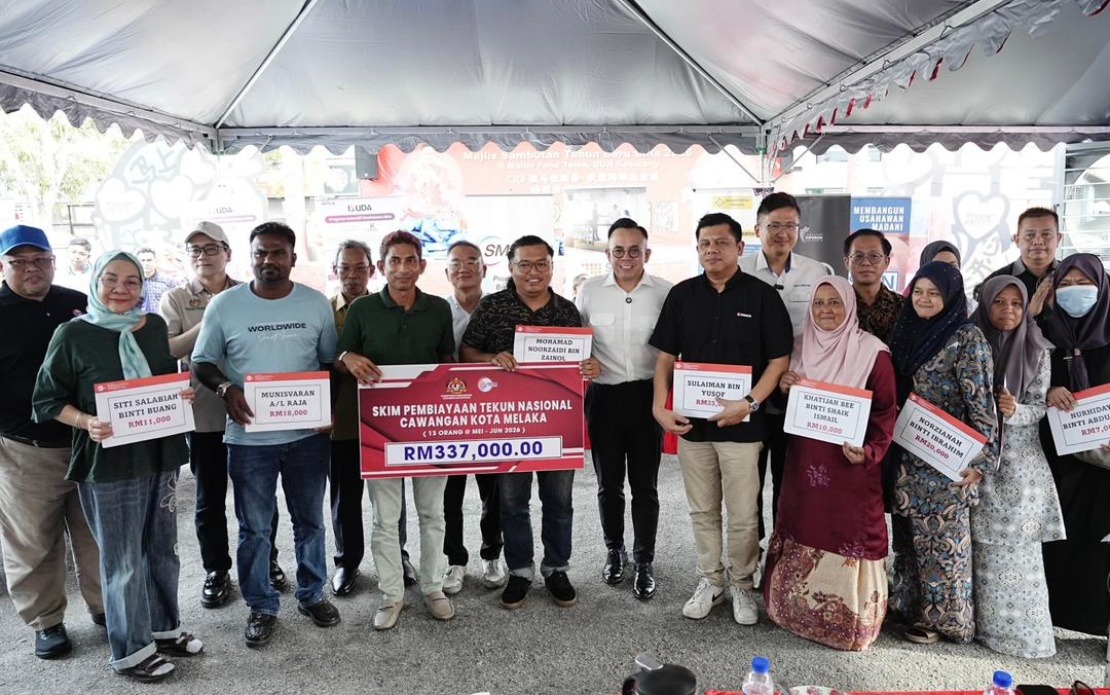
The ministry distributed nearly RM1 million through TEKUN Nasional and SME Corp Malaysia to 18 selected entrepreneurs during the Melaka events. Recipients operated across notably diverse sectors including food and beverages, wholesale distribution, professional services, construction contracting, retail operations, e-commerce ventures, automotive services, and various other commercial activities. This sectoral diversity reflects the inclusive nature of KUSKOP's mandate and suggests that financing mechanisms have achieved sufficient flexibility to support business models ranging from traditional brick-and-mortar operations to digital-first enterprises.
Looking forward, the ministry has established an ambitious target through its PowerUp10K initiative, which aims to channel RM15 billion in financing to MSMEs nationwide during 2024. This escalation from the RM5 billion already distributed in the first five months suggests acceleration in the second half of the year, or alternatively reflects revised estimates accounting for seasonal variation in application patterns. Should the ministry achieve this target, it would represent substantial capital mobilisation supporting business development across all states and federal territories, with implications for employment generation and economic resilience.
Sim's remarks emphasised Malaysia's distinctive competitive advantages in the context of global capital flows and talent migration. The country's diversity in ethnicity, language, and cultural expression creates demonstrable advantages for both attracting foreign direct investment and enabling domestic enterprises to scale across regional boundaries. Investors increasingly recognise that culturally diverse management teams and workforces enhance innovation capacity and facilitate market penetration in heterogeneous consumer bases. Local entrepreneurs operating within Malaysia's multicultural environment develop intuitive understanding of diverse consumer preferences, positioning them favourably for expansion into Southeast Asian markets where demographic patterns mirror Malaysia's own composition.
The financing announcements arrive within a broader context of regional economic competition and domestic policy priorities. Within Southeast Asia, several neighbouring economies have launched comparable MSME support initiatives, making financing accessibility an important factor in the relative attractiveness of different national ecosystems for entrepreneurship. Malaysia's ability to deploy capital at scale while maintaining reasonable approval timelines and flexible criteria contributes to its reputation as a relatively business-friendly destination within the region. For Malaysian entrepreneurs considering expansion into Singapore, Thailand, or Indonesia, the experience of accessing domestic capital with comparative ease may enhance confidence in navigating international market entry.
The emphasis on job creation through entrepreneur support connects KUSKOP's work to broader employment policy objectives. Rather than relying solely on large multinational corporations or foreign direct investment to generate employment, the ministry's strategy harnesses the distributed job-creation capacity inherent in MSME growth. A food entrepreneur opening a second outlet or a manufacturing operator expanding capacity typically hires additional staff from local communities, creating employment pathways for individuals without advanced qualifications or specialised credentials. This bottom-up employment generation complements top-down foreign investment strategies, creating a more resilient labour market.
Looking at implementation patterns, the fact that Melaka has received RM100 million across 4,300 businesses indicates an average disbursement of approximately RM23,255 per entrepreneur. This relatively modest average per-business suggests that financing is reaching genuine microenterprises and informal business operators rather than concentrating capital among larger established firms. Such targeting aligns with poverty reduction objectives and inclusive growth priorities, though it also suggests that individual businesses may require sequential tranches of support to achieve meaningful operational scaling. The ministry's willingness to engage with this granular level of the business ecosystem distinguishes its approach from financing mechanisms that might focus exclusively on businesses with formal structures or established track records.

