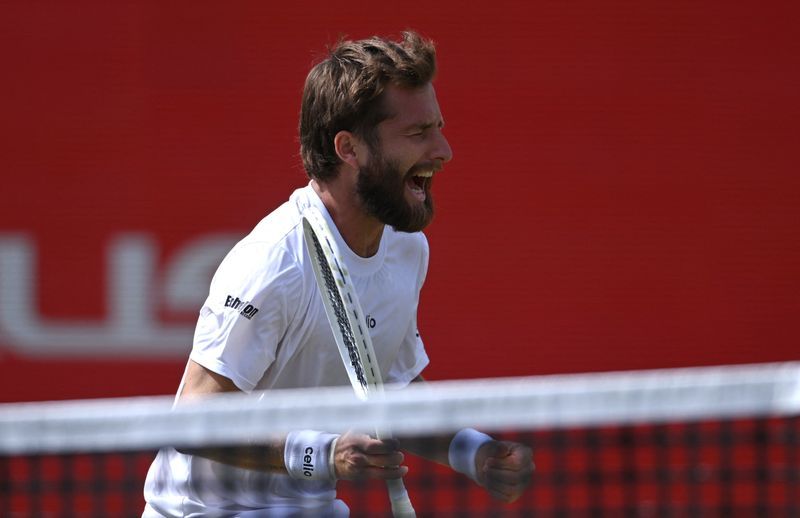
French tennis player Corentin Moutet has lost virtually his entire prize purse from the Queen's Club tournament after incurring a substantial fine for expletive-laden remarks made during an on-court interview with the BBC. The 27-year-old world number 36 was penalised $40,000 by the ATP for unsportsmanlike conduct following his first-round victory over compatriot Giovanni Mpetshi Perricard, a blow that effectively erased his earnings from the prestigious grass-court event held in London.
Moutet's disciplinary trouble emerged immediately after his opening match triumph. During the mandatory post-match television interview conducted courtside by BBC personnel, the French player punctuated his remarks with profanity on seven separate occasions. The exchange proved particularly awkward when the interviewer explicitly requested that Moutet refrain from repeating a specific expletive he had uttered while describing his reaction to being aced at match point by a 142mph second serve from his opponent. Rather than comply with this gentle redirection, Moutet proceeded to use the same offensive language three additional times before the interview was terminated prematurely. Public apologies were subsequently issued to both the spectators present at Queen's and television viewers who had witnessed the exchange.
The financial consequence has proven severe for the player. His earnings for advancing to the second round totalled $43,000, and the $40,000 penalty leaves him with minimal compensation for his participation in the tournament. Given the fine nearly matches his prize money, Moutet effectively earned nothing meaningful from his efforts at Queen's Club, transforming what should have been a profitable week into a costly one. The ATP's statement formalised the punishment as relating to unsportsmanlike conduct, though Moutet has lodged an appeal challenging the decision, suggesting he may contest the severity or validity of the sanction.
Moutet's tenure at the tournament proved brief despite the initial victory. His second-round encounter against Spain's Alejandro Davidovich Fokina resulted in elimination, curtailing any hope of deeper progression that might have offset the financial damage. The swift exit meant his presence at Queen's lasted barely two matches, hardly the runway needed for redemption or further earnings.
Following the incident, Moutet took to Instagram to characterise his conduct as humorous rather than genuinely provocative, claiming he was "just joking" during the exchange. This characterisation rings somewhat hollow given the interviewer's contemporaneous request for restraint and the explicit nature of his subsequent repetitions of the language in question. The dismissal of the episode as mere jest appears unconvincing to observers and does little to mitigate the seriousness with which the ATP has treated the matter.
This latest controversy sits within a troubling pattern of behavioural issues that have shadowed Moutet's career progression. In 2022, the player was defaulted from the Adelaide International for directing profanities at the umpire during a match against Serbia's Laslo Djere, demonstrating that his disciplinary problems extend beyond media interactions into competition itself. The incident revealed a concerning volatility that surfaces under competitive pressure, suggesting systemic issues rather than isolated lapses in judgement.
Moutet's conduct problems have also drawn scrutiny from his national governing body. The French Tennis Federation suspended its support for the player that same year, withdrawing backing due to behavioural concerns that extended beyond a single incident. This institutional sanction from the FFT underscores the breadth of frustration with Moutet's conduct within tennis administration, indicating the problem is not confined to a single tournament or governing body but represents a recurring pattern across multiple competitive and institutional contexts.
For Malaysian and Southeast Asian tennis followers, Moutet's trajectory serves as a cautionary tale about the intersection of talent and temperament in professional sport. Despite possessing sufficient skill to compete at the ATP level and achieve ranking positions within the global top 50, his repeated disciplinary lapses have repeatedly undermined his potential for sustained progress. His behaviour suggests that technical ability alone proves insufficient for long-term career development without corresponding emotional regulation and professional conduct.
The Queen's Club incident also highlights the expectations professional tennis places upon players regarding decorum during high-profile broadcasts. These post-match interviews serve important functions for broadcasters and sponsors, and players are bound by codes of conduct that reflect the sport's institutional standards. Moutet's apparent disregard for these requirements—either through volatility or deliberate provocation—creates complications for tournament organisers and media partners responsible for delivering family-friendly content to global audiences.
The appeal mechanism now available to Moutet represents his pathway to potentially recouping lost earnings, though success appears unlikely given the clear documentary evidence of his conduct captured during live broadcast. Tournament officials typically apply stringent standards when video evidence substantiates alleged misconduct, leaving little room for mitigation or reinterpretation of events that millions of viewers witnessed directly.

