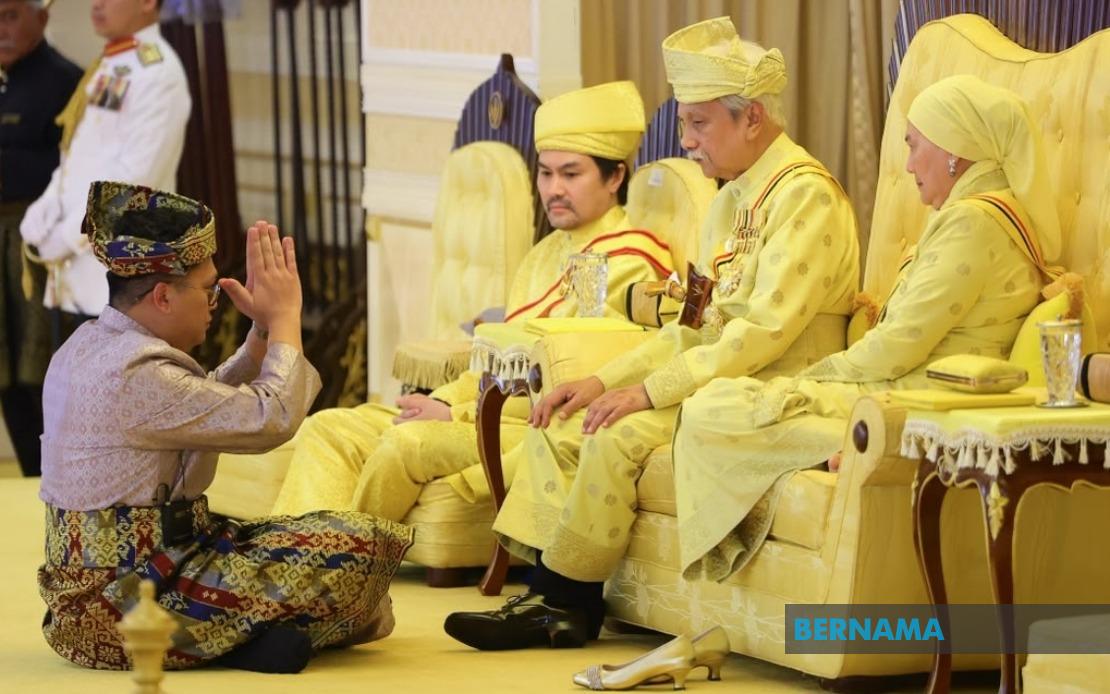
Muhammad Faris Johari has been formally installed as the 11th Undang of Luak Sungei Ujong following a traditional ceremony conducted by the Yang Dipertuan Besar of Negeri Sembilan, Tuanku Muhriz Tuanku Munawir, at Istana Besar Seri Menanti in Kuala Pilah. The installation marks an important transition in the leadership of one of Negeri Sembilan's historic chiefdoms, blending constitutional monarchy with customary governance structures that have defined the state's unique political system for centuries.
The ceremonial proceedings unfolded according to established protocols governing the succession of Undang positions within Negeri Sembilan's feudal hierarchy. The Orang Empat Istana—the four senior palace officials—initiated the formal process by securing the ruler's permission to proceed with the installation rituals. Muhammad Faris subsequently took an oath of allegiance to Tuanku Muhriz, reaffirming the binding obligations between the chieftain and the sovereign that underpin the state's governance framework. Following this pledge, the ruler issued a formal proclamation establishing Muhammad Faris in his new position and bestowing upon him the hereditary title Datuk Klana Petra, a designation carrying historical weight within Negeri Sembilan's aristocratic nomenclature.
During his address at the ceremony, Tuanku Muhriz emphasised the paramount importance of honouring the commitments made during such installations, urging adherence to principles of sincerity, integrity and unwavering responsibility. The Yang Dipertuan Besar's remarks reflected broader concerns about maintaining institutional coherence within Negeri Sembilan's constitutional arrangement, where the ruler's authority intersects with customary leadership to ensure stable governance. His injunction to the chieftains to demonstrate steadfast loyalty to the institution of the Yang Dipertuan Besar and cultivate respectful relations with the Palace underscores the delicate balance necessary to preserve both monarchical prerogatives and traditional authority structures in the state.
The ruler further highlighted the foundational necessity of relationships rooted in mutual respect, trust and consensus for the preservation of constitutional monarchy and the continuity of customary traditions. This emphasis carries particular resonance in Negeri Sembilan, where the Adat Perpatih—a matrilineal customary law system unique to the state—governs succession, property rights and social organisation in ways that distinguish it from other Malaysian states. Tuanku Muhriz's exhortation to the population to collaborate closely with customary leaders while safeguarding and perpetuating Adat Perpatih values represents an attempt to reconcile modern governance requirements with the preservation of indigenous cultural frameworks that remain integral to Negeri Sembilan's identity and social cohesion.
Several senior members of the royal household attended the installation ceremony, lending gravitas and symbolic weight to the proceedings. Present were Tunku Ampuan Besar Tuanku Aishah Rohani Tengku Besar Mahmud, Tunku Besar Seri Menanti Tunku Ali Redhauddin Tuanku Muhriz, and Tunku Panglima Besar Tunku Zain Al-'Abidin. The attendance of Menteri Besar Datuk Seri Aminuddin Harun alongside heads of state government departments reflected the formal recognition accorded to the installation within Negeri Sembilan's administrative structure, bridging the worlds of constitutional executive authority and traditional chieftaincy.
Muhammad Faris, aged 28, brings professional qualifications to his new role, having completed a bachelor's degree in accountancy from Universiti Teknologi MARA and subsequently obtaining professional credentials through the Association of Chartered Certified Accountants programme in 2022. Born on October 30, 1997, he represents a generation of customary leaders increasingly educated within modern professional frameworks, potentially signalling evolving approaches to reconciling traditional authority with contemporary governance expectations. His marriage to Sharifah Amirah Syed Ismail Ash-Shahab further reinforces linkages within Negeri Sembilan's aristocratic networks through alliance patterns historically significant in the state's social structure.
The appointment to the Undang position carries responsibilities extending beyond ceremonial functions, encompassing roles in land administration, conflict resolution and the preservation of customary practices within the Luak Sungei Ujong chiefdom. The Undang traditionally serves as custodian of territorial interests and mediator between individual communities and the state apparatus, representing both upward accountability to the Yang Dipertuan Besar and downward obligations to constituent communities. This dual positioning requires navigating competing pressures arising from modern administrative requirements and preservation of customary autonomy, a tension increasingly evident in Malaysian traditional governance systems.
The installation ceremony itself demonstrates the continued vitality of Negeri Sembilan's unique constitutional arrangements, wherein the position of Yang Dipertuan Besar rotates among the Undangs of the four Luaks according to the Negeri Sembilan Constitution. This rotation system, informed by Adat Perpatih principles, creates direct interconnections between local chieftaincy and state-level sovereignty, contrasting with governance structures in other Malaysian states where the ruler's role remains constitutionally separated from executive administration. The continuity of such ceremonial recognition affirms that customary political institutions retain meaningful space within Malaysia's contemporary constitutional framework, even as centralising pressures reshape governance hierarchies across the federation.
The ceremony also provided occasion for the Yang Dipertuan Besar to reaffirm expectations regarding stewardship of Adat Perpatih and the responsibilities accompanying customary leadership. His articulation of principles guiding proper governance relationships suggests an interpretation of traditional authority as necessarily embedded within frameworks of mutual obligation, reciprocal respect and collective welfare rather than as autonomous power. This framing reflects contemporary understandings of traditional governance as requiring alignment with constitutional principles and rule-of-law expectations while preserving distinctive cultural and institutional characteristics that distinguish Negeri Sembilan from other Malaysian jurisdictions.
A second installation ceremony was scheduled for later that day to formalise the appointment of the 22nd Undang of Luak Rembau, indicating that succession transitions within Negeri Sembilan's chiefdom structure proceed regularly and according to established constitutional protocols. The sequential scheduling of these installations suggests a systematic approach to managing hereditary leadership transitions while ensuring adequate ceremonial attention to each appointment. The regularity of such formal procedures underscores the institutional depth of Negeri Sembilan's customary governance systems and the ongoing relevance of these structures within Malaysia's broader constitutional architecture, offering potential instructive examples for reflection on federalism, diversity and the accommodation of traditional institutions within modern democratic frameworks.

