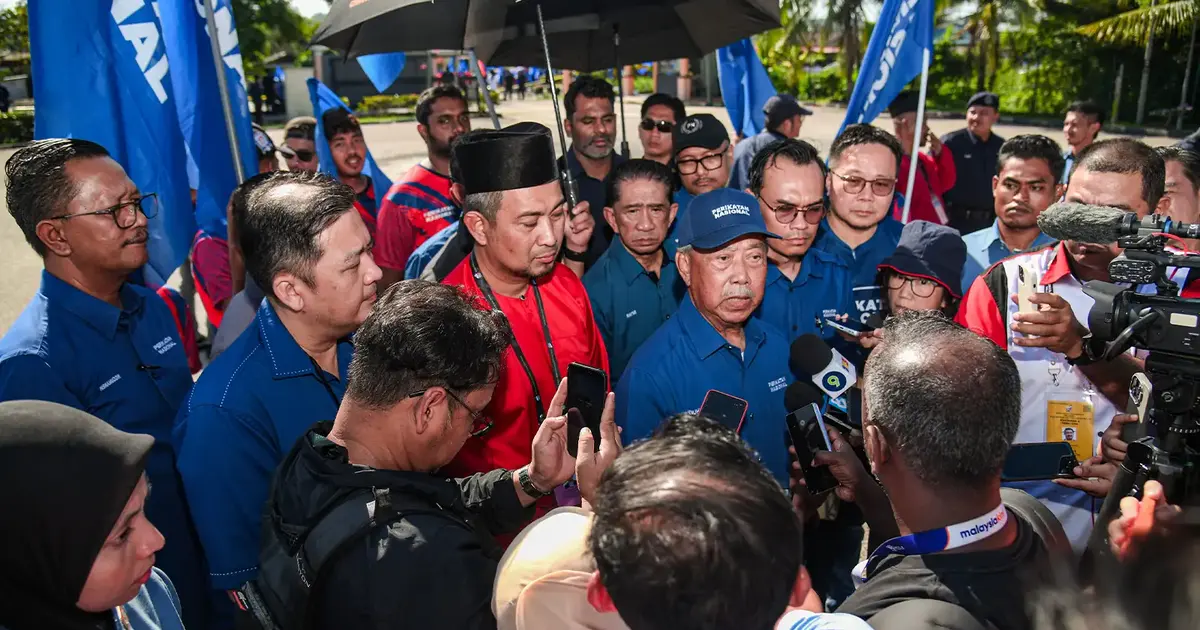
Perikatan Nasional harbours genuine prospects of governing the next state, according to Bersatu president Muhyiddin Yassin, who pointed to a broadening political alliance that extends considerably beyond the coalition's formal membership. The assertion underscores PN's evolving political strategy as it seeks to expand its parliamentary and state assembly footprint, particularly through partnerships with parties positioned outside its traditional coalition framework.
Muhyiddin's optimism reflects PN's confidence in its ability to command sufficient support across multiple configurations. The coalition, which presently encompasses Bersatu, PAS, and Perikatan's other formal members, has cultivated relationships with additional political actors that could prove instrumental in reaching the numerical thresholds required for state government formation. These external allies, Muhyiddin indicated, are willing to lend support to PN-led administrations when political circumstances align favourably.
Muda, the progressive upstart party that has garnered considerable traction among younger voters and urban constituencies, stands among these prospective partners. The party's positioning as a non-aligned political force has made it an attractive coalition partner for various combinations seeking to form governments, and its potential willingness to support PN represents a tangible expansion of the coalition's structural advantages. Such flexibility in alliance-building reflects contemporary Malaysian politics' fluid nature, where governments can be assembled through varied arithmetic depending on local conditions and negotiations.
The confidence expressed by PN's leadership comes at a moment when Malaysian state politics remains highly competitive across numerous constituencies. Multiple states possess unclear electoral mandates or fragmented state assemblies where no single coalition commands an overwhelming majority. This fragmentation has elevated the importance of negotiating partnerships with independent assemblymen and smaller political parties, making alliances like those with Muda strategically significant.
PN's formal coalition structure has undergone considerable evolution since its formation as Perikatan Rakyat. The relationship between Bersatu and PAS, the two principal components, has demonstrated resilience despite occasional policy disagreements. However, Muhyiddin's emphasis on allies outside the coalition suggests that PN recognises the necessity of maintaining diplomatic channels with parties that may not formally join but can provide critical support when required. This approach allows PN greater flexibility than traditional locked-in coalition arrangements would permit.
The emergence of Muda as a significant player in Malaysian politics reflects broader demographic and ideological shifts within the electorate. The party's appeal to voters seeking alternatives to established powers has created political space that neither BN nor PH has fully captured. For PN, cultivating relations with Muda opens pathways to support in constituencies where traditional PN messaging may prove less resonant, particularly in urban centres and among younger demographics.
State-level governance formations have become increasingly important in Malaysian politics as they serve as testing grounds for coalition experiments and provide platforms for parties to demonstrate administrative competence. PN's prospects for leading state governments would strengthen its hand in any future federal electoral contest, allowing it to point to successful governance records and administrative achievements. Conversely, coalition partners like Muda may view supporting PN-led state governments as opportunities to build their own track records without necessarily surrendering their political independence.
The political landscape facing PN is neither uniformly favourable nor entirely constraining. Several states present genuine opportunities where PN's coalition strength, supplemented by potential allies such as Muda, could generate winning combinations. However, PN would need to navigate competing claims within its own structure while simultaneously managing expectations among external partners regarding ministerial positions, policy implementation, and resource allocation. The intricate balancing act required to maintain such diverse alliances presents both opportunities and significant management challenges.
Muhyiddin's public confidence appears calibrated to signal both internal resolve within Bersatu and openness to potential partners considering collaboration with PN. Such messaging serves multiple strategic purposes: it reassures PN supporters that the coalition remains a viable governance alternative, it encourages external parties to view PN as an ascending political force worth backing, and it positions Bersatu as confident leadership material capable of assembling working majorities across various scenarios.
The significance of Muhyiddin's statement extends beyond immediate state-level implications. By emphasising PN's capacity to form state governments through diverse coalition arrangements, the Bersatu president is constructing a narrative about PN's viability as a future federal coalition partner. Parties evaluating their long-term political alignments take note of which coalitions can credibly claim governing capacity and which ones merely maintain theoretical formations without practical ability to exercise power.

