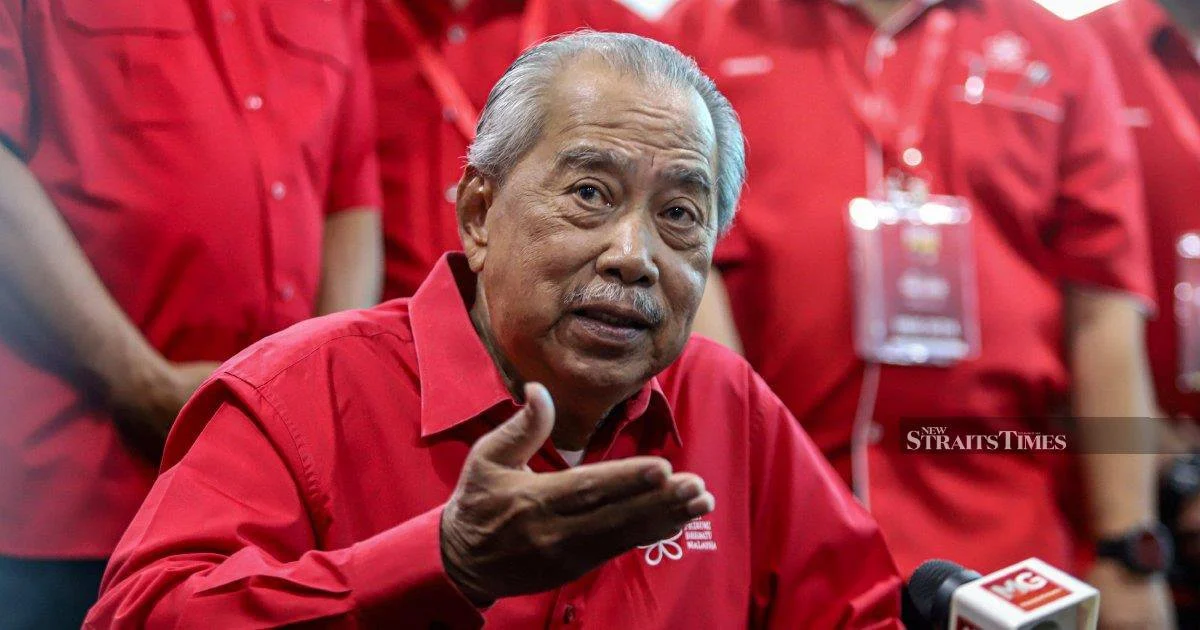
Tan Sri Muhyiddin Yassin has moved to quell concerns about the stability of the Perikatan Nasional (PN) coalition by declaring that Bersatu intends to maintain its membership indefinitely, brushing aside persistent questions about the coalition's longevity and internal cohesion.
The Bersatu president's statement represents an attempt to project unity and certainty at a time when Malaysia's fractious opposition bloc faces continuous scrutiny over its durability. His assertion that the party will remain a loyal component of PN comes as various political factions continue to maneuver for advantage in a highly competitive electoral landscape, where coalition partnerships remain fragile and subject to rapid shifts in allegiances.
Perikatan Nasional, formed as an alternative political grouping to challenge the ruling coalition, comprises multiple parties with occasionally divergent interests. Bersatu's anchoring within this bloc is significant given the party's substantial influence and the personal standing of Muhyiddin, a former Prime Minister who commands considerable support within opposition circles. His unequivocal reaffirmation serves as a stabilizing signal to both party members and coalition partners concerned about potential realignments.
The timing of such declarations often reflects underlying tensions within coalition structures. Speculation about PN's future typically intensifies during periods when smaller member parties explore alternative arrangements, or when electoral calculations suggest that members might benefit from independent maneuvering. By stating his position explicitly, Muhyiddin appears to be attempting to prevent any individual party from using withdrawal threats as leverage in internal negotiations.
For Malaysian political observers, such reassurances carry practical implications. Coalition stability directly affects the viability of opposition politics in a system where divided opposition votes can hand advantages to stronger competitors. When prominent figures like Muhyiddin emphasize commitment, they aim to reassure investors, civil society organizations, and potential supporters that PN represents a coherent political force rather than a temporary arrangement of convenience.
Bersatu's position within PN warrants particular attention given the party's trajectory since its formation in 2016. The party has experienced significant fluctuations in political fortunes, having held the Prime Minister's office and subsequently faced considerable electoral setbacks. Its continued participation in PN thus reflects both strategic calculation—that opposition unity serves Bersatu's interests—and political necessity, as the party seeks to maintain relevance in an increasingly competitive multiparty system.
The broader context of Malaysian coalition politics involves constant evaluation of party strengths and electoral prospects. Larger parties, while generally more stable, nonetheless experience internal debates about optimal coalition configurations. Smaller partners frequently grapple with whether they receive adequate representation and campaign support. Muhyiddin's unambiguous statement appears designed to elevate PN's status above the level of transactional political convenience to something more principled and durable.
Regional observers noting Malaysian political developments recognize that opposition coalition management remains considerably more challenging than government coalition administration. The ruling coalition typically provides its members with tangible benefits—ministerial positions, electoral support, and resource allocation—that incentivize loyalty. Opposition coalitions must rely more heavily on shared ideological commitments and calculations about electoral competitiveness, making them inherently less stable in the absence of actual government power to distribute among members.
The emphatic language employed by Muhyiddin, using the phrase "forever" rather than more cautious terminology, suggests an intention to foreclose discussion about Bersatu's future status. Such definitive statements serve multiple audiences simultaneously: they reassure PN partners that their coalition remains intact, signal to party members that leadership has made settled decisions, and attempt to convince the broader public that PN represents a credible political alternative, not merely an unstable assembly of convenience-driven alliances.
Looking forward, the sustainability of Muhyiddin's commitment will ultimately depend on how effectively PN performs in future electoral contests and whether its member parties perceive that coalition membership serves their individual political interests. Malaysia's opposition landscape has historically experienced rapid transformations when parties concluded that alternative arrangements better served their goals. Even explicit pledges of loyalty can prove less durable than the political calculations underlying them.
Bersatu's firm positioning within PN nonetheless represents an important signal about the coalition's expected trajectory in the immediate term. The party's decision to reaffirm its commitment publicly provides PN with renewed momentum and credibility as it prepares for future electoral contests and attempts to present itself as a serious contender for national leadership.

