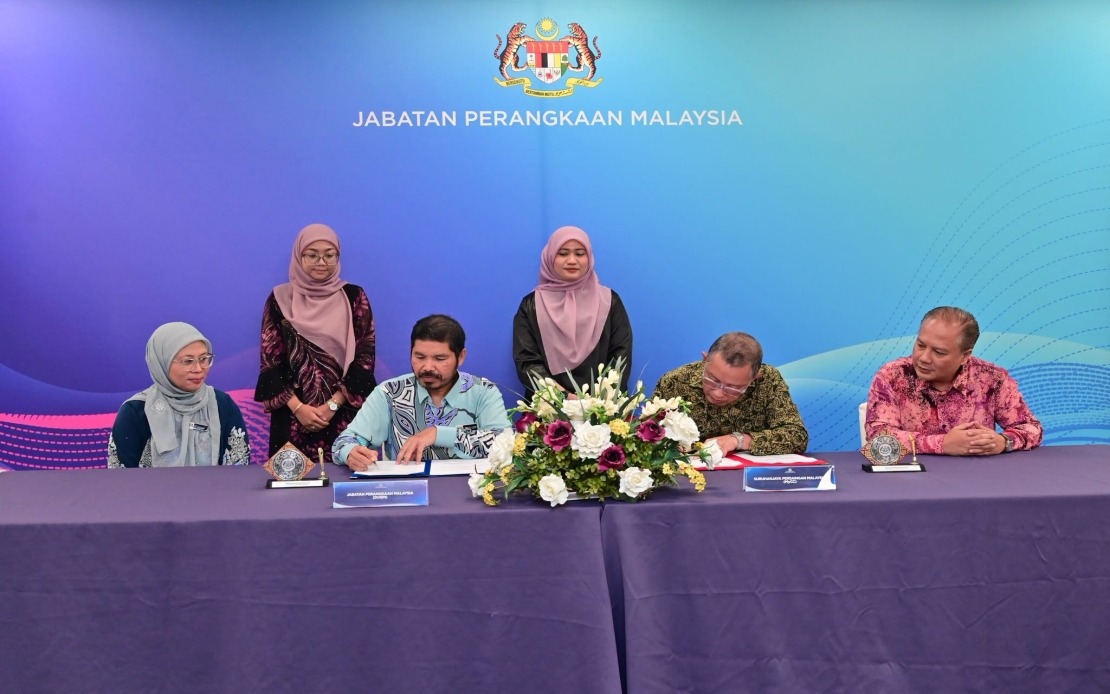
The Malaysia Competition Commission (MyCC) and the Department of Statistics Malaysia (DOSM) have formally entered into a strategic partnership aimed at leveraging their respective strengths in competition enforcement and statistical analysis. The memorandum of understanding, signed at DOSM headquarters in Putrajaya on June 19, represents a significant step toward integrating data-driven decision-making into Malaysia's economic governance and competition policy framework. MyCC chairman Tan Sri Idrus Harun and Chief Statistician Datuk Seri Dr Mohd Uzir Mahidin affixed their signatures to the accord, with MyCC chief executive officer Datuk Iskandar Ismail and DOSM Deputy Chief Statistician (Economic Programmes) Siti Asiah Ahmad present as witnesses.
The collaboration emerges from a recognition within government circles that fragmented data management and analysis can hinder the effectiveness of policy enforcement. By uniting the analytical capabilities of the statistics agency with the investigative mandate of the competition commission, both organizations gain access to complementary information that each would struggle to develop independently. DOSM brings authoritative economic data spanning production, consumption, trade and employment figures, while MyCC contributes sector-specific intelligence gathered through competition investigations and market monitoring. This pooling of resources creates a more comprehensive foundation upon which to understand market dynamics and detect anti-competitive practices that might otherwise remain obscured.
The agreement encompasses multiple dimensions of cooperation extending beyond simple data exchange. A structured framework for sharing administrative records and economic datasets forms the bedrock of the arrangement, allowing both agencies to access information previously confined within individual organizational silos. More significantly, the partnership commits both organizations to joint capacity-building initiatives, recognizing that data alone carries limited utility without the analytical sophistication to interpret it meaningfully. Training programmes, knowledge transfers and expertise exchanges will enable MyCC economists to deepen their understanding of statistical methodology, whilst DOSM analysts can gain exposure to competition economics and market structure assessment.
MyCC characterized the partnership as emblematic of the government's pivot toward data-centric governance, particularly in formulating and enforcing competition policy. As markets grow more complex and cross-border economic flows intensify, conventional enforcement mechanisms increasingly prove inadequate without sophisticated analytical backing. The commission views this collaboration as positioning Malaysia to respond more intelligently to emerging market risks, from pricing collusion to exclusionary conduct by dominant firms. By integrating real-time economic statistics with competition investigation capabilities, MyCC can move beyond reactive enforcement toward predictive monitoring that identifies market failures before they entrenches.
Mohd Uzir emphasized that the partnership strengthens both agencies' capacity to deliver comprehensive economic analysis that transcends traditional statistical reporting. Rather than DOSM merely publishing aggregate indicators and MyCC conducting isolated investigations, the two bodies can now conduct joint examinations of strategic sectors and assess the competition implications of government policies. This coordinated approach proves particularly valuable when evaluating the effectiveness of price controls, subsidy schemes, trade policies and sectoral regulations, all of which exert indirect but significant influence on competitive dynamics. The chief statistician signaled that the MoU specifically targets enhanced understanding of market structures, supply chain configurations and the constellation of factors driving price movements across the economy.
For Malaysian businesses and consumers, the partnership carries substantial implications. Enhanced competition monitoring grounded in rigorous statistical analysis should theoretically result in swifter identification and prevention of anti-competitive conduct, whether through cartelization, bid-rigging or abuse of market dominance. Small and medium enterprises, which often lack resources to contest anti-competitive behaviour independently, stand to benefit from more proactive enforcement based on improved intelligence. Simultaneously, the collaboration creates opportunities for legitimate business activity, as clearer understanding of competitive dynamics enables more informed policy calibration that avoids unintended restrictions on efficient market functioning.
The timing of this initiative reflects broader global trends toward leveraging data as an essential economic resource. As Mohd Uzir and MyCC leadership both noted, data now occupies a position in the global economy analogous to that traditionally held by natural resources or labour. Nations and organizations that master data integration and analysis gain competitive advantages in identifying market opportunities, managing risks and formulating effective policy responses. Malaysia's decision to institutionalize data-sharing between its statistics and competition authorities positions the country to participate more effectively in this data-driven economy, potentially attracting multinational firms seeking jurisdictions with sophisticated market intelligence capabilities.
The partnership also addresses a persistent challenge in developing economies: the fragmentation of government data infrastructure. Historically, various Malaysian agencies have accumulated substantial information without systematic mechanisms for cross-agency utilization, resulting in inefficient duplication and missed opportunities for integrated analysis. This MoU establishes MyCC and DOSM as pioneers in breaking down information silos, potentially creating a template for expanded inter-agency collaboration across other domains such as trade policy, consumer protection and market supervision. Should this model prove successful, government-wide data governance could evolve substantially, multiplying the efficiency gains achievable through coordinated economic management.
The emphasis on capacity building within the agreement reflects understanding that effective data utilization depends on human capital development alongside technological and informational resources. Both MyCC and DOSM commit to developing their respective workforces' capabilities through structured exchange programmes and joint training initiatives. This investment in people ensures that the partnership generates sustained competitive advantage rather than functioning as a one-time data transfer. Economists, statisticians and analysts from both organizations will interact regularly, creating informal networks of expertise that persist beyond formal arrangement deadlines and foster continuous innovation in analytical methodologies applicable to competition and economic policy.
For Malaysian consumers and workers, the practical significance of improved competition analysis and economic monitoring could manifest in multiple ways. More effective detection of collusive pricing arrangements in essential goods markets, improved understanding of how regulatory policies affect labour market competition and clearer identification of structural barriers impeding new firm entry all contribute to more efficient markets and broader opportunities for advancement. The partnership signals governmental commitment to treating competition not as a peripheral concern but as central to economic development strategy. As Southeast Asian economies increasingly compete for foreign investment and talent, the credibility of competition enforcement and economic transparency provided by integrated statistical-analytical capacity becomes a meaningful differentiator.
Beyond Malaysia's borders, this collaboration carries implications for regional economic integration and ASEAN competitiveness. As member states pursue deeper trade and investment liberalization, the capacity to monitor cross-border competitive dynamics becomes increasingly critical. Malaysia's enhanced data-sharing and analytical capabilities position it as a potential leader in regional competition cooperation, potentially influencing how other ASEAN nations structure their own institutional responses to competition issues. Should this MoU generate measurable improvements in market efficiency and economic performance, neighbouring countries may adopt similar organizational models, gradually strengthening competition governance across Southeast Asia and supporting more robust regional supply chains and investment flows.

