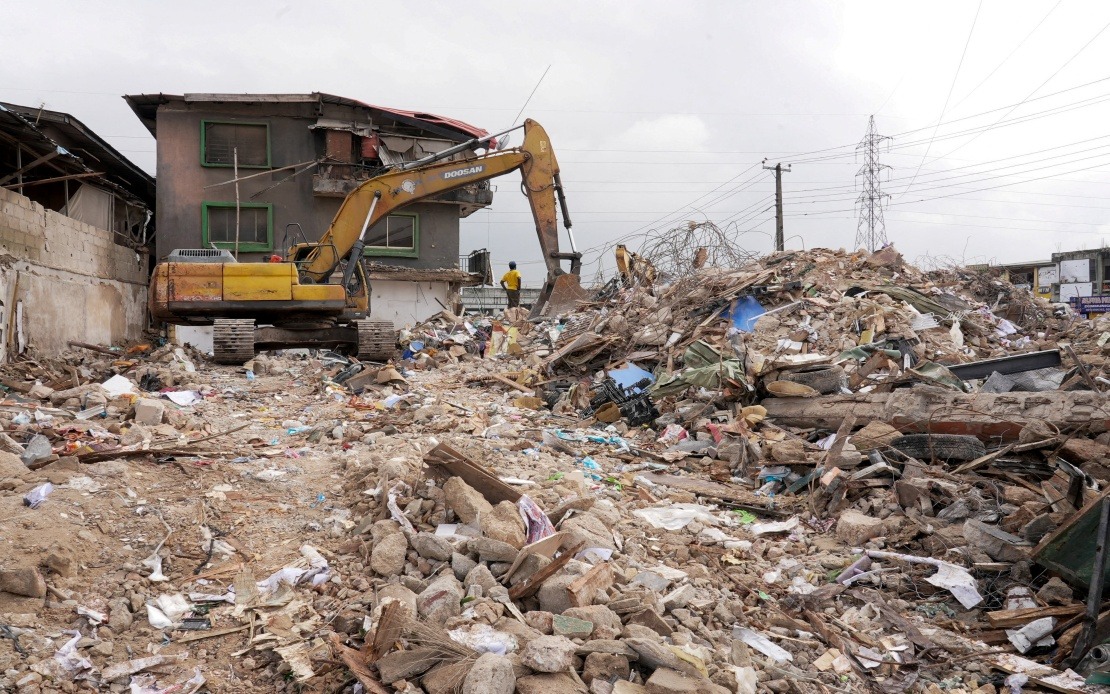
A devastating structural failure in Lagos has claimed nine lives, with rescue teams managing to pull 27 survivors from the debris of a three-storey shopping complex that gave way on Thursday morning in Alakija, a burgeoning commercial satellite town situated along the congested Lagos-Badagry Expressway corridor. The incident underscores persistent concerns about construction standards and building safety across Nigeria's most populous and economically vital state.
Emergency responders launched a coordinated rescue effort immediately after the three-level commercial structure buckled to the ground, with teams from multiple agencies converging on the Alakija site to search through tonnes of rubble and twisted metal. Olufemi Oke-Osanyintolu, permanent secretary of the Lagos State Emergency Management Agency, confirmed that exhaustive search-and-rescue operations continued through the night before concluding early Friday morning. Rescue personnel worked relentlessly to locate and extricate individuals buried beneath the collapsed structure, extracting both those who remained conscious and others requiring urgent medical intervention.
The casualty toll reflects the sudden nature of the collapse and the commercial activity ongoing at the time of failure. Preliminary assessments indicate that the victims were predominantly business proprietors and shoppers engaged in normal trading operations when the structure gave way. The shopping complex served the surrounding residential neighbourhood, and some local residents were also among those trapped in the wreckage. The 27 individuals rescued sustained injuries ranging from minor wounds to severe trauma requiring hospitalisation. Medical facilities throughout Lagos received the injured victims, who are undergoing treatment for their various ailments.
The involvement of the China Civil Engineering Construction Corporation in rescue operations reflects the company's presence in the region, where it is executing a railway infrastructure project. This participation demonstrates how construction firms and specialised contractors can mobilise resources during emergencies, though it also highlights questions about coordination between different entities operating within Lagos's crowded urban landscape. The scale and speed of the rescue response illustrated organised emergency protocols, yet the fact that such collapses continue to occur raises broader questions about preventative measures and regulatory oversight.
Authorities have not yet determined what triggered the structural failure. An investigation into the collapse's root causes has commenced, with teams likely to examine structural integrity, construction quality, and maintenance records. This investigative process is crucial for understanding whether the failure resulted from acute causes such as heavy loading or structural degradation, or whether it reflected chronic deficiencies in the original design and construction.
Nigeria has experienced recurring building collapse incidents in recent years, particularly in Lagos where rapid urban expansion and high property demand create pressure for quick construction and cost-cutting. Engineering experts consistently point to three interconnected factors that render many Nigerian structures vulnerable to sudden failure. First, numerous buildings deteriorate significantly over decades without adequate maintenance or reinforcement, particularly older commercial structures. Second, widespread violations of building codes and planning regulations allow construction to proceed without proper oversight or compliance inspections. Third, the use of substandard materials—ranging from inferior concrete to compromised steel reinforcement—substantially weakens structural capacity.
The regulatory environment in Lagos has evolved in response to previous disasters, with the state government implementing stricter building approval processes and inspection regimes. Nevertheless, the persistence of collapses suggests that enforcement remains inconsistent and that informal construction practices continue unchecked in many areas. Corruption in the permit and inspection systems has been identified as enabling factor, with some operators bypassing safety requirements through unofficial channels.
For regional observers, the Lagos collapse serves as a cautionary reminder of urbanisation risks facing fast-growing cities across West Africa and beyond. Malaysia, with its own rapid urban development, has invested substantially in building code enforcement and structural safety systems. The contrast illustrates how institutional capacity and regulatory consistency directly influence public safety outcomes. Southeast Asian cities can draw important lessons from Nigeria's experience regarding the necessity of rigorous pre-construction approval, ongoing inspection protocols, and mandatory maintenance standards.
The human cost of this incident—nine deaths and dozens injured—reflects the stakes involved in construction safety. Beyond the immediate tragedy, building failures create lasting economic damage to businesses, undermine investor confidence, and divert limited emergency resources. For Lagos's commercial sector, recurring collapses threaten the stability and reputation of trading districts and shopping areas that depend on consumer confidence and safety perception.
Longer-term solutions will require strengthened institutional frameworks, including better-resourced regulatory agencies, modernised building inspection technologies, and enforcement mechanisms with genuine deterrent power. Professional standards for engineers and contractors must be enforced, with serious consequences for those who compromise structural integrity through cost-cutting or negligence. Public awareness campaigns highlighting building safety risks could encourage residents and business operators to report structural concerns before catastrophic failure occurs.
The Alakija incident will likely trigger renewed scrutiny of commercial structures throughout Lagos, possibly prompting targeted inspections of older shopping complexes. State authorities may use this disaster to advocate for increased budget allocation to building safety programmes and regulatory capacity. International partners, including construction oversight bodies and engineering associations, may offer technical assistance and best-practice guidance to strengthen Nigeria's building safety architecture.

