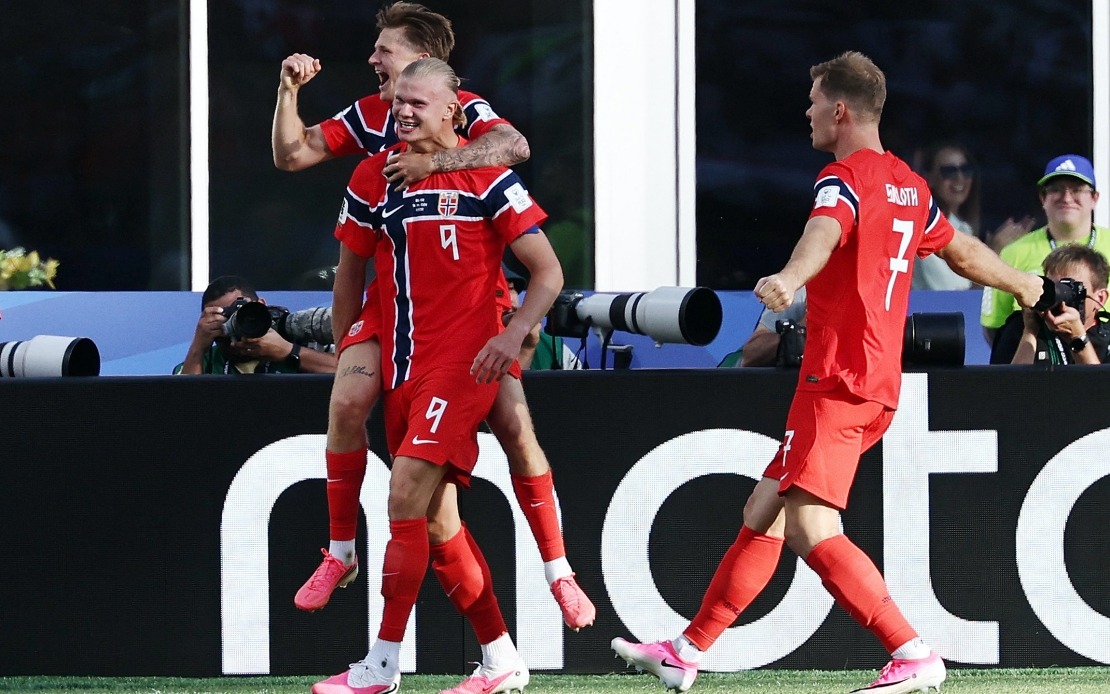
Three of Norway's most prominent footballers are carrying an unmistakable sense of family obligation into their World Cup campaign, each harbouring a personal quest to achieve what their fathers could not three decades ago. Erling Haaland, Alexander Sørloth, and Kristian Thorstvedt represent a rare convergence of sporting lineage, with their fathers—Alf-Inge Haaland, Gøran Sørloth, and Erik Thorstvedt—having represented Norway during the 1994 World Cup in the United States, an experience that ended in group-stage disappointment for the Scandinavian nation.
Norway's emphatic 4-1 opening triumph against Iraq has provided an encouraging foundation for their tournament aspirations, and the younger generation possesses considerably higher individual profiles than their predecessors did. Haaland, in particular, has emerged as one of global football's most lethal strikers, currently performing at the elite level with Manchester City, a transfer that mirrors his father's own career progression through top-tier European clubs. The Manchester City forward's own trajectory suggests possibilities far beyond what was available to the 1994 generation, yet the weight of historical underachievement remains a motivating factor.
The personal dimension of this World Cup experience carries particular resonance for Haaland, who has acknowledged the amusing contrast between his contemporary image and his father's appearance from that bygone era. When presented with photographs from the 1994 tournament, Haaland remarked on his father's youthful appearance and notably long hairstyle, a detail that underscores how substantially football culture and player presentation have evolved across three decades. This generational bridge extends beyond mere nostalgia; it represents a genuine opportunity for these players to rewrite family history on sport's grandest stage.
Sørloth, currently plying his trade at Atlético Madrid, has articulated particularly poignant sentiments regarding his participation in this tournament. The attacker described the experience as simply magnificent, crediting his father with providing foundational instruction in football that continues to inform his professional approach. His earliest World Cup recollection dates to the 2002 tournament held across Japan and South Korea, when the Sørloth family holidayed in Denmark and he watched matches alongside his father, an experience that crystallised his ambitions to eventually compete at that level himself. Such narratives underscore how parental influence shapes not merely technical capability but also the psychological and emotional investment players bring to international competition.
Thorstvedt's participation completes this triumvirate of second-generation talent, though he occupies a slightly less prominent position within the Norwegian setup compared to Haaland and Sørloth. Nevertheless, his presence in the squad reinforces the narrative arc of sons attempting to exceed their fathers' achievements, a theme that resonates deeply within Norwegian sporting culture and beyond. The concentration of three such players within a single national squad represents an extraordinary statistical rarity in modern football.
Norway faces a demanding schedule ahead, with a critical encounter against Senegal scheduled for Monday that could secure qualification to the knockout rounds—a scenario neither Haaland nor his teammates' fathers achieved in 1994. The prospect of advancing beyond the group phase would represent a tangible accomplishment that transcends the purely symbolic satisfaction of simply participating in the tournament. Such progression would validate both the individual talents these players have cultivated and the broader investment Norwegian football has made in their development.
The group-stage finale against France presents an additional examination of this team's credentials, pitting them against one of the competition's favourites and providing a high-profile stage upon which to demonstrate their advancement beyond their predecessors' capabilities. France's position as tournament contenders elevates the significance of this encounter, though for Haaland and his contemporaries, merely reaching this stage already exceeds their fathers' experience.
Beyond the playing field, the Norwegian team has garnered remarkable institutional and popular support. The hereditary Princess Ingrid Alexandra and Prince Sverre Magnus, offspring of Crown Prince Haakon and Crown Princess Mette-Marit, are anticipated to attend Monday's fixture in New Jersey, providing royal endorsement for the team's efforts. This level of high-profile support reflects the broader resonance football possesses within Norwegian society and governance structures.
The cultural expression surrounding this campaign has extended into parliamentary precincts, where legislators from across the political spectrum participated in coordinated displays of support for the national team, drawing upon historical Viking cultural references. Such manifestations of parliamentary backing underscore how national sporting endeavours transcend typical sporting boundaries, acquiring significance as expressions of broader national identity and pride. The mobilisation of political institutions in support of the team reflects the genuine investment Norwegian society has vested in this World Cup campaign.
For Malaysian and Southeast Asian observers, this narrative offers instructive parallels regarding generational sporting ambition and the transmission of excellence across family lines. While Malaysian football has produced notable individual talent across decades, the concentration of second-generation elite performers within a single squad remains exceptional. The Norwegian experience demonstrates how previous generations' experiences, whether successful or disappointing, can catalyse subsequent generations toward enhanced performance, provided structural support and professional opportunity align with individual capability and motivation.
The unfolding Norwegian campaign will likely prove instructive regarding whether second-generation players can leverage familial motivation into tangible tournament success, or whether such historical narrative carries limited practical value compared to contemporary preparation and tactical execution. As Haaland, Sørloth, and Thorstvedt progress through their tournament, their individual and collective performances will constitute the ultimate measure of whether family legacy translates into championship achievement or remains confined to compelling storytelling.

