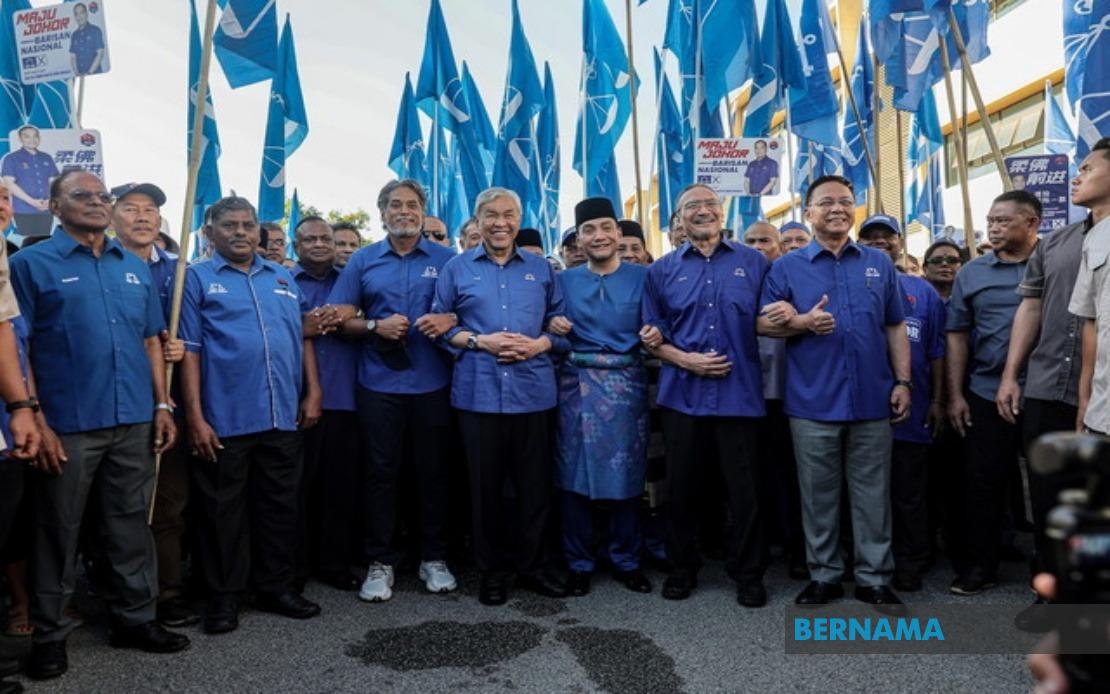
Johor Barisan Nasional chairman Datuk Onn Hafiz Ghazi formally submitted his candidacy for the upcoming Johor state election on June 27, filing nomination documents at 9.10 am through the nomination centre operated at the Muafakat Hall of the Simpang Renggam District Council. The timing and location reflected standard electoral procedures, though the calibre of supporters present underscored the significance attached to his candidacy by Malaysia's dominant coalition partner.
The incumbent Machap state assemblyman's nomination filing became a showcase of UMNO muscle and organisational reach, drawing a constellation of party heavyweights to the venue. UMNO president Datuk Seri Dr Ahmad Zahid Hamidi, who leads the party through its ongoing revival following the 2018 electoral earthquake, made a personal appearance to endorse Onn Hafiz's bid. Such direct presidential involvement in a state-level nomination is never ceremonial—it signals confidence in the candidate and readiness for a competitive campaign.
The UMNO delegation extended to include Sembrong MP Datuk Seri Hishammuddin Tun Hussein, a figure long embedded in the party's establishment and parliamentary representation, alongside Khairy Jamaluddin, whose presence as a former minister adds institutional weight to proceedings. These individuals represent different generational cohorts within UMNO, suggesting the party has mobilised across traditional factional lines to demonstrate unity behind Onn Hafiz's candidacy. For observers tracking UMNO's internal dynamics, such displays of consolidated leadership are rare and typically reserved for strategically important contests.
Former Johor Menteri Besar Datuk Seri Hasni Mohammad also attended the nomination filing, bringing with him the residual authority and ground connections associated with previous state-level executive leadership. His participation signals continuity in Johor's political establishment and potentially strengthens the linkage between current and former administrative networks—a factor of considerable relevance in a state where local relationships and patronage networks remain potent electoral forces.
The nomination centre itself witnessed the kind of grassroots mobilisation characteristic of major electoral contests in Malaysia. Supporters congregated in the surrounding areas, visibly organised according to their respective party affiliations and armed with the standard paraphernalia of campaign season: coloured attire matching party symbolism, banners and flags displaying candidate endorsements. This visual demonstration of organisational capacity serves multiple functions simultaneously—it energises supporters, signals momentum to undecided voters, and provides media-friendly imagery for dissemination through social networks.
The Johor state election represents a consequential battleground within Malaysia's broader electoral landscape. As the nation's second-most populous state and a historical bastion of Barisan Nasional dominance, Johor's political fortunes carry symbolic and material weight extending well beyond state boundaries. Results here influence perceptions of coalition strength heading into potential federal-level contests, and they test whether UMNO's rehabilitation efforts since 2020 are translating into sustainable electoral recovery.
Onn Hafiz's elevation as Johor BN chairman reflects calculated positioning within UMNO's leadership succession dynamics. His youth relative to many senior figures, combined with his incumbency in Machap, positions him as emblematic of a transitional generation. The visible backing from Ahmad Zahid and other seniors suggests he enjoys factional support, though Johor's complex political ecology means such endorsements must be converted into grassroots wins through door-to-door organising and community engagement.
The nomination filing itself marks a formal transition from internal party selection processes to open electoral competition. Once papers are submitted, the stakes shift visibly—candidates can no longer be swapped or withdrawn without significant reputational consequences. For Onn Hafiz, this moment crystallised his party's investment in his candidacy and implicitly committed senior leadership to campaign activities on his behalf.
Malaysia's state election calendar remains fluid, and Johor's electoral contest will inevitably draw scrutiny from regional analysts monitoring Barisan Nasional's capacity to consolidate support in its traditional strongholds. The graphic show of UMNO leadership presence at Onn Hafiz's nomination suggests the coalition recognises this election as sufficiently important to warrant high-profile intervention, even at the nomination stage when outcomes remain uncertain.
The crowd dynamics at Simpang Renggam reflected broader patterns in Malaysian electoral mobilisation, where party machinery remains organised around traditional command structures while newer communication technologies enable faster information dissemination. The interplay between this grounded campaigning and digital-era political communication will likely shape the contest's trajectory. For Onn Hafiz specifically, the challenge ahead involves translating elite-level support into voter conversions across Machap's diverse constituencies, where local grievances and bread-and-butter concerns often matter more than national party positioning.

