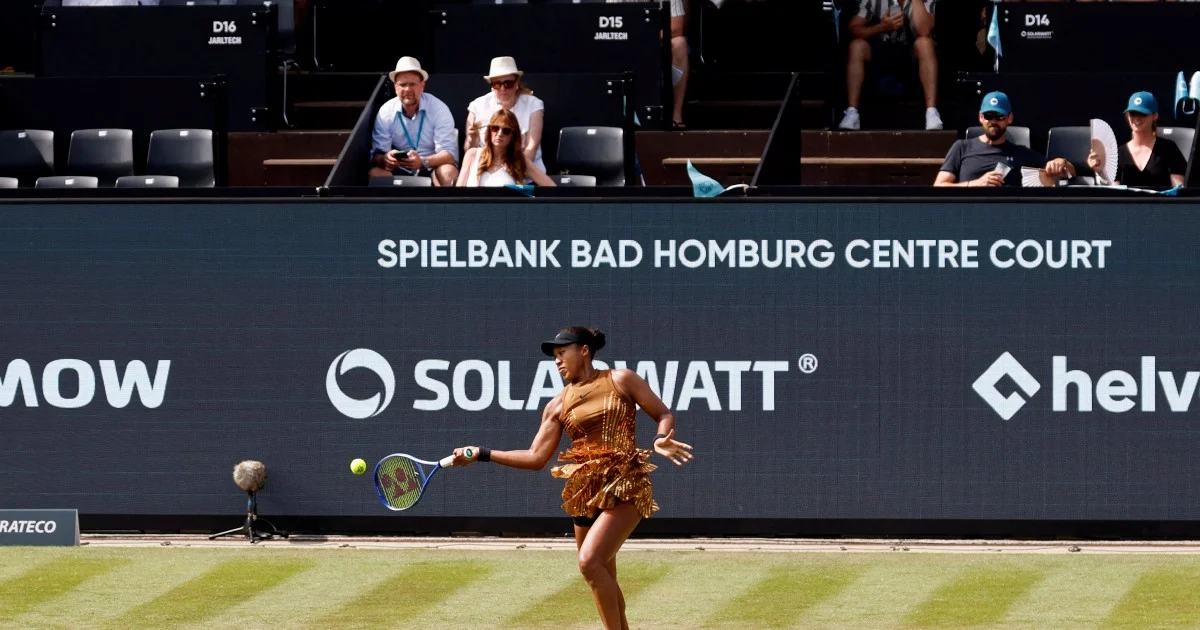
Naomi Osaka moved into the quarter-finals of the Bad Homburg grass-court tournament in Germany on Tuesday, dispatching Belgian player Elise Mertens with a convincing 6-3, 6-3 victory that showcased her improved form midway through the second round encounter. Despite contending with oppressive heat conditions and an initial sluggish performance that saw her stumble early in the first set, the Japanese former world number one recovered composure to dominate the remainder of the match.
Osaka has developed a discernible pattern at this grass-court event, struggling to find her rhythm in opening sets before shifting into a higher gear as matches progress. This pattern repeated itself against Mertens, as the Japanese player appeared to lack sharpness during the opening games, suggesting that adapting to grass surfaces and the specific demands of rapid court movement remains an ongoing adjustment. However, once Osaka settled into her groundstrokes and served with greater conviction, the deficit evaporated remarkably quickly.
The sweltering conditions at Bad Homburg presented a secondary challenge that both competitors had to navigate. Playing in intense heat can dramatically impact player stamina, service velocity, and decision-making during crucial points, particularly on grass where movement becomes more challenging and extended baseline exchanges are less common. Osaka managed these environmental factors more effectively than her opponent as the match progressed, indicating improved preparation and possibly superior fitness levels compared to Mertens during this particular tournament phase.
Mertens, a Belgian player ranked among the world's top competitors across multiple surface types, struggled to maintain consistency once Osaka found her serving range. The match became notably uncompetitive in the second set, with Osaka's superior groundstroke depth and court positioning gradually grinding down Mertens' ability to generate offensive opportunities. The 6-3 final set margin understates the growing gulf between the competitors' performances as the encounter wore on.
For Osaka, this victory represents meaningful progress in her grass-court campaign during the early summer season. The four-time Grand Slam champion has worked diligently to rebuild confidence and consistency following previous injury setbacks and mental health challenges that disrupted her competitive calendar. Tournament victories on grass, which represents her weakest surface relative to clay and hard courts, carry particular significance in her broader career rehabilitation effort.
The Bad Homburg tournament serves as a crucial preparation event for the Wimbledon Championships, scheduled to commence shortly after this tune-up competition concludes. Players use this event to acclimate to grass conditions, experiment with tactical adjustments, and build match confidence heading into the most prestigious grass-court tournament globally. Osaka's advancing deeper into Bad Homburg suggests she may arrive at Wimbledon with increasingly sharpened competitive instincts.
Mertens has historically performed well on grass surfaces despite her reputation as a clay-court specialist, making her defeat to Osaka more significant than typical tournament results might suggest. The Belgian's inability to trouble Osaka consistently indicates that the Japanese player's grass-court game has genuinely improved, moving beyond mere incremental development to substantive tactical refinement. This represents tangible progress in Osaka's attempts to broaden her game across all surface types.
Osaka's path to the quarter-finals also demonstrates the mental resilience required at elite levels of professional tennis. Rather than becoming frustrated by slow starts, she maintained composure and made strategic adjustments that gradually shifted momentum decisively in her favour. This psychological dimension often distinguishes champion players from merely talented competitors, particularly when facing the additional pressures of international competition and extreme environmental conditions.
The German tournament continues to produce compelling storylines as competitors jockey for favourable seeding and momentum heading into Wimbledon. Osaka's advancement ensures continued Japanese interest in this particular tournament, as her performances carry significance for Asian audiences monitoring grass-court development among top-ranked players from the region. Her continued progression beyond early tournament rounds validates the substantial investments made in her recovery and competitive redevelopment over recent months.

