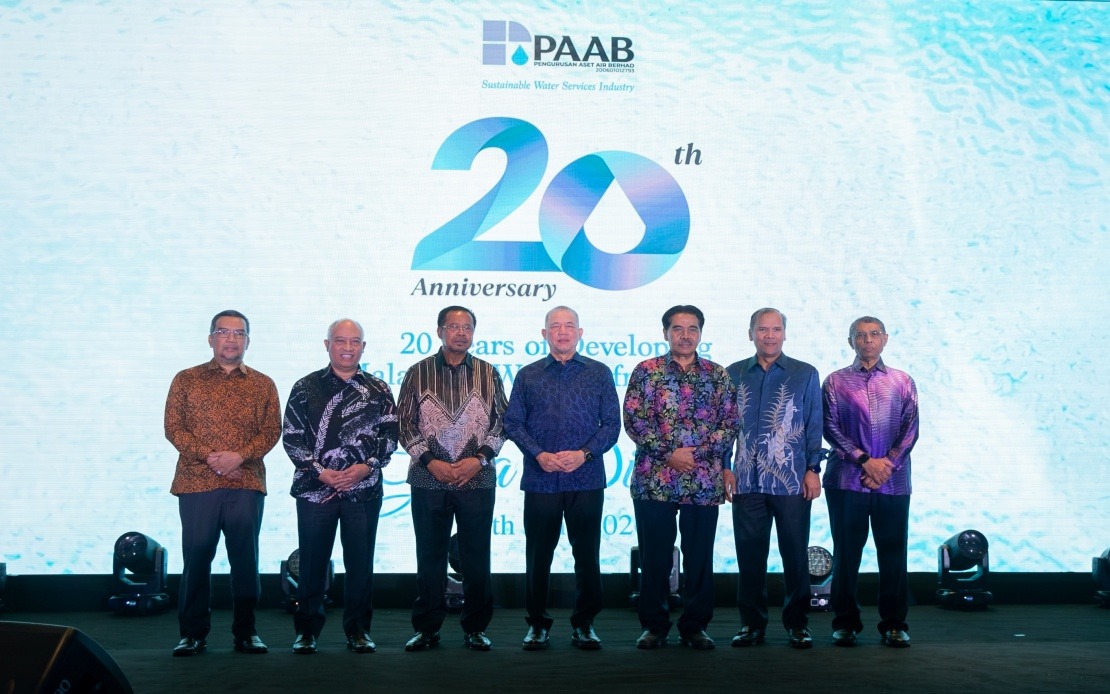
Pengurusan Aset Air Berhad (PAAB) reached a significant milestone this week, reflecting twenty years of work in reshaping Malaysia's water services landscape and bolstering the nation's water supply security. Since its establishment on May 5, 2006, the wholly owned subsidiary of the Minister of Finance Incorporated has channelled RM46.88 billion in combined financing and capital investment, establishing itself as a cornerstone of Malaysia's public infrastructure transformation and a linchpin in efforts to modernise the country's aging water systems.
The scope of PAAB's financial engagement reveals the scale of restructuring required across the sector. The entity has assumed responsibility for RM23.04 billion in water industry loans previously held by various stakeholders, effectively consolidating debt burdens across the system. Simultaneously, it has deployed RM23.84 billion in capital expenditure for infrastructure modernisation, reflecting the substantial reinvestment needed to move Malaysia's water networks toward contemporary standards. This dual mechanism—debt assumption coupled with strategic capital deployment—distinguishes PAAB's approach from conventional utility management and positions it as a restructuring vehicle rather than an operational water company.
Deputy Prime Minister Datuk Seri Fadillah Yusof, who holds the Energy Transition and Water Transformation portfolio, delivered a pointed message at PAAB's anniversary celebration, emphasising that the sector's current trajectory falls dangerously short of meeting Malaysia's water security needs. He highlighted the persistence of non-revenue water (NRW) losses at approximately 40 per cent nationwide, characterising this as a crisis demanding immediate intervention rather than reliance on long-term planning horizons extending to 2050. The proportion of water lost through leakage, unauthorised consumption, and metering inaccuracies represents not merely an operational inefficiency but a strategic vulnerability in the context of Malaysia's rapid economic transformation and growing water demands from data centre operators and manufacturing sectors.
The economic implications of Malaysia's water loss crisis extend beyond simple waste calculations. As the nation positions itself as a regional hub for data centres and advanced manufacturing—sectors characterised by intense and stable water consumption—any disruption to water supply carries significant competitive consequences. Foreign investors evaluating Malaysia against alternative locations will increasingly weigh water security and system reliability as investment criteria. Fadillah framed the water challenge explicitly in this context, noting that immediate, coordinated action is essential to ensure the stable supply patterns these industries demand, lest Malaysia loses investment opportunities to competing jurisdictions with more resilient infrastructure.
Ten states have now formally committed to PAAB's National Water Services Industry Restructuring Plan, with ten additional states signing by December 2025, though the original source indicates the figure at that date. The completion of substantial infrastructure projects under this framework demonstrates tangible progress: twenty-one water treatment plants have come online with combined capacity of 2,085 million litres daily, forty-two storage facilities with 783 million litres capacity have been constructed, and 3,263 kilometres of pipeline upgrades and extensions have been completed across the country. These numbers represent decades of systematic investment in physical assets, yet Fadillah's remarks suggest that even this infrastructure expansion cannot outpace losses currently embedded in operational systems.
PAAB's implementation roadmap extends across four distinct phases spanning from 2008 to 2050, beginning with a Migration phase from 2008 to 2020 and progressing through Stabilisation, Consolidation, and ultimately Full Cost Recovery phases. The Full Cost Recovery Roadmap envisions a water sector capable of sustaining itself financially without perpetual government subsidy—a structural transformation comparable in ambition to tariff rationalisation efforts undertaken in other essential utilities across developing economies. However, the timeline itself became a point of contention during this week's anniversary remarks, with Fadillah asserting that waiting a decade to achieve meaningful reductions in non-revenue water represents an unacceptable policy stance given Malaysia's current economic trajectory and competitive positioning.
The capital expenditure breakdown illuminates the current distribution of PAAB's investment portfolio. Of the RM23.84 billion deployed through December 2025, RM8.33 billion has funded completed projects now transferred to operational entities, RM1.84 billion remains in active construction, and RM13.67 billion is allocated to projects in design and planning stages. This distribution suggests that the majority of PAAB's planned investment remains ahead of execution, creating both opportunity and risk. The extended planning horizon provides flexibility to adjust allocations based on emerging priorities, yet it also means that anticipated infrastructure benefits remain largely prospective, whilst water losses continue unabated in present-day operations.
PAAB chairman Datuk Seri Jaseni Maidinsa and chief executive Zulkiflee Omar structured their institutional narrative around the concept of impact measurement extending beyond financial metrics or asset quantity. They emphasised that organisational success ultimately manifests through tangible improvements in water quality, reliability, and accessibility for Malaysian citizens and businesses. This framing reflects growing international consensus that water infrastructure assessment must incorporate service outcome indicators rather than capital investment volume alone, though the persistent 40 per cent non-revenue water rate suggests that current service outcomes remain substantially disconnected from infrastructure investment levels.
The involvement of National Water Services Commission (SPAN) leadership—including chairman Datuk Abdul Kadir Mohd Din and chief executive Datuk Ahmad Faizal Abdul Rahman—indicates the institutional coordination required to execute water sector restructuring at scale. SPAN functions as the sector regulator and policy architect, whilst PAAB operates as the financing and asset-holding vehicle, creating a division of labour intended to separate operational management, regulatory oversight, and capital provision. Yet the consistent messaging regarding urgency and coordination challenges suggests that institutional separation alone cannot overcome the technical and political complexities embedded in Malaysia's fragmented water administration, where federal, state, and local authorities maintain overlapping jurisdictions and competing financial interests.
The water sector challenge confronting Malaysia reflects broader development economics dynamics. Emerging economies frequently inherit water infrastructure built for smaller populations and lower consumption patterns, requiring wholesale expansion precisely as urbanisation, industrial development, and climate variability increase stress on systems. Malaysia's situation exemplifies this pattern: rapid economic growth in data centres and semiconductor manufacturing has coincided with urban population concentration, yet the regulatory frameworks and tariff structures governing water services have lagged behind infrastructure investment needs. PAAB's two-decade trajectory demonstrates the capital requirements involved in closing this gap, yet Fadillah's warnings indicate that asset expansion alone cannot succeed without complementary operational efficiency improvements, particularly in reducing non-revenue water through pipe rehabilitation, meter digitalisation, and enforcement against illegal connections.
The political economy of Malaysia's water sector transformation involves competing stakeholder interests that complicate reform implementation. State governments maintain control over water resources and operational concessions; federal authorities drive standardisation and capital provision; consumers face tariff increases necessary to fund infrastructure; and industrial users require supply security. PAAB functions within this contested institutional landscape, serving as a neutral capital vehicle potentially insulating long-term investment decisions from short-term political pressures. Yet the Deputy Prime Minister's intervention suggests growing frustration with the pace of progress, implying that institutional mechanisms alone cannot overcome political economy obstacles or behaviour change among water system operators requiring incentive restructuring beyond current regulatory frameworks.
Looking forward, Malaysia's water sector faces a critical juncture. PAAB's two-decade record demonstrates substantial capital mobilisation and infrastructure expansion, yet persistent non-revenue water losses suggest that supply-side investment has outpaced demand-side management and operational efficiency improvements. The Deputy Prime Minister's emphasis on immediate, coordinated action signals potential policy recalibration emphasising leak reduction, smart metering, and operator accountability rather than continued infrastructure expansion. For regional observers, Malaysia's experience illustrates the complex relationship between capital investment and service outcomes in water systems, offering cautionary lessons about the limits of financing innovation in contexts where institutional reform, regulatory incentives, and operational behavioural change remain incomplete.

