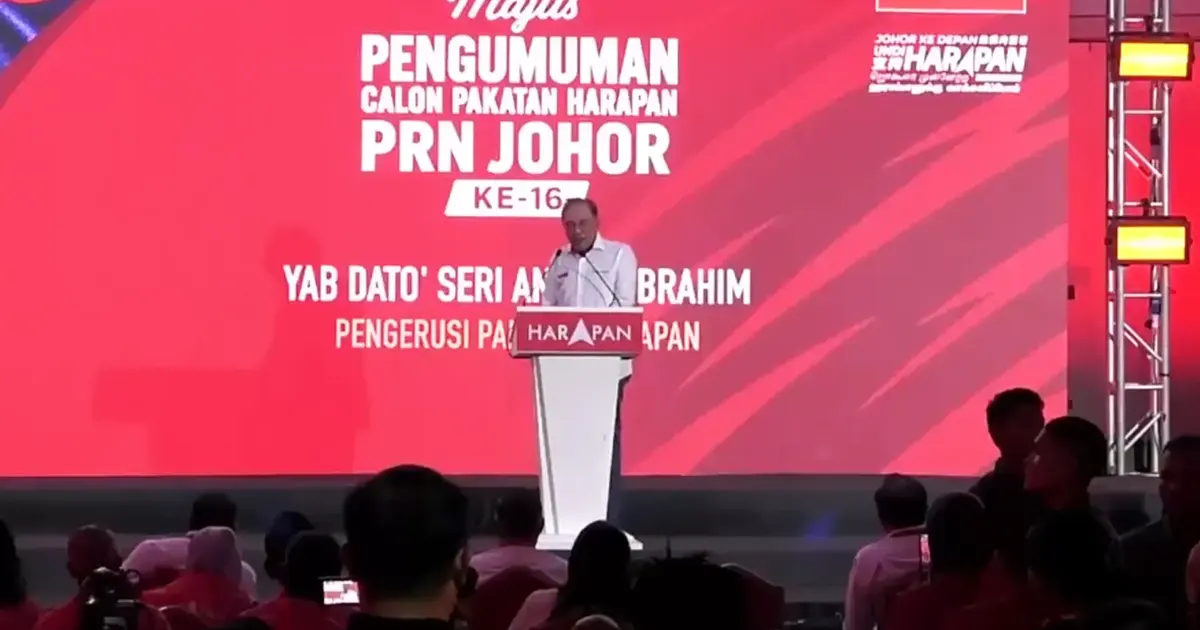
Pakatan Harapan has confirmed its election lineup for two crucial state seats in Johor, tapping former federal education minister Maszlee Malik to represent the Puteri Wangsa constituency while positioning incumbent Member of Parliament Onn Abu Bakar to contest the Senggarang seat. The coalition's strategic selections reflect an effort to leverage experienced political figures and sitting parliamentarians to strengthen its foothold in Malaysia's second-largest state by population.
Maszlee Malik, who previously served as minister of education during the PH government from 2018 to 2020, brings a national political profile to the state-level race. His appointment to contest Puteri Wangsa represents a calculated move to deploy a recognised federal-level figure in what the coalition evidently views as a winnable urban or semi-urban constituency. Having held one of Malaysia's most visible ministerial portfolios, Maszlee carries both brand recognition and accumulated experience navigating complex education policy issues that resonate with Malaysian voters across income and education levels.
Onn Abu Bakar's candidacy for Senggarang marks a strategic cross-level deployment, leveraging his existing parliamentary mandate to expand PH's representation into the state assembly. As the sitting MP for Batu Pahat, Onn brings institutional advantage and established grassroots networks that parties typically leverage when transitioning representatives between different electoral tiers. His selection underscores a common Malaysian political practice wherein successful federal MPs venture into state politics to consolidate influence and build political machines within their geographical strongholds.
The timing and composition of this candidature announcement carry implications for the broader Johor political landscape. Johor has historically served as a crucial battleground between the major political coalitions, with its 56 state seats wielding outsized influence on national coalition mathematics. Recent years have witnessed significant political volatility in the state, including significant shifts in voter preferences and inter-coalition dynamics that have reshaped the state's political balance multiple times.
Pakatan Harapan's investment in these two seats suggests the coalition is prioritising specific constituencies where internal polling or ground assessment indicates competitive viability. Fielding high-profile federal figures in state races is a calculated gambit—it can attract urban and educated voters while simultaneously drawing media attention and campaign resources. However, it also entails converting national political capital into localised support, a transition that does not always succeed, particularly if local grievances and state-specific concerns diverge from federal narratives.
Maszlee's portfolio as former education minister positions him as a potential appeal to parent voters and educators concerned with school standards, curriculum development, and education financing. These remain resonant issues in Malaysian electoral politics, particularly in urban constituencies where education outcomes and institutional quality drive voting behaviour. Yet his tenure also included controversial episodes and policy shifts that may invite scrutiny from opposition forces and critical voter segments.
The Senggarang selection reflects PH's confidence in Onn Abu Bakar's parliamentary standing translating into state-assembly appeal. Incumbency advantages in Malaysian politics frequently extend across electoral levels, as sitting MPs often enjoy name recognition, established administrative relationships, and demonstrated capacity for constituency service. Using parliamentary incumbency as a springboard for state candidacy is a standard coalition tactic aimed at securing supermajority control of state legislatures, which in Malaysia's constitutional framework determines state executive formation.
For Malaysian observers, these candidature decisions illuminate broader coalition positioning ahead of the election. PH continues attempting to recover lost ground in Johor following earlier electoral setbacks and defections. The appointment of experienced federal figures alongside sitting MPs suggests a two-pronged strategy: deploying heavyweight personalities to elevate coalition visibility whilst anchoring campaigns to incumbent MPs' established support networks. This combination reflects coalition strategists' assessment that Johor requires simultaneous national-level political messaging and granular local-level consolidation.
The electoral significance of Johor extends beyond state governance. As Malaysia's most populous opposition-friendly state in certain demographics, Johor state assembly results influence national political momentum and coalition viability assessments. Successful PH performance in Johor could reinvigorate the coalition's image as a credible national alternative, while disappointing results would further entrench perceptions of PH's contraction as a political force. These two candidature announcements thus represent PH's strategic bet that experienced federal politicians and entrenched parliamentary MPs can generate sufficient voter momentum to secure contested constituencies within a state that has proven volatile and unpredictable in recent electoral cycles.

