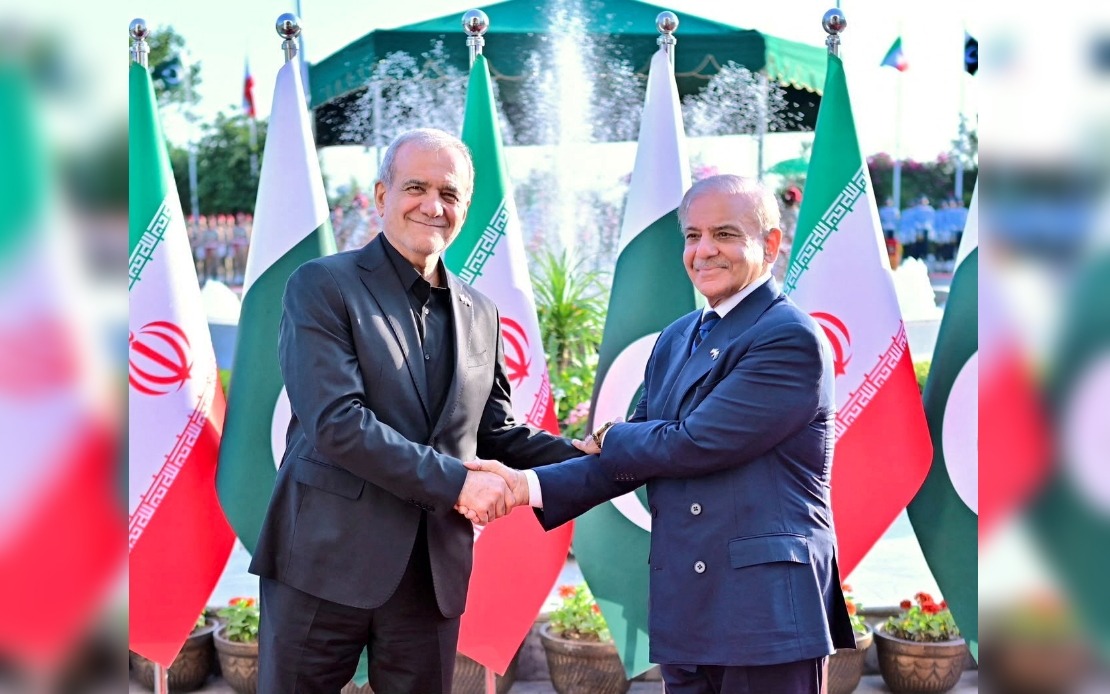
Pakistan's government has thrown its diplomatic weight behind Iran's ballistic missile programme, with Prime Minister Shehbaz Sharif using high-level talks in Islamabad to rebut international criticism of Tehran's weapons capabilities. The strong endorsement came during an official state visit by Iranian President Masoud Pezeshkian, underscoring the deepening strategic alignment between the two neighbouring nations at a pivotal moment in Middle Eastern geopolitics. Sharif's remarks represent a clear signal that Pakistan, despite its efforts to mediate between regional antagonists, sees no contradiction between brokering peace and supporting Iran's defensive military posture.
In carefully framed statements, Sharif distinguished between the recent US-Iran memorandum of understanding—signed on June 17 following months of Pakistan-facilitated negotiations—and the separate matter of Iranian missile capabilities. He pointedly noted that missile systems were never included in the discussions that produced the accord, and that the Iranian delegation had consistently refused to treat this subject as negotiable. This clarification carries significance for Southeast Asian observers, as it demonstrates how regional powers navigate the delicate balance between intermediation and alignment. Pakistan's ability to maintain diplomatic channels with both Tehran and Washington, while publicly championing Iran's security interests, reflects the complex web of relationships that define contemporary Asian geopolitics.
The timing of Sharif's statement gains additional weight given that United States President Donald Trump has recently acknowledged the fairness of Iran possessing ballistic missiles, comparable to other nations. In Paris on June 17, Trump told journalists that denying Iran such capabilities while permitting other countries to maintain them would constitute a clear double standard. This unexpected American concession opens diplomatic space for countries like Pakistan to articulate positions that would previously have drawn Washington's ire, allowing Islamabad to operate with greater freedom in its regional mediation efforts. For Malaysian policymakers observing from Southeast Asia, this shift illustrates how great power recalculation can reshape the possibilities available to middle powers navigating complex regional disputes.
Pezeshkian used his platform in Islamabad to frame Iran's missiles as purely defensive necessities rather than tools of aggression or regional destabilization. Speaking at a joint press conference with Sharif, the Iranian president articulated a narrative familiar across the Middle East: without these weapons, Iran would face the same fate as Gaza, subjected to overwhelming military intervention without restraint. This framing reflects how Tehran conceptualizes its strategic position, viewing its arsenal as the only mechanism preventing what it perceives as existential threats. For Southeast Asian readers, this defensive posture mirrors arguments made by other regional states regarding their own military capabilities, illustrating how security dilemmas and threat perceptions drive weapons development across diverse geographies.
Pakistan's mediation achievements deserve particular scrutiny when assessing the credibility of Sharif's statements. Over preceding months, Pakistan had brokered not only the recent understanding but also a temporary ceasefire between Iran and the United States in April, positioning Islamabad as perhaps the sole neutral actor capable of productive dialogue with both sides. This brokerage role required extraordinary diplomatic dexterity, particularly given Pakistan's own security challenges and historical alignments. Sharif explicitly acknowledged the contributions of Deputy Prime Minister and Foreign Minister Ishaq Dar and Chief of Army Staff Field Marshal Syed Asim Munir in these negotiations, underlining that missile diplomacy represented a whole-of-government effort rather than merely civilian political posturing.
Yet Sharif also warned of what he termed "spoilers all over the world" intent on undermining the nascent understanding between Washington and Tehran. In the Pakistani prime minister's assessment, Israel represents the primary obstacle to regional stability, with its military actions in Lebanon and the occupied Palestinian territories creating perpetual friction that complicates efforts at de-escalation. This characterization reveals how Pakistan perceives the regional balance: as a struggle between forces seeking peace and those benefiting from conflict. For Malaysian observers attuned to regional security dynamics, this analysis raises questions about how smaller nations can influence outcomes when larger powers prioritize their own strategic interests over collective stability.
The ceremonial dimensions of Pezeshkian's visit reinforced the substantive diplomatic messages conveyed in bilateral discussions. Pakistan accorded the Iranian president the full panoply of state honours, including a 21-gun salute and an escorting wing of six Pakistani Air Force fighter jets as his aircraft approached Islamabad. President Asif Ali Zardari personally received Pezeshkian at the airport, alongside Prime Minister Sharif. These theatrical elements communicate respect and partnership to both internal and international audiences, signalling that Pakistan views Iran not as a problematic neighbour requiring careful management, but as a valued strategic partner deserving ceremonial recognition typically reserved for closest allies.
The backdrop to these discussions involves Iran's assessment of its security environment following military strikes by Israel and the United States on February 28. Though details remain contested, the strikes represented a significant escalation in the long-running shadow conflict between Iran and its adversaries. Against this context, Iran's ballistic missiles have acquired heightened strategic importance as potential deterrents to future military action. Pakistani validation of this Iranian security logic carries implications beyond bilateral relations, potentially influencing how other regional powers calculate their own deterrence strategies. Southeast Asian nations navigating their own maritime security challenges may observe how Pakistan's rhetoric demonstrates one approach to legitimizing military capabilities within international discourse.
The broader geopolitical significance of Pakistan's position reflects shifting configurations of power in Asia. For decades, the United States maintained hegemonic control over international narratives regarding weapons of mass destruction and delivery systems, with Washington determining which nations merited such capabilities and which faced sanctions or military pressure. Pakistan's willingness to publicly contradict American preferences—or at least to carve out space where American preferences no longer apply—indicates erosion of this unipolar moment. Malaysia and other Southeast Asian nations, monitoring these developments, must consider whether comparable shifts might affect their own strategic autonomies in coming years.
From a technical standpoint, Sharif's insistence that ballistic missiles fell outside the scope of the US-Iran memorandum holds analytical interest. The exclusion of such capabilities from peace agreements raises questions about whether genuine de-escalation has occurred or whether the accord represents merely a tactical pause in competition. If missiles remain outside negotiating frameworks, Iranian and American strategic competition regarding these systems will persist beneath the surface of official peace, creating ongoing friction. This distinction between formal agreements and practical security competition proves particularly relevant for Southeast Asian states that must sometimes accept peace accords while maintaining independent assessments of actual regional threat levels.
Pakistan's cultivation of relationships with both Iran and the United States, demonstrated through successful mediation followed by public endorsement of Iranian positions, exemplifies a diplomatic strategy increasingly adopted by rising middle powers. Rather than choosing exclusive alignment with one superpower, Pakistan leverages its geographic position and relationships to maintain space for independent action. This approach requires careful calibration: overreach in any direction risks losing credibility with other essential partners. For Malaysia navigating between American and Chinese interests, or between various regional powers with competing claims, Pakistan's model offers both inspiration and caution regarding the possibilities and pitfalls of strategic ambiguity.
Looking forward, the durability of the US-Iran understanding remains uncertain. The exclusion of ballistic missiles from the agreement suggests unresolved tensions that could reignite when political circumstances shift. Pakistan's public backing of Iran's missile programme may complicate future negotiations should Washington seek additional constraints on Iranian capabilities. Yet from Islamabad's perspective, maintaining credibility with Iran appears more strategically vital than accommodating potential future American preferences. This calculation reflects a broader recalibration of regional power dynamics where smaller powers increasingly feel empowered to articulate positions independent of Washington's preferences, reshaping the diplomatic terrain across Asia.
The visit by Pezeshkian to Islamabad, and Pakistan's vocal endorsement of Iran's military capabilities, signals to Southeast Asia that regional alignments remain fluid and that middle powers retain capacity to influence outcomes through skilled diplomacy and strategic positioning. However, the underlying tensions between the United States and Iran remain unresolved, and Pakistan's mediation role, while impressive, faces ongoing tests. Malaysian policymakers monitoring these developments should recognize that Pakistan's success in maintaining relationships across dividing lines reflects particular historical and geographic circumstances that may not be easily replicated elsewhere. Nevertheless, the broader lesson—that countries need not accept imposed hierarchies and can craft independent foreign policies even in constrained circumstances—carries relevance across the Asian region.

