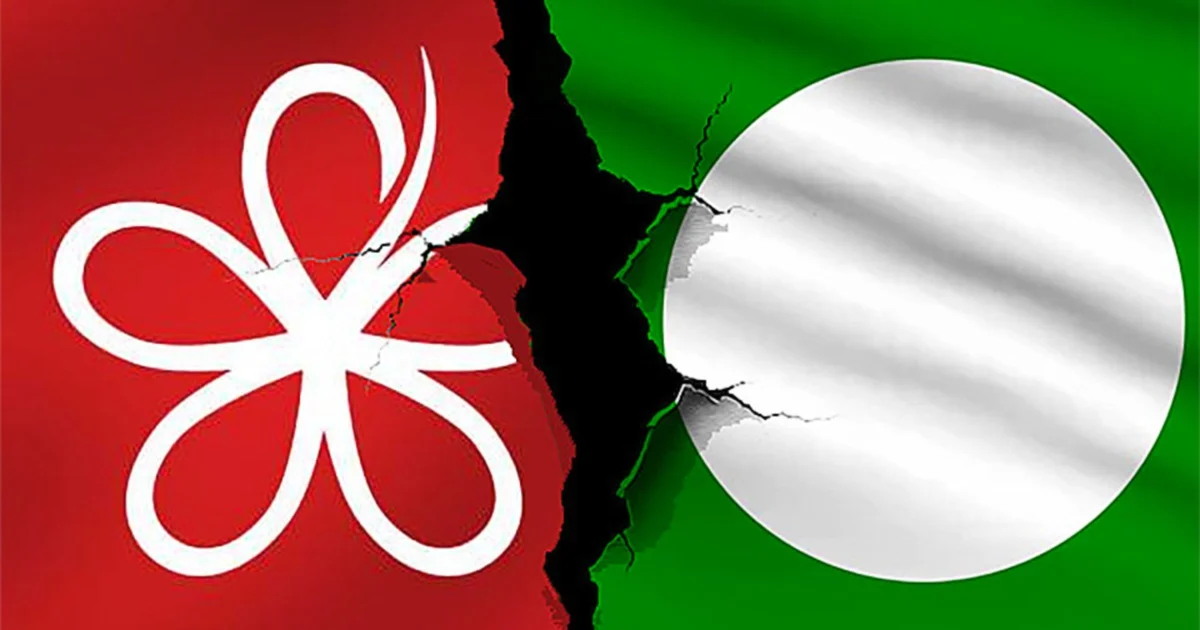
The Perikatan Nasional coalition faces internal turbulence as PAS considers moves to oust Bersatu from the opposition bloc, a development that could reshape Malaysia's political landscape and weaken the alliance's appeal to centrist voters. Political analysts monitoring coalition dynamics have warned that such a manoeuvre carries substantial electoral consequences that extend beyond the immediate dispute between the two partners.
PAS, the pan-Malaysian Islamic Party, has emerged as a dominant force within PN following the 2023 general election, claiming increased legitimacy within Islamist circles. The party's growing assertiveness has created friction with Bersatu, the Bumiputera Empowerment Party founded by former Prime Minister Muhyiddin Yassin, which joined the coalition relatively recently. Underlying tensions about party positioning, resource allocation, and ideological direction have surfaced periodically, though both parties have historically maintained a facade of unity in opposing the governing Pakatan Harapan administration.
The strategic miscalculation in pursuing Bersatu's removal would stem from the composition of PN's broader electoral coalition. Bersatu, despite its smaller parliamentary representation compared to PAS, maintains relevance among certain demographic segments that PN requires to remain nationally competitive. The party commands loyalty in specific state contexts and among voters who appreciate its more moderate positioning on religious and social issues. These constituencies often overlap with wavering voters in urban and semi-urban areas who have grown sceptical of both PAS and ruling-coalition agendas.
Moderate voters across Malaysia have become increasingly pivotal in determining election outcomes, particularly in competitive parliamentary constituencies where margins frequently fall within single-digit percentages. Any perception that PN is being steered toward a more exclusively Islamist agenda could trigger defections among these crucial swing voters. Such demographic shifts have historically benefited ruling coalitions at opposition expense, as voters concerned about governance coherence and pluralistic representation gravitate toward perceived stability rather than ideological consolidation.
Analysts point to the inherent contradiction between PN's need to expand its voter base and any narrowing of its ideological spectrum through factional manoeuvres. The coalition initially gained traction partly because it appeared to offer an alternative to the polarised binary choice between PH and the previous ruling coalition. Removing a party perceived as a counterbalance to PAS's religious platform would fundamentally alter that positioning. Public perception of PN as increasingly dominated by Islamic-centric politics could accelerate the departure of secular-minded and moderate Muslim voters who previously abandoned PH due to governance concerns rather than ideological preference.
Bersatu's presence within PN also serves a practical function in coalition management. The party provides ballast in state-level negotiations and seat distribution discussions, offering flexibility that a purely PAS-dominated coalition would lack. Beyond the 15 federal seats Bersatu currently holds, its influence extends through strategic alliances and personality-driven politics in several states. The loss of this capacity would force PN to depend even more heavily on PAS's organisational machinery and electoral machinery, potentially increasing the Islamic party's leverage over coalition strategy and candidate selection.
International and regional investor sentiment could also shift if PN's internal conflicts translate into perceptions of instability or ideological extremism. Malaysia's competitive positioning in attracting foreign direct investment and maintaining business confidence depends partly on political coherence and predictable governance frameworks. Coalition infighting that appears motivated by religious ideology rather than substantive policy disagreement creates reputational risks that echo beyond domestic political circles. Foreign observers and investors often evaluate political stability through coalition durability and consensus-building capacity.
The timing of PAS's potential move deserves scrutiny in Malaysian political context. The next general election remains scheduled for 2028, providing PN with approximately two years to consolidate messaging and prepare its electoral machinery. Internal factional disputes immediately preceding election campaigns have historically damaged opposition coalitions more severely than governing coalitions, partly because ruling parties can frame instability as opposition weakness. PAS leadership must weigh whether short-term factional advantage justifies medium-term electoral vulnerability.
Historical parallels exist in Malaysian politics where ideologically driven alliance adjustments produced counterintuitive results. Parties that purged perceived ideological opponents frequently discovered that core voters had either departed or become less energised when competing visions within coalitions disappeared. The complexity of Malaysian electoral politics, where voters simultaneously hold multiple preferences regarding Islam's role in governance, economic management, and ethnic representation, requires coalitions that can credibly speak to diverse constituencies.
For moderate voters particularly, the prospect of PN fragmenting over religious policy intensity may simply drive them back toward PH, despite the ruling coalition's governance challenges. The alternative remains not a stronger PN but a further fractionalised opposition landscape benefiting the incumbent administration. Analysts suggest that PAS's strategic interest lies in demonstrating inclusive coalition leadership rather than sectarian dominance, a message that resonates more powerfully in Malaysia's diverse electorate than purist ideological positioning.
Bersatu's retention within PN therefore carries significance extending far beyond normal coalition mechanics. It represents the coalition's commitment to maintaining relevance among Malaysia's ideological centre—a critical battleground in 2028 where the ultimate election outcome will likely be determined. PAS leadership's calculation on this matter will substantially influence whether PN strengthens as a credible governmental alternative or weakens through self-inflicted ideological narrowing.