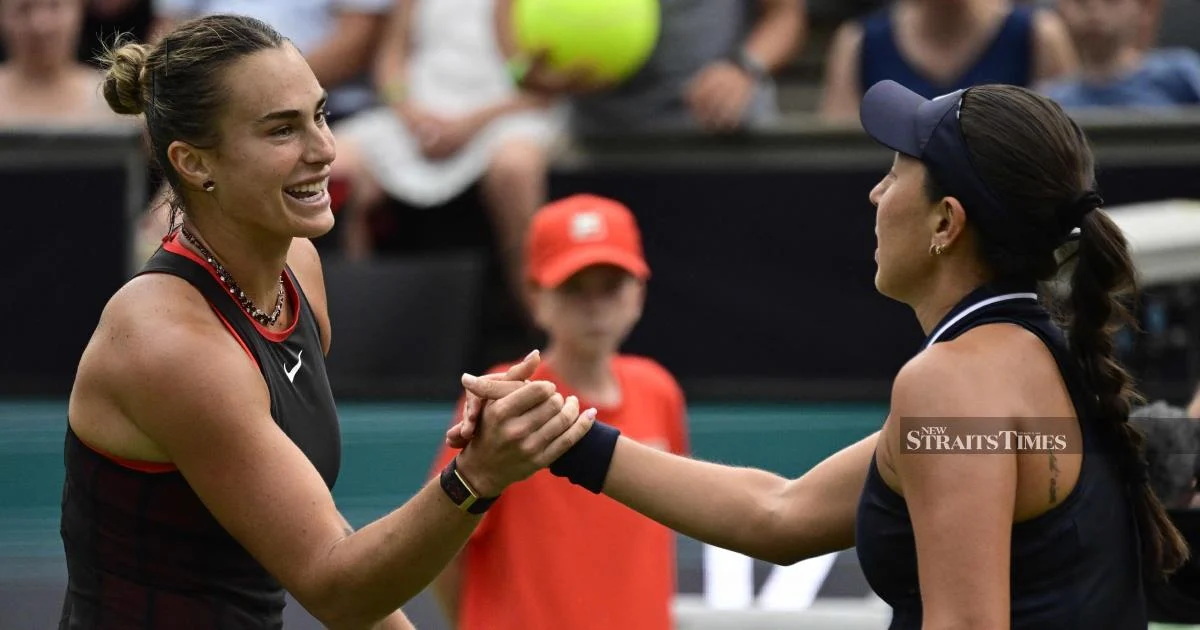
Jessica Pegula's impressive run at the Berlin WTA grass-court championship deepened on Friday as the American delivered a decisive semi-final victory over reigning world number one Aryna Sabalenka, securing a 6-2, 6-7 (4-7), 6-0 triumph to book her place in the final. The result marks Pegula's second appearance in the championship decider, underlining her credentials on one of the professional tennis circuit's most demanding surfaces.
Pegula's performance against the top-ranked Sabalenka demonstrated the depth of her grass-court game and her capacity to compete at the highest level against tennis's elite. Though Sabalenka carries the considerable weight of being the world's primary ranking holder, the American refused to be intimidated by the scoreboard, instead constructing her victory through aggressive baseline play and precise net positioning. The one-sided nature of the opening set, which Pegula claimed with remarkable efficiency at 6-2, suggested the dynamics of the contest had swung decisively in her favour from the opening exchanges.
The second set proved more competitive and ultimately proved the turning point in terms of momentum. Sabalenka mounted a spirited comeback after dropping the first frame, levelling the match through superior play in extended passages and forcing the set into a tie-break. However, that mini-break would prove the closest the Belarusian would come to preventing the American's progress. Pegula's execution in the crucial moments of the tie-break proved superior, allowing her to prevail 7-4 when points mattered most and to move within one set of the final.
Having secured a two-set advantage with the psychological momentum firmly in her possession, Pegula overwhelmed Sabalenka completely in the third set. The American's dominance during that concluding frame was absolute, with the scoreline of 6-0 telling the entire story of control and superiority. Such decisive set scores at this level of professional tennis typically reflect not merely technical excellence but also a significant shift in confidence, with Pegula evidently growing stronger as the match progressed while Sabalenka appeared to diminish physically or mentally as the contest developed.
The Berlin grass-court event, officially known as the Internationaler Tennisclub Berlin (Steffi Graf Stadion), stands among the most prestigious tournaments on the women's professional calendar and has produced numerous memorable champions throughout its history. The surface itself presents unique challenges distinct from hard courts and clay, demanding aggressive play, swift footwork, and the ability to construct points efficiently at the net. Players accustomed to the slower clay surfaces that dominate much of the European season often require significant adjustment periods when transitioning to grass, making Pegula's control against the world number one particularly noteworthy.
For Pegula, this represents career momentum building at a crucial juncture in her season. The American has established herself among the sport's steadier competitors in recent years, consistently performing at Grand Slam tournaments and maintaining a top-20 ranking that reflects her status as a reliable major contender. Her presence in the Berlin final for the second time indicates that she has acquired a comfort level with the grass surface that rivals and even exceeds that of many specialist grass-court players, a development that should encourage her team's confidence heading toward Wimbledon, where similar playing conditions await.
Sabalenka's exit from the tournament, meanwhile, will prompt examination of how the top-ranked player performed in this particular tie. While the Belarusian's dominance in recent months on faster surfaces has been undeniable, her track record on grass courts has historically lagged behind her performance on other surfaces. The decisive nature of the loss here suggests that adjustments may be necessary if Sabalenka is to mount a serious challenge at grass-court majors later in the season, particularly as Wimbledon approaches on the calendar.
Pegula's pathway to the final now depends upon the outcome of the remaining semi-final contest, which will determine her opponent in what promises to be a compelling championship match. Regardless of her opponent's identity, Pegula will carry considerable confidence into the final, having demonstrated both technical proficiency and mental fortitude in dispatching the world's top-ranked player across three sets. The American's aggressive approach and consistent execution on grass have clearly paid dividends and appear likely to serve her well in the final stage of this Berlin tournament.
For Southeast Asian tennis followers monitoring the development of women's professional tennis, Pegula's emergence as a genuine threat at grass-court events adds another dimension to what has become an increasingly competitive field at this level. Her ability to adapt across surfaces and compete against the sport's elite players provides a template for younger players developing their games, demonstrating that success in tennis frequently requires versatility and the capacity to perform effectively under pressure against world-class opposition.

