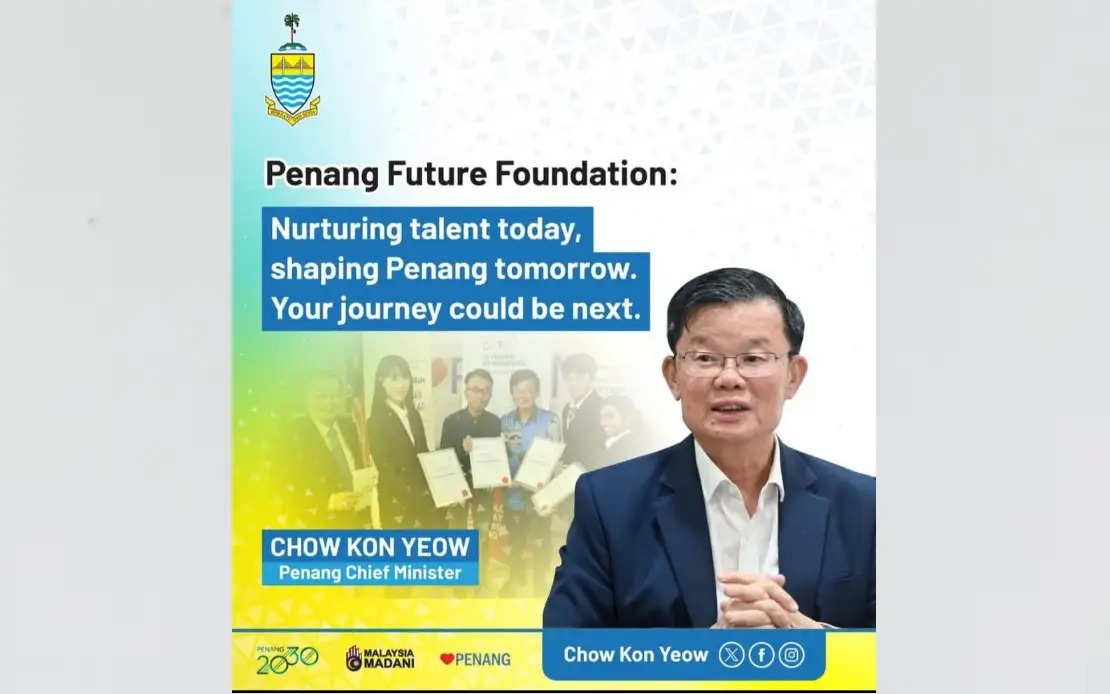
The Penang Future Foundation, a scholarship programme launched by the state government in 2015, has channelled nearly RM47.7 million towards developing Malaysian talent across 863 individual awards over the past decade. Now in its 11th year of operations, the initiative reflects the Penang administration's commitment to addressing workforce demands in high-skill sectors whilst positioning the state competitively within Malaysia's knowledge economy.
Chief Minister Chow Kon Yeow underscored the foundation's strategic importance for Penang's economic trajectory, emphasising that retaining skilled professionals has become essential as the state pursues ambitious growth targets over the coming five decades. The scholarship programme operates through a collaborative funding model combining government resources with private sector contributions, creating a sustainable mechanism for supporting academic excellence among deserving candidates nationwide.
Last year's cohort of 58 scholarship recipients exemplifies the breadth of the foundation's reach. These students pursued diverse educational pathways spanning Science, Technology, Engineering, Mathematics, accountancy and finance—sectors identified as critical to Penang's competitive advantage in attracting multinational corporations and fostering homegrown innovation ecosystems. The deliberate focus on STEM and financial professions reflects regional and global trends showing persistent skills shortages in these fields.
The foundation operates two distinct scholarship tiers to accommodate varying academic profiles. The PFF Penang Scholar category targets high-achieving students with cumulative GPAs of 3.67 or above, whilst the PFF Mutiara Scholar stream extends opportunities to those with GPAs between 3.00 and 3.66. This tiered approach broadens accessibility whilst maintaining rigorous academic standards, ensuring that talented individuals across multiple performance levels receive support.
For Malaysian students considering applications, the 2026 cycle opens substantially on July 15 and closes August 5. The compressed application window requires prospective applicants to monitor the foundation's official website at www.penangfuturefoundation.my for periodic updates and submission guidelines. This transparent, centralised approach reduces administrative barriers whilst maintaining application integrity.
Chow's remarks highlight how state governments are increasingly competing to retain domestic talent amid regional brain drain pressures. By investing directly in scholarships for Malaysian students—regardless of geographic origin—Penang positions itself as an employer destination for graduates seeking pathways into quality careers. This strategy extends beyond mere altruism; it represents calculated economic development policy aimed at strengthening the labour supply pipeline for high-value industries.
The foundation's cumulative impact becomes apparent when considering scale. Nearly RM48 million in scholarships translates to significant financial relief for recipients, reducing education costs that often deter talented but resource-constrained students from pursuing advanced qualifications. For recipient families, such support removes educational access barriers whilst signalling state-level commitment to meritocratic advancement.
Industry alignment proves crucial to the foundation's credibility and impact. By prioritising STEM and finance disciplines, the programme responds directly to employer demands documented across Southeast Asian labour market analyses. Penang's concentration in electronics manufacturing, semiconductor processing and emerging digital services creates genuine employment prospects for graduates in these fields, strengthening the causal connection between scholarship investment and career outcomes.
The private-public funding model deserves emphasis as it reflects evolving corporate social responsibility approaches within Malaysia. Businesses contributing to the foundation gain reputational benefits whilst accessing talent pipelines aligned with their hiring preferences. This symbiotic arrangement distributes funding responsibilities whilst embedding corporate values into scholarship governance.
Statewide participation demonstrates the foundation's inclusive philosophy. Rather than restricting awards to Penang-domiciled students, the programme welcomes applicants from across Malaysia, essentially functioning as a talent recruitment mechanism. This approach generates goodwill nationally whilst ensuring the foundation selects from the broadest possible candidate pool, maximising quality outcomes.
For current and prospective students, the foundation represents tangible opportunity amid rising tertiary education costs. Scholarship recipients gain not merely financial support but also networking exposure through a curated cohort of high-performing peers. Such social capital, accumulated during the scholarship period, often proves invaluable as graduates enter professional networks.
Looking forward, the foundation's sustainability depends on maintaining diverse funding sources and demonstrating measurable graduate outcomes to stakeholders. Tracking alumni career trajectories, measuring employment rates within target sectors and quantifying contributions to Penang's economic development will strengthen the business case for continued investment from both government and corporate sponsors.

