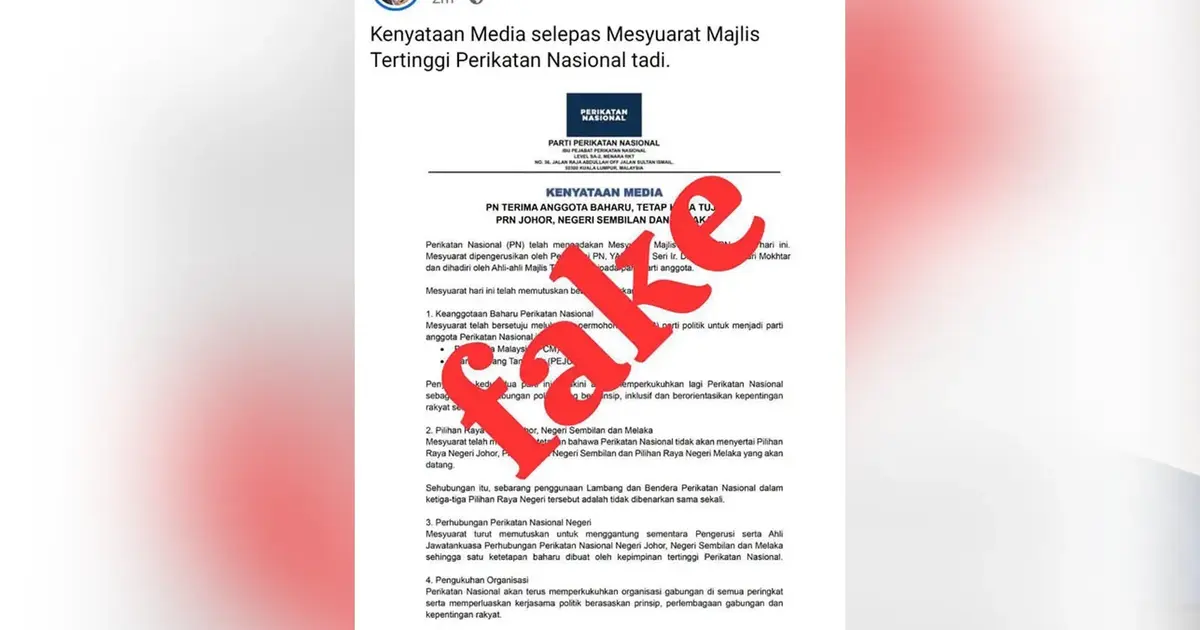
Perikatan Nasional moved swiftly to extinguish rumours circulating on social media that suggested the opposition coalition plans to abstain from competing in three state electoral contests. The coalition issued a formal statement characterising the allegations as misleading and without factual foundation, underlining their commitment to electoral participation across Malaysia's diverse political landscape.
The emergence of such claims reflects the intensifying political manoeuvring ahead of Malaysia's electoral calendar, where positioning and strategic decisions by major coalitions can significantly influence state-level outcomes. Perikatan Nasional, which has consolidated considerable influence in several states and contested aggressively in recent federal ballots, has built its political brand on widespread engagement across the country. The denial therefore carries strategic weight, as any perceived withdrawal from electoral competition might suggest weakness or shifting priorities within the coalition's leadership structure.
Fake statements and misinformation regarding political parties remain a persistent challenge in Malaysia's media ecosystem. The rapid spread of unverified claims through social platforms—particularly messaging applications and Facebook—has complicated the information landscape, making it increasingly difficult for voters to distinguish authoritative communications from fabricated narratives. Political parties across the spectrum have grappled with this phenomenon, often finding that rebuttals, while necessary, struggle to achieve the same viral reach as the original false claims.
For Perikatan Nasional specifically, such false attributions carry particular significance given the coalition's relatively recent consolidation as a major political force. The coalition brings together parties with distinct geographical strongholds and ideological foundations, and maintaining unified messaging across these constituent parties requires careful coordination. Any suggestion of strategic retreat or inconsistency across different levels of governance can create internal tensions and external perceptions of disunity.
The coalition's swift response demonstrates the importance Malaysian political actors now place on countering misinformation in real time. Unlike traditional media spaces where corrections could be scheduled for publication, the digital environment demands immediate reaction to preserve credibility and control narrative flow. The speed of Perikatan Nasional's denial reflects this contemporary political reality, where a party's ability to respond promptly has become integral to managing public perception.
State elections in Malaysia carry outsized importance within the broader electoral ecosystem. While federal elections determine national governance, state-level contests shape local policy implementation, resource allocation, and the political fortunes of regional leaders. For coalitions like Perikatan Nasional, maintaining competitive presence across all available electoral contests serves both practical and symbolic purposes—practical in securing influence over state governments and symbolic in demonstrating comprehensive political reach throughout the federation.
The circulation of false claims about electoral participation also raises questions about the disciplinary mechanisms governing political discourse in Malaysia. While laws exist addressing sedition and defamation, the enforcement of rules against deliberate misinformation remains uneven and sometimes controversial. Political actors therefore often rely on rapid public rebuttals rather than legal recourse, a strategy that depends entirely on media attention and audience receptivity.
Peikatan Nasional's coalition partners bring varied electoral strategies and regional strengths to the larger formation. Ensuring coordination across these entities regarding participation in state elections requires ongoing negotiation and consensus-building. The false statement's suggestion that the coalition might skip certain contests therefore potentially touched on sensitive internal discussions around resource allocation and strategic priorities—making the denial not merely a factual correction but a reassurance to constituent parties about commitment to electoral engagement.
The incident also underscores how Malaysian voters increasingly navigate multiple information streams simultaneously, often lacking established mechanisms to verify political claims before accepting or sharing them. This information fragmentation creates openings for false narratives to gain traction, particularly when they align with existing political narratives or play into observers' preconceived expectations about coalition behaviour. Perikatan Nasional's experience reflects challenges facing all major political actors in sustaining message discipline across competing platforms.
Moving forward, political parties in Malaysia may need to invest more substantially in direct communication channels with their base, reducing dependency on third-party platforms where false attributions can circulate unchecked. For Perikatan Nasional, the false statement serves as a reminder that maintaining clear, consistent messaging across all electoral levels remains essential to preserving coalition cohesion and voter confidence as Malaysia's political landscape continues to evolve.

