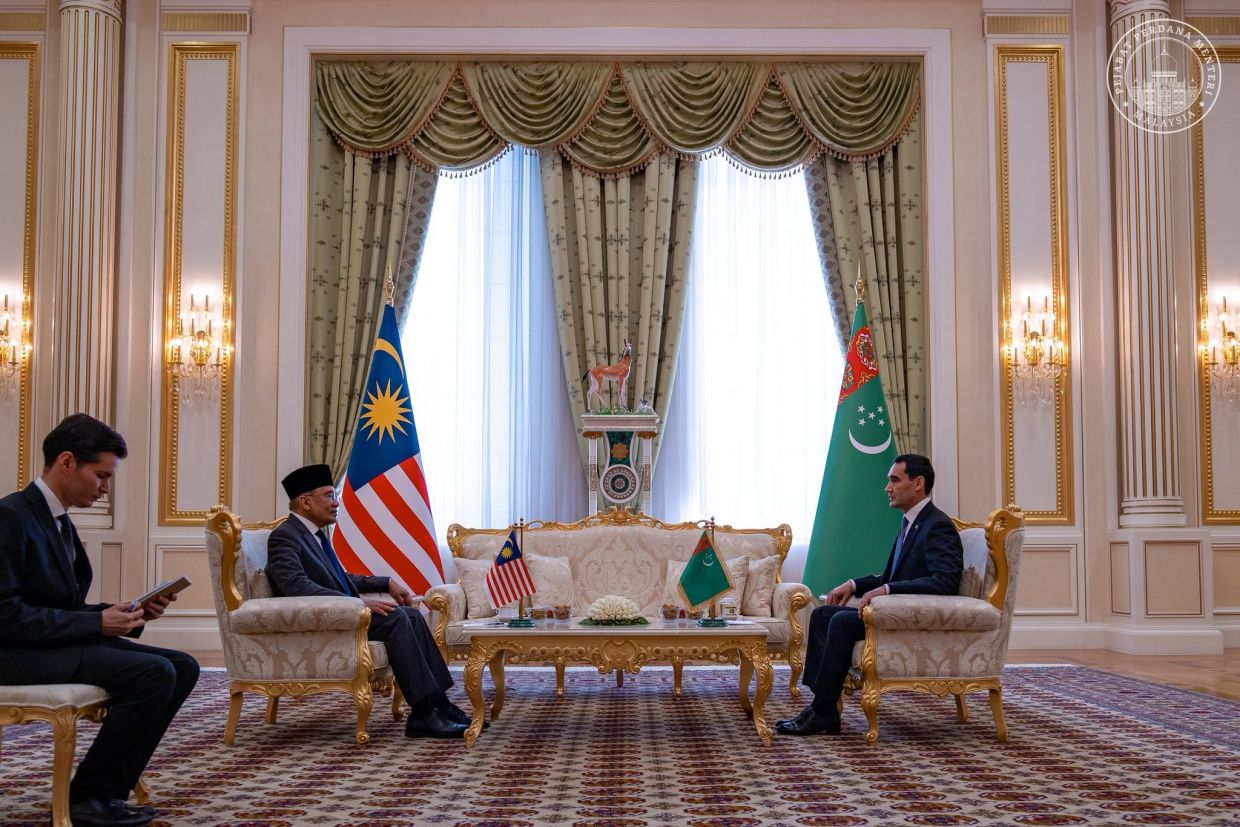
Prime Minister Datuk Seri Anwar Ibrahim and Turkmenistan President Serdar Berdimuhamedov today oversaw the formalisation of a strategic partnership between national oil and gas giant PETRONAS and Turkmenistan authorities, crystallising deepening ties between Malaysia and the oil-rich Central Asian nation. The accord, inked during Anwar's two-day official visit to Ashgabat, represents both a culmination of three decades of bilateral energy sector engagement and a platform for expanded cooperation in one of the world's most strategically significant hydrocarbon-producing regions.
The timing of the partnership carries particular resonance, coinciding precisely with the three-decade milestone in Malaysia-Turkmenistan energy collaboration. This longevity underscores the resilience and mutual benefit of the relationship, transforming what began as exploratory engagement into a mature, institutionalised framework for technology transfer, skill development, and resource management. The Prime Minister's Office characterised the arrangement as extending well beyond conventional commercial transactions, framing it instead as a mechanism for knowledge dissemination and expertise-sharing that positions both nations as beneficiaries of technological advancement.
Turkmenistan possesses among the planet's most expansive proven and potential natural gas reserves, a resource endowment that has historically shaped its economic orientation and geopolitical significance. The new partnership explicitly contemplates deeper Malaysian involvement in developing these vast energy deposits, a prospect that carries substantial implications for PETRONAS's international portfolio and Malaysia's standing within global energy markets. For Turkmenistan, the arrangement reflects confidence in Malaysian technical capabilities and project execution standards, particularly given PETRONAS's established track record across multiple hydrocarbon basins and operational environments.
The agreement also projects Malaysia's technological and human capital capacities onto a broader international canvas. By demonstrating that Malaysian firms and expertise can command partnership opportunities with resource-rich nations, the accord validates the MADANI government's broader strategic industrial aspirations. This visibility extends Malaysia's influence beyond its immediate Southeast Asian neighbourhood, positioning the country as a credible interlocutor in Central Asian energy diplomacy and investment frameworks—a domain traditionally dominated by established global powers and Asian competitors.
Financial dimensions of the relationship underscore its substantive nature. PETRONAS has maintained a continuous investment presence in Turkmenistan since 1996, accumulating total commitments of RM52.73 billion across nearly three decades. This cumulative capital deployment reflects sustained confidence in the operational environment and partnership potential, despite the extended timeframe required for hydrocarbon development projects to yield returns. The scale of investment places PETRONAS among significant foreign economic actors within Turkmenistan's industrial landscape, granting the Malaysian enterprise considerable structural influence over energy sector development.
Bilateral trade flows reveal a complementary economic dynamic, with Malaysia's 2025 exports to Turkmenistan valued at RM75.50 million, representing a nine percent annual increase. Although trade volumes remain modest relative to Malaysia's engagement with other regions, the growth trajectory and Turkmenistan's designation as Malaysia's fourth-largest trading partner within Central Asia indicate expanding commercial interconnection. These trade relationships typically precede and facilitate deeper investment and partnership arrangements, suggesting that current expansion may portend further intensification of bilateral economic integration.
The strategic partnership carries implications for Malaysian energy security and long-term resource diversification strategies. As global energy markets face transition pressures and geopolitical volatility affects conventional supply chains, securing preferential access to established hydrocarbon reserves provides strategic insurance for domestic energy requirements and export revenue generation. Additionally, exposure to Central Asian energy challenges and opportunities enriches PETRONAS's operational experience and enhances the corporation's capacity to execute complex projects in diverse regulatory and geographical contexts.
From a geopolitical perspective, the partnership reflects broader Malaysian positioning within Asian regional architecture. Malaysia's engagement with Central Asian energy producers and states differentiates it from competitors concentrating exclusively on Middle Eastern or Southeast Asian resource relationships. This diversified approach to energy diplomacy reduces dependency on any single supplier region and enhances negotiating leverage across multiple energy-producing jurisdictions. Turkmenistan, meanwhile, benefits from reduced concentration of economic partnerships, as Malaysia's involvement supplements existing relationships with traditional partners, thereby improving Turkmenistan's strategic autonomy.
The accord also addresses contemporary energy market imperatives around transition and decarbonisation. Natural gas, whilst a hydrocarbon, occupies an intermediate position in global energy transition narratives, offering lower carbon intensity than crude oil and coal whilst bridging the transition toward renewable energy systems. Malaysian involvement in developing Turkmenistan's gas sector positions PETRONAS to participate in this transitional phase, potentially incorporating carbon management technologies and sustainable extraction practices that satisfy both commercial and environmental objectives.
Anwar's physical presence at the signing ceremony, rather than delegation to subordinate officials, signals prime ministerial elevation of the partnership within Malaysia's diplomatic and economic priorities. This high-level engagement communicates to Turkmenistan the seriousness of Malaysian commitment and provides political cover for future partnership deepening. Such symbolic gestures, whilst appearing ceremonial, establish the diplomatic foundation upon which technical and commercial cooperation ultimately depends, particularly within relationship contexts where trust and mutual respect carry outsized importance.
Looking forward, the partnership architecture creates institutional mechanisms for managing bilateral energy cooperation across multiple dimensions—upstream exploration and development, downstream processing, technology transfer, workforce training, and research collaboration. This multidimensional approach maximises relationship resilience by distributing mutual benefits across diverse value chain segments, thereby anchoring partnerships beyond narrow commercial considerations. For Malaysian stakeholders, the arrangement opens sustained revenue generation pathways whilst simultaneously amplifying Malaysia's presence within one of Asia's most strategically consequential energy regions.

