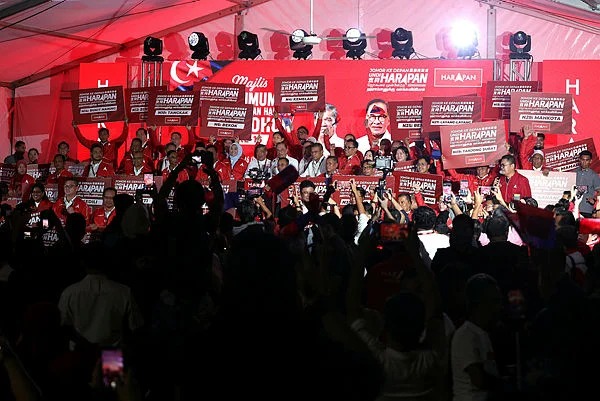
Malaysian politics is organised around coalitions rather than single parties, and three dominate the national stage in 2026: Pakatan Harapan, Barisan Nasional and Perikatan Nasional. Understanding how they line up is essential to following the Johor state election.
Pakatan Harapan (PH), the "Alliance of Hope," is chaired by Prime Minister Anwar Ibrahim. Its three main components are PKR (the People's Justice Party), the DAP (Democratic Action Party) and Amanah (the National Trust Party). Its leaders include Anwar at PKR, Anthony Loke at the DAP and Mohamad Sabu at Amanah. PH is the largest bloc in the federal Dewan Rakyat.
Barisan Nasional (BN), the "National Front," is the long-dominant coalition led by UMNO president and Deputy Prime Minister Ahmad Zahid Hamidi. Its core parties are UMNO, the MCA and the MIC. Once Malaysia's sole governing coalition for decades, BN is now a pillar of the federal unity government.
Perikatan Nasional (PN), the "National Alliance," has historically been built around Bersatu and PAS, with Gerakan. Its leadership and composition have been in flux during 2026: PN is now chaired by Ahmad Samsuri Mokhtar of PAS, who replaced Muhyiddin Yassin, and the alliance has been reshaped by tensions between its component parties. PN remains the main opposition bloc federally.
A crucial point for 2026: at the federal level, PH and BN — historic rivals — govern together in a unity government formed after the November 2022 general election. However, in the Johor state contest they are running as separate competitors, not as a joint ticket. The caretaker Menteri Besar drew this distinction publicly, and PH fielded its own slate of 56 candidates, announced by Anwar on June 22, 2026.
So while national headlines describe PH and BN as partners, Johor voters on July 11 face a genuine multi-cornered contest in which those same coalitions compete against one another seat by seat.

