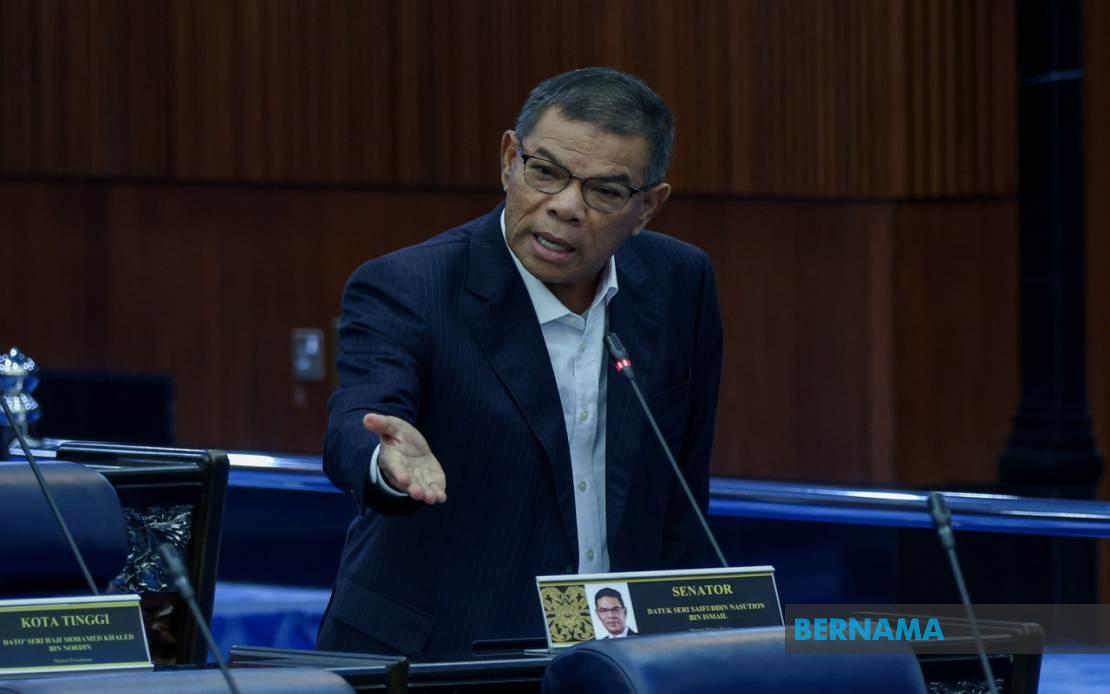
Prime Minister Datuk Seri Anwar Ibrahim has approved a RM22 million allocation to supply the Border Control and Protection Agency (AKPS) with firearms and equipment deemed appropriate for its operational requirements, Home Minister Datuk Seri Saifuddin Nasution Ismail announced during parliamentary question time. The decision came after escalating concerns about personnel safety at Malaysia's border checkpoints, where officers have long operated without adequate protective resources.
The funding commitment represents a significant investment in border security infrastructure and directly responds to a dangerous incident in February when gunfire targeted a vehicle carrying one of AKPS's senior commanders in Bukit Kayu Hitam, Kedah. This attack underscored the vulnerability of agency personnel who were patrolling the nation's entry points without standard weaponry or protective equipment. Saifuddin Nasution explained that the Prime Minister acted swiftly after receiving his formal request, recognising the urgent operational necessity to strengthen the defensive capabilities of frontline officers managing Malaysia's increasingly complex border environment.
The supplementary question prompting the announcement came from Datuk Seri Takiyuddin Hassan of Kota Bharu, who highlighted persistent constraints faced by AKPS officers operating without safety equipment. This parliamentary intervention reflects broader concern within the legislature about the practical challenges confronting officers tasked with controlling movement across Malaysia's land, air, and sea borders. The shooting incident served as a catalyst, transforming longstanding requests for protective measures into a budgetary priority that reached the Prime Minister's office.
Saifuddin Nasution acknowledged an important operational reality: AKPS comprises personnel transferred from multiple government agencies, including the Ministry of Health, yet only specific segments possess the training and certification to operate firearms responsibly. This heterogeneous workforce structure means the RM22 million allocation cannot be distributed uniformly; instead, authorities must identify qualified personnel—notably those with police backgrounds—and concentrate advanced weaponry among officers certified to deploy such systems safely. This selective distribution approach balances security enhancement with risk management.
The establishment of AKPS itself represents a fundamental restructuring of Malaysia's border administration. Previously, border control responsibilities fragmented across more than twenty separate agencies, creating bureaucratic inefficiency and, more problematically, multiple opportunities for corruption and procedural irregularities. By consolidating these functions under a single operational entity, the government aims to eliminate sequential administrative processes that slow response times and create integrity vulnerabilities. Saifuddin Nasution characterised this consolidation as essential for reducing corruption exposure and streamlining decision-making at the nation's entry points.
During its inaugural year of operations, AKPS has already compiled a notable operational record. The agency coordinated a major drug seizure valued at tens of millions of ringgit at Penang International Airport, demonstrating capacity for large-scale interdiction operations. Additionally, cooperation with partner agencies has enabled AKPS to detect e-waste smuggling at Malaysian ports, addressing both environmental protection and revenue protection objectives. These successes suggest the agency's unified command structure enhances coordination between formerly separate agencies and produces tangible results in combating transnational crime.
Questions about AKPS's constitutional standing and impact on Sabah and Sarawak's autonomy have featured prominently in parliamentary debate. Datuk Seri Shafie Apdal of Warisan-Semporna sought assurance that the agency's operations comply with constitutional requirements and respect the special provisions of the Malaysia Agreement 1963. Saifuddin Nasution responded by confirming that AKPS operations do not violate the Federal Constitution and that Sabah and Sarawak's constitutional protections remain intact. He further noted that these constitutional and jurisdictional issues were exhaustively discussed before the AKPS Bill reached parliament, indicating that current implementation concerns focus on operational effectiveness rather than underlying policy legality.
The establishment of AKPS reflects a broader government strategy of consolidating fragmented security and enforcement agencies into unified operational frameworks. Saifuddin Nasution cited precedents including the Eastern Sabah Security Command (ESSCOM) and the Malaysian Maritime Enforcement Agency (MMEA), both of which successfully integrated multiple agencies under single command structures while enhancing security outcomes. These examples suggest that consolidation, coupled with adequate resourcing and modern equipment, can overcome bureaucratic fragmentation and strengthen national security capacity.
The RM22 million allocation addresses a critical operational gap that has constrained AKPS effectiveness since its establishment. While the agency inherited personnel and infrastructure from predecessor agencies, it often inherited outdated or insufficient equipment specifications. The firearms and protective gear funded through this allocation will modernise the agency's defensive capabilities and signal commitment to personnel welfare—a factor increasingly important for recruitment and retention in demanding border security roles. By equipping officers with appropriate tools, the government acknowledges the real dangers inherent in border enforcement work.
For Malaysia's security architecture, this funding decision carries several implications. It demonstrates parliamentary willingness to appropriate substantial sums for border security when operational necessity is demonstrated. It also reflects growing recognition that consolidating security functions requires upfront investment in equipment and training to realise the efficiency and integrity benefits of unified command structures. As AKPS matures and operational demands intensify, additional funding requests for training facilities, surveillance technology, and personnel development may follow this initial allocation.
The timing of this announcement—more than four months after the February shooting incident—suggests careful deliberation about implementation details and budget capacity. Rather than rushing to acquire firearms, the government appears to have conducted proper assessments of AKPS personnel qualifications and operational requirements. This measured approach, culminating in a substantial but targeted allocation, reflects the complexity of equipping a merged agency comprising personnel with varying backgrounds and capabilities. The RM22 million figure represents a balance between operational ambition and fiscal responsibility.

