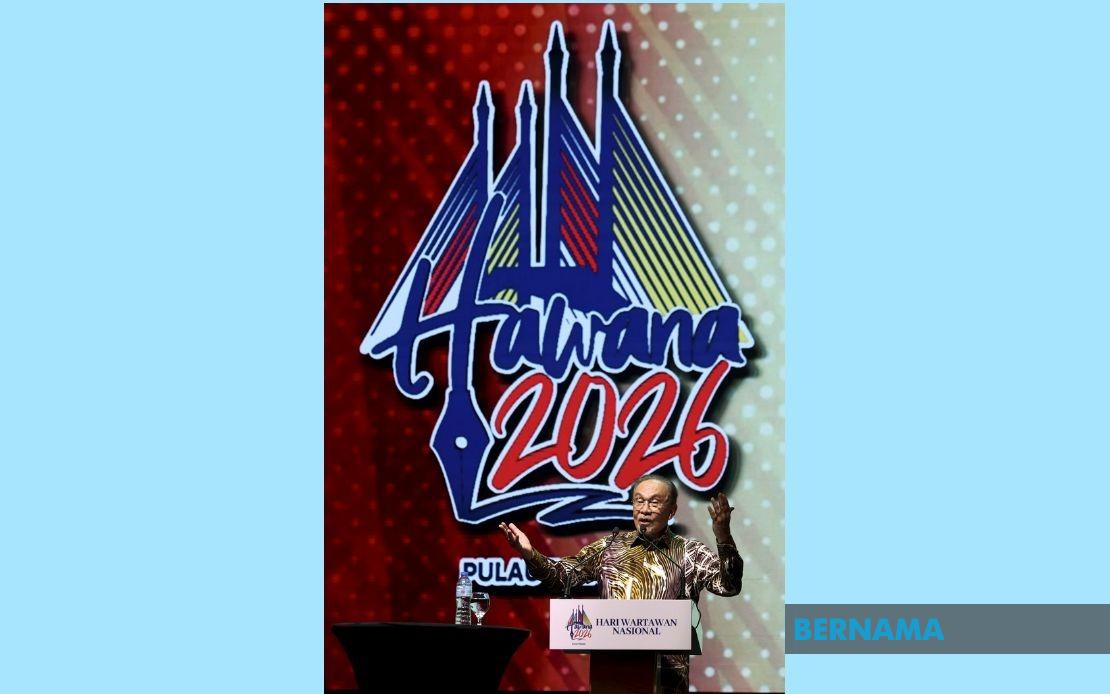
Prime Minister Datuk Seri Anwar Ibrahim has unveiled an additional RM1 million allocation for Tabung Kasih@HAWANA, reinforcing the government's commitment to safeguarding the financial security of Malaysia's journalism community. The announcement came during the National Journalists' Day (HAWANA) 2026 main event held at the PICCA Convention Centre@Butterworth Arena in Butterworth, where Anwar, who concurrently holds the Finance Minister portfolio, outlined the fresh injection of funds as a demonstration of the administration's ongoing dedication to media sector welfare.
The Tabung Kasih@HAWANA represents a targeted social safety net specifically designed for journalists and former media practitioners facing financial hardship. Since its inauguration during HAWANA 2023 celebrations, the fund has expanded its reach considerably, with 773 media professionals nationwide having accessed support totalling RM2.26 million to date. The fund operates across multiple dimensions of assistance, encompassing direct financial aid to those experiencing economic difficulty, coverage of medical expenses for practitioners and their dependants, family welfare support during critical periods, and other tailored interventions responsive to the unique pressures inherent in journalism work.
Anwar's framing of the additional allocation as stemming from a principle of "compassion and care" signals a broader philosophical positioning around media support within government policy. By characterising the commitment in these humanitarian terms rather than purely institutional or regulatory language, the Prime Minister appears to be emphasising that press freedom and journalist welfare are interconnected concerns worthy of state investment. This rhetorical approach carries particular significance in Malaysia's media landscape, where questions of press autonomy and professional security have historically been contested terrain.
The HAWANA 2026 gathering itself served as a substantive platform for discussing contemporary media challenges. Held under the theme 'Media Integrity Strengthens Credibility', the event drew together more than 1,000 media professionals from across Malaysia and international delegations representing Timor-Leste, Cambodia, and Laos. This cross-border participation underscores growing regional recognition that journalism faces common pressures across Southeast Asia, from economic sustainability questions to information warfare and erosion of public trust.
The breadth of official representation at the Butterworth event—including Penang Chief Minister Chow Kon Yeow, Communications Minister Datuk Fahmi Fadzil, and senior Communications Ministry officials—reflects the government's institutional prioritisation of the journalists' day celebrations. Malaysian National News Agency (Bernama) leadership, including chairman Datuk Seri Wong Chun Wai and chief executive officer Datin Paduka Nur-ul Afida Kamaludin, also participated prominently, highlighting the state news agency's central role in coordinating official support mechanisms for the broader media community.
For Malaysian journalists specifically, the expanded Tabung Kasih@HAWANA fund addresses a persistent structural vulnerability within the profession. Media practitioners in Malaysia frequently operate under precarious employment conditions, with freelancers and workers at smaller outlets particularly exposed to income volatility and limited access to conventional social security provisions. The welfare fund fills a critical gap, offering financial cushioning during periods of unemployment, illness, or other crises that might otherwise force experienced journalists out of the profession entirely. This retention function carries implications beyond individual welfare, as the preservation of experienced practitioners contributes to maintaining professional standards and institutional memory within news organisations.
The timing of the announcement also merits consideration within Malaysia's broader political and economic context. As the nation navigates post-pandemic economic recovery and inflation pressures continue affecting household budgets nationwide, government support for specific professional groups carries symbolic weight. Investment in journalist welfare can be read as recognition that media sector sustainability constitutes a public good rather than merely a private commercial matter. This framing potentially opens conversation about other policy supports that might strengthen journalism's institutional viability—from tax incentives for media organisations to regulatory frameworks protecting editorial independence.
The fund's expansion occurs amid evolving regional trends in media economics and journalist working conditions across Southeast Asia. Countries throughout the region have witnessed newspaper circulation declines, advertising revenue migration to digital platforms, and intensifying competition for audience attention. Within this landscape, government welfare provisions like Tabung Kasih@HAWANA offer a counterweight to purely market-driven outcomes that might otherwise degrade working conditions or reduce entry pathways for aspiring journalists. The fund therefore represents a policy choice to actively intervene in professional welfare rather than allowing market forces alone to shape the sector's human capital dynamics.
Practical accessibility remains a key consideration in evaluating the fund's effectiveness. While the cumulative RM2.26 million distributed to 773 practitioners demonstrates meaningful outreach, questions persist regarding awareness levels, application processes, and whether assistance reaches practitioners across all media sectors and geographic regions. Rural and provincial journalists, as well as workers in smaller independent outlets, may face informational barriers or administrative friction in accessing fund benefits despite formal eligibility. Enhanced outreach and streamlined application procedures could potentially expand the fund's impact beyond current penetration levels.
The international dimension of HAWANA 2026, with its inclusion of journalists from other Southeast Asian nations, also positions Malaysia as a regional advocate for press freedom and professional support. By hosting cross-border dialogue on media integrity and providing visible government backing for journalist welfare, Malaysia signals commitment to broader regional standards around professional practice and freedom of expression. This soft power dimension may contribute to Malaysia's positioning within international rankings and assessments of press freedom, while also fostering professional networks and knowledge-sharing across the region.
Looking forward, the RM1 million annual commitment appears positioned as an ongoing allocation rather than a one-time gesture, suggesting the government anticipates sustained engagement with journalist welfare as a policy priority. Whether future administrations maintain or expand this commitment, and how the fund's criteria evolve to reflect emerging pressures within journalism—such as digital transition costs, mental health support for trauma-exposed practitioners, or cybersecurity training—will shape its long-term significance within Malaysia's media support infrastructure.
The Tabung Kasih@HAWANA ultimately represents an intersection of social policy, institutional support, and symbolic commitment to journalism's role in democratic and pluralistic society. Beyond the RM1 million allocation itself, the announcement reinforces that journalist welfare constitutes a legitimate object of government attention and resource allocation. For media practitioners navigating economic uncertainties and professional pressures, this institutional recognition of their vulnerabilities offers both material assistance and acknowledgment of journalism's societal value—recognition that may itself carry importance beyond the immediate financial dimension.

