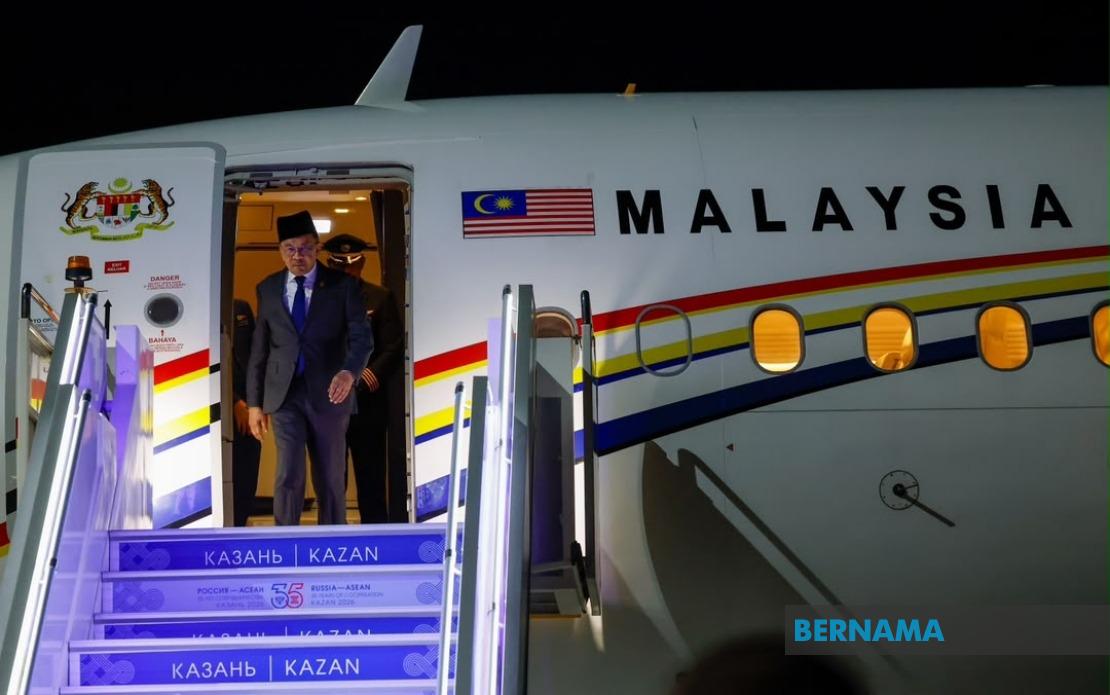
Prime Minister Datuk Seri Anwar Ibrahim touched down in Kazan late Tuesday evening, beginning a two-day working visit to Russia's Tatarstan capital where he will represent Malaysia at a significant diplomatic gathering honouring decades of cooperation between Southeast Asia and Moscow. His arrival at Kazan International Airport at 10.20 pm local time (3.20 am Wednesday Malaysian time) signals Malaysia's continued commitment to engaging with major powers amid a complex geopolitical landscape.
The delegation accompanying the Prime Minister underscores the economic dimensions of this engagement. Minister of Investment, Trade and Industry Datuk Seri Johari Abdul Ghani, Minister of Economy Akmal Nasrullah Mohd Nasir, and supporting officials from the Prime Minister's Office and Foreign Ministry travelled alongside Anwar, indicating that trade, investment, and economic cooperation feature prominently on the agenda. The composition of the delegation reflects how Malaysia views Russia not merely as a political actor but as an economic partner with whom diversified cooperation remains valuable.
At the tarmac, Malaysia's Ambassador to Russia Datuk Cheong Loon Lai received the Prime Minister, while the Russian side fielded a high-ranking reception including Ilya Nachvin, the Minister of Digital Development of Tatarstan, Kazan Mayor Ilsur Metshin, and protocol officials. This carefully balanced welcome underscores the ceremonial importance both nations place on the summit and the personal nature of these diplomatic exchanges.
The ASEAN-Russia Commemorative Summit on June 17-18 assumes particular significance as it marks the 35th anniversary of formal diplomatic relations between the two regional organisations, a partnership that was formally established in Kuala Lumpur back in 1991. Three and a half decades represent a substantial period during which both blocs have navigated the Cold War's aftermath, Asian economic transformation, and the emergence of a multipolar world order. The occasion provides a natural inflection point for the two sides to assess what has been accomplished and to chart pathways for deeper collaboration in the coming years.
According to Malaysia's Ministry of Foreign Affairs, discussions will encompass an expansive range of cooperation areas reflecting how regional partnerships have evolved beyond traditional diplomatic channels. Trade and investment cooperation forms the bedrock, but the agenda extends to energy security, addressing food security challenges, advancing digital economy opportunities, fostering scientific and technological collaboration, cultural exchange, educational partnerships, and people-to-people engagement. This breadth reveals how ASEAN and Russia seek to address shared contemporary challenges while building resilience in a rapidly changing global environment.
The summit is slated to produce four substantive outcome documents that will provide the framework for future cooperation. The Kazan Declaration marking the 35th anniversary sets the commemorative tone, while separate statements on energy and cultural cooperation address specific sectoral priorities. Most significantly, the Comprehensive Plan of Action to Implement the ASEAN-Russia Strategic Partnership 2026-2030 will establish concrete benchmarks and timelines for the coming five years, transforming aspirational goals into actionable commitments. These documents represent the accumulated diplomatic work preceding the summit and will guide bilateral and multilateral efforts through the decade's first half.
For Malaysia specifically, participation at this level reflects a strategic calculation about maintaining diverse partnerships and preventing any single power from dominating Southeast Asian relationships. By positioning itself prominently at ASEAN-Russia forums, Kuala Lumpur demonstrates that ASEAN Centrality remains more than rhetorical commitment—it involves sustained engagement with multiple partners on the region's own terms. In an increasingly contested geopolitical environment where powers compete for influence, Malaysia's approach emphasises dialogue, economic interdependence, and institutional cooperation as stabilising forces.
Beyond the formal summit agenda, Anwar is expected to hold bilateral meetings with Russian President Vladimir Putin and Tatarstan's leadership, providing opportunities to discuss issues of bilateral importance and matters affecting the broader regional environment. The Prime Minister's focus areas—advocating dialogue and peace, supporting economic resilience, advancing energy and food security, and deepening people-to-people links—align with Malaysia's broader strategic objectives while acknowledging Russia's interests in regional stability and economic engagement.
This represents Anwar's third visit to Russia since assuming the premiership in November 2022, indicating a deliberate pattern of engagement rather than episodic diplomacy. His September 2024 visit to Vladivostok for the Eastern Economic Forum and his May 2025 trip to Moscow for comprehensive bilateral talks with Putin demonstrate Malaysia's intention to maintain regular high-level contact with Russian leadership. Those previous discussions covered trade, investment, agriculture, education, aerospace, and energy cooperation—sectors where both nations possess complementary strengths and opportunities for mutual benefit.
The visit acquires added context given Malaysia's economic vulnerabilities and strategic interests. As a net energy importer with significant agricultural needs, Malaysia has incentive to explore energy partnerships and food security cooperation with Russia, a major commodity exporter. Simultaneously, Malaysian companies seek investment opportunities and technology partnerships in emerging sectors like digital economy and aerospace. From Russia's perspective, Southeast Asian markets and the strategic position of ASEAN in regional affairs make substantive cooperation worthwhile, particularly as Moscow seeks to diversify partnerships beyond Western-dominated structures.
Regionally, the summit signals that ASEAN members view Russia as a legitimate and valuable dialogue partner despite geopolitical tensions elsewhere globally. Southeast Asian nations have generally maintained more balanced approaches to great power competition than some other regions, and Malaysia's participation underscores this pragmatic tradition. The emphasis on economic cooperation, cultural exchange, and people-to-people engagement suggests that ASEAN prefers cooperative frameworks to confrontational posturing.
Looking forward, the 2026-2030 strategic partnership plan will likely shape how Malaysia and other ASEAN members engage with Russia across multiple domains. Whether cooperation in energy, digital economy, or educational exchanges actually materialises will depend on implementation capacity, political will, and international developments. Nevertheless, the summit represents a moment when Southeast Asia and Russia reaffirm their commitment to relationship-building in a multipolar world, with Malaysia positioned as an active participant shaping the region's external relations and advancing its conception of what regional partnership means in practice.

