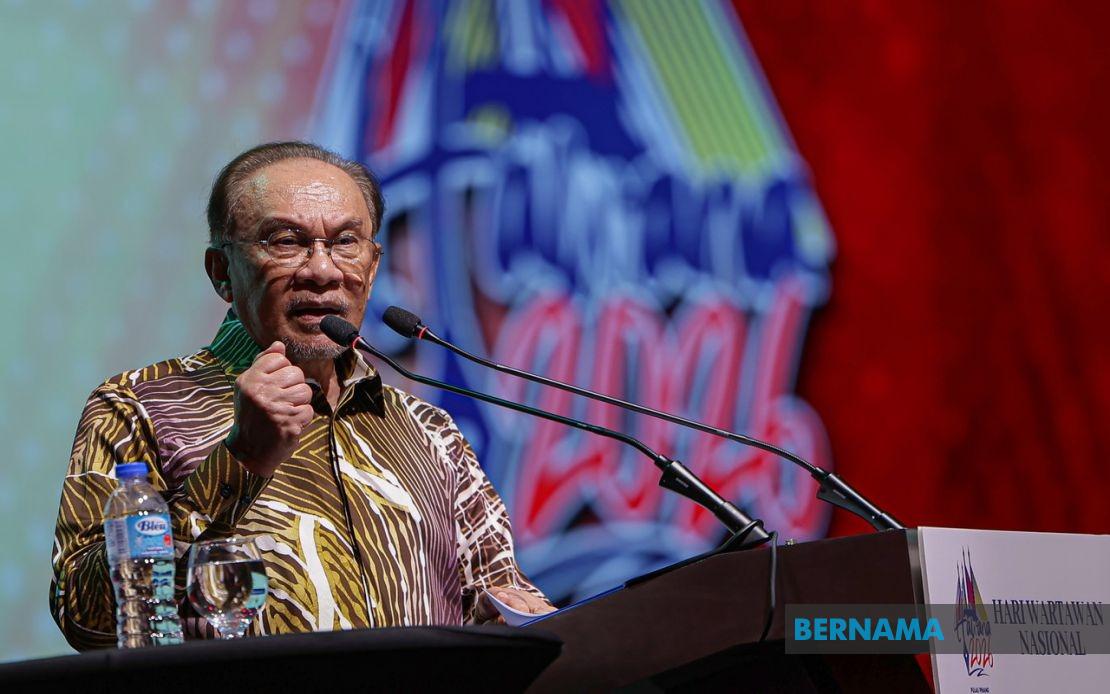
Prime Minister Datuk Seri Anwar Ibrahim has thrown his full support behind the appointment of former Federal Court judge Tan Sri Nallini Pathmanathan as the new chairman of the Malaysian Media Council, viewing the selection as a strategic move to rebuild institutional credibility and restore public trust in Malaysia's media regulatory framework. Speaking during the National Journalists' Day (HAWANA) 2026 celebration in Butterworth, Anwar highlighted how Nallini's distinguished judicial background and proven track record of integrity would fundamentally reshape the council's standing within the broader media landscape. His public endorsement signals the government's commitment to ensuring the council operates with the highest standards of impartiality and professional conduct at a time when media institutions globally face mounting scrutiny over their role in democratic discourse.
Nallini's elevation to the MMC chairmanship represents a significant institutional appointment that has been months in the making. The Malaysian Media Council board members unanimously endorsed her candidacy during a formal meeting held on May 26, a process that underscores the confidence her peers place in her leadership capabilities. Rather than a contentious selection driven by political considerations, the appointment emerged from careful deliberation that weighed her extensive experience navigating complex judicial matters and her reputation for upholding principles of fairness and due process throughout her career on the bench. This consensus approach to her selection reflects recognition that media regulation demands leadership insulated from partisan pressure and grounded in constitutional principles.
The Malaysian Media Council itself is relatively new to Malaysia's institutional architecture, having been formally established under the Malaysian Media Council Act 2025. As a self-regulatory body operating within the framework of this recent legislation, the council carries the dual mandate of maintaining journalistic standards while simultaneously protecting the fundamental democratic principle of media freedom. The organisation's responsibilities span a demanding range of functions, from adjudicating public complaints against news organisations to promoting ethical journalism practices and ensuring that editorial decisions remain accountable to professional standards rather than narrow commercial or political interests. This balancing act requires leadership with sufficient credibility to command respect from both journalists and the general public.
Anwar's remarks at the HAWANA 2026 event, delivered in the presence of senior government officials including Penang Chief Minister Chow Kon Yeow and Communications Minister Datuk Fahmi Fadzil, placed significant emphasis on the symbolic importance of Nallini's appointment. He noted that her credentials transcend the technical qualifications required for the role, extending instead to an intangible but essential quality—an ability to project institutional impartiality and independence to a Malaysian public increasingly concerned about whether major institutions operate according to publicly articulated standards or behind closed doors. For Anwar, Nallini's appointment represents not merely an administrative personnel decision but rather a statement about the administration's commitment to strengthening democratic institutions and restoring confidence in the self-regulatory capacity of the media sector.
The timing of this appointment carries particular significance within Malaysia's political and media context. The communications sector has undergone substantial evolution in recent years, with digital transformation creating new challenges around misinformation, content moderation, and the blurring boundaries between traditional journalism and online content creation. These developments place considerable pressure on regulatory bodies to develop frameworks that remain relevant and credible even as the technological landscape shifts beneath them. A media council led by someone with Nallini's judicial experience may be better positioned to navigate these complexities while maintaining legitimacy across constituencies that harbour divergent views about media freedom, press regulation, and the proper balance between editorial independence and public accountability.
The presence of Communications Minister Datuk Fahmi Fadzil at the Butterworth ceremony underscores the portfolio's investment in ensuring the MMC functions effectively as an arm's-length regulatory institution. While the council operates as a self-regulatory body rather than a government agency directly, the communications portfolio maintains an institutional relationship with the council's work. Having a minister actively visible in supporting the council's leadership demonstrates governmental backing without suggesting improper influence—a delicate boundary that becomes increasingly important as Malaysia navigates concerns about media pluralism and regulatory capture that have emerged across the regional landscape.
For Malaysian journalists and news organisations, Nallini's appointment carries practical implications for how complaints will be adjudicated and how ethical guidance will be developed and communicated. Her judicial background suggests she will bring a legalistic approach to interpretation of the council's regulatory framework, potentially emphasizing procedural fairness and transparent decision-making processes. This methodology could enhance the council's standing among journalists who worry that media regulation might become a tool for suppressing legitimate reporting or protecting powerful interests from scrutiny. Conversely, members of the public seeking redress against media organisations may appreciate the application of formal legal reasoning to their grievances, even if such an approach sometimes moves slowly.
The broader Southeast Asian context adds another layer of significance to this appointment. Across the region, media councils and self-regulatory bodies operate under varying degrees of pressure, with concerns that government influence undermines their independence. Malaysia's explicit creation of a statutory framework for media self-regulation, combined with the appointment of a respected judicial figure to lead this institution, positions the country as relatively committed to protecting editorial independence while maintaining mechanisms for public accountability. This may resonate positively with international observers of press freedom while simultaneously signalling to Malaysian journalists and publishers that regulatory oversight need not be synonymous with censorship or political manipulation.
The establishment of the MMC under the 2025 act represents a departure from purely government-directed media policy approaches. By creating an independent regulatory body with representation from the media industry itself, Malaysia has adopted a model more aligned with international best practices in media governance. Nallini's appointment as chair potentially validates this model by placing someone at the helm who has demonstrated, through her judicial work, an ability to interpret law and regulate conduct according to principled standards rather than political preference. Her success in this role may influence how other Southeast Asian nations approach similar questions about media regulation and institutional independence.
For the incoming MMC leadership under Nallini, considerable work lies ahead in establishing operational procedures, developing complaint-handling protocols, and building relationships with news organisations across Malaysia's diverse media landscape. The council must prove, through its actual decisions and processes, that it merits the confidence that Prime Minister Anwar has publicly invested in the institution through his endorsement of her appointment. Early decisions will be scrutinised not only by journalists and publishers but also by civil society organisations and international observers of press freedom, making the council's initial work particularly consequential for determining whether this institutional innovation achieves its intended purpose of strengthening journalistic standards while protecting media independence.
Anwar's public backing of Nallini should be understood as more than a routine endorsement of an administrative appointment. Rather, it represents a political investment in the success of Malaysia's media self-regulatory framework at a moment when global trends suggest strengthening rather than weakening institutional protections for press freedom. The Prime Minister has essentially staked his administration's commitment to this principle on Nallini's ability to lead the MMC in a manner that commands credibility across the ideological and sectoral divisions that characterise Malaysia's complex media environment. Success will require her to navigate inevitable tensions between the council's protective role for journalists and its accountability function for the public, demonstrating that these objectives complement rather than contradict one another.

