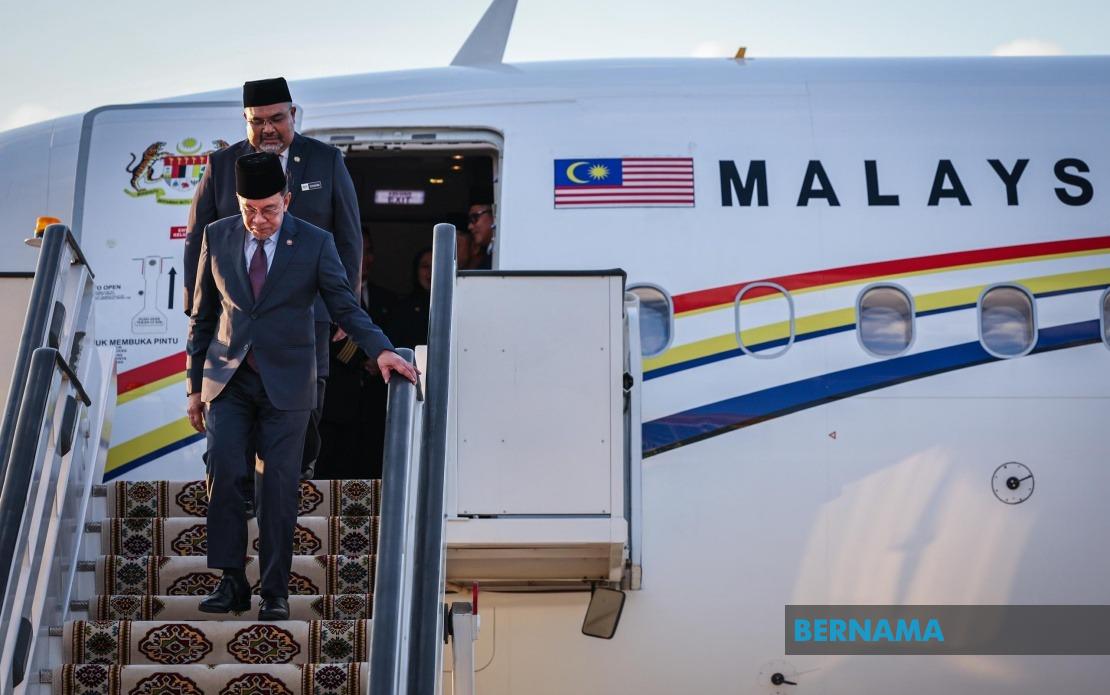
Prime Minister Datuk Seri Anwar Ibrahim touched down in Ashgabat on Tuesday evening, concluding the Central Asian leg of his international travels that began with a working visit to Kazan in Russia's Republic of Tatarstan. The aircraft landed at Ashgabat International Airport at 8 pm local time, marking the beginning of Malaysia's top leadership's engagement with Turkmenistan's government and business community over the next 48 hours. The timing reflects Kuala Lumpur's strategic pivot toward deepening relationships with energy-rich nations in the broader Central Asia region, a move that carries particular significance given the geopolitical and economic realignments reshaping Eurasia.
Anwar's delegation comprises several key economic figures including Minister of Investment, Trade and Industry Datuk Seri Johari Abdul Ghani and Minister of Economy Akmal Nasrullah Mohd Nasir, signalling that commercial partnership and investment potential form central pillars of the discussions ahead. The composition of the Malaysian contingent underscores the visit's focus on tangible economic outcomes rather than ceremonial diplomacy alone. Malaysia's Ambassador to Turkmenistan Mohd Suhaimi Ahmad Tajuddin welcomed the prime minister upon arrival, while Turkmenistan's Deputy Chairman of the Cabinet of Ministers for Oil and Gas Guvanch Agajanov led the receiving delegation, highlighting the energy sector's prominence in bilateral relations.
The visit arrives at the personal invitation of Turkmenistan President Serdar Berdimuhamedov and serves as reciprocal acknowledgement of his December 2024 official visit to Malaysia. This marks Anwar's inaugural official journey to the Central Asian nation and represents the fifth such visit by a Malaysian prime minister to Turkmenistan, underscoring the continuity of high-level engagement between the two countries across multiple administrations. The sequential nature of these exchanges reflects a deliberate diplomatic strategy to maintain momentum in bilateral affairs despite the geographical distance and limited cultural linkages between the nations.
Wednesday's programme focuses on ceremonial and substantive governmental engagement. President Berdimuhamedov will host a welcoming ceremony at the Presidential Palace, followed by restricted bilateral discussions between the two leaders. These sessions will culminate in the signing of a joint statement and the execution of previously negotiated agreements and memoranda of understanding, suggesting that extensive preparatory work has already crystallised specific areas of cooperation. Such structured agendas typically address trade facilitation, investment frameworks, and sectoral collaboration across energy, infrastructure, and human resource development.
Beyond official state functions, Anwar's itinerary incorporates cultural and religious dimensions reflecting Malaysia's diplomatic approach toward Muslim-majority nations. The prime minister will perform Friday prayers at the Turkmenbashi Ruhy Mosque, commonly known as the Gypjak Mosque, a gesture acknowledging the shared Islamic heritage that underpins Malaysia-Turkmenistan relations. An official luncheon hosted by President Berdimuhamedov will provide informal setting for further discussion, while a joint officiation of the Malaysia-Turkmenistan Forum at the Chamber of Commerce and Industry offers a platform to engage with Turkmen business leaders and potential investors. The visit concludes with a press conference addressing Malaysian media, providing opportunity for Anwar to frame outcomes for domestic audiences.
Tuesday evening saw Anwar attend a dinner reception with Malaysia's diaspora community in Ashgabat and local friends of Malaysia, a customary engagement that reinforces connections with overseas Malaysians and cultivates grassroots goodwill. Such interactions, though often overshadowed by high-level governmental meetings, provide valuable intelligence regarding on-ground conditions and community sentiment that informs diplomatic strategy. The diaspora engagement also signals Malaysia's commitment to maintaining bonds with citizens residing abroad, a constituency whose networks frequently facilitate business and cultural exchange.
The economic relationship between Malaysia and Turkmenistan, whilst relatively modest in aggregate terms, carries strategic weight disproportionate to its monetary value. In 2025, Turkmenistan ranked as Malaysia's fourth-largest trading partner among Central Asian nations, with total bilateral trade reaching RM75.80 million. Malaysian exports constituted the overwhelming majority at RM75.50 million, representing a nine percent year-on-year increase and demonstrating steady growth in demand for Malaysian goods and services within Turkmenistan's marketplace. This trajectory suggests expanding commercial opportunities as the Central Asian nation diversifies its economy beyond traditional energy sectors.
The presence of Petroliam Nasional Bhd (Petronas) in Turkmenistan represents the most substantial Malaysian economic footprint in the country. The national oil company's cumulative investments since 1996 have reached RM52.73 billion, positioning Malaysia as a significant foreign investor in Turkmenistan's crucial hydrocarbon sector. Petronas operates major projects extracting and developing oil and gas reserves in the Caspian Sea and onshore fields, making the company instrumental to Turkmenistan's economy. Maintaining cordial government-to-government relations directly impacts Petronas's operational stability, regulatory environment, and expansion prospects, rendering Anwar's visit consequential for Malaysia's energy security strategy.
Turkmenistan's vast natural gas reserves, among the world's largest, constitute a strategic resource attracting global investment despite the nation's governance challenges and international isolation resulting from human rights concerns. Malaysia's pragmatic approach toward energy-rich authoritarian states reflects the nation's realpolitik foreign policy framework, prioritising economic and strategic interests over governance advocacy. This stance allows Malaysian companies to operate successfully in environments where Western counterparts face constraints, positioning Malaysia as a bridge between Central Asian resource producers and Asian consumers seeking diversified energy supplies.
Anwar's Central Asian tour signals Malaysia's serious commitment to expanding engagement beyond Southeast Asia and traditional Commonwealth partners. The broader diplomatic arc encompassing stops in Russia and Turkmenistan reflects positioning toward emerging markets and resource-rich regions as the global economy undergoes structural realignment. Central Asia presents opportunities for Malaysian firms in sectors ranging from energy to infrastructure development, whilst also offering potential partnerships in halal products, Islamic finance, and educational exchange. As China, Russia, and Iran expand their footprint throughout the region, Malaysia's presence, though modest, contributes to ensuring that Asian diversity and Southeast Asian perspectives remain part of Central Asia's international calculus.
The diplomatic significance of the visit extends beyond bilateral relations to regional implications. Malaysia's engagement with Central Asian nations helps maintain pluralistic international spaces where smaller and medium powers can exercise agency independently of great power competition. The visit also demonstrates Malaysia's willingness to engage nations regardless of geopolitical alignment, maintaining relationships across the Eurasian expanse. For Malaysian policymakers, deepening ties with energy-rich Central Asian countries provides leverage in regional forums and diversifies Malaysia's diplomatic portfolio, reducing excessive reliance on relationships with traditional Western partners or immediate Southeast Asian neighbours.
Looking forward, the visit's outcomes—reflected in signed agreements and joint statements—will shape the trajectory of Malaysia-Turkmenistan relations over coming years. Potential areas for expanded cooperation likely include enhanced trade facilitation, investment guarantee frameworks, sectoral collaboration in energy and infrastructure, and people-to-people exchange through educational scholarships and cultural programmes. Success in realising these objectives depends substantially on follow-through by respective governments and agencies, a challenge complicated by administrative capacity constraints in Turkmenistan and competing priorities within Malaysia's domestic agenda. Nevertheless, the visit represents concrete affirmation of Malaysia's strategic interest in Central Asia and commitment to building enduring partnerships with nations offering complementary economic interests and geopolitical value.