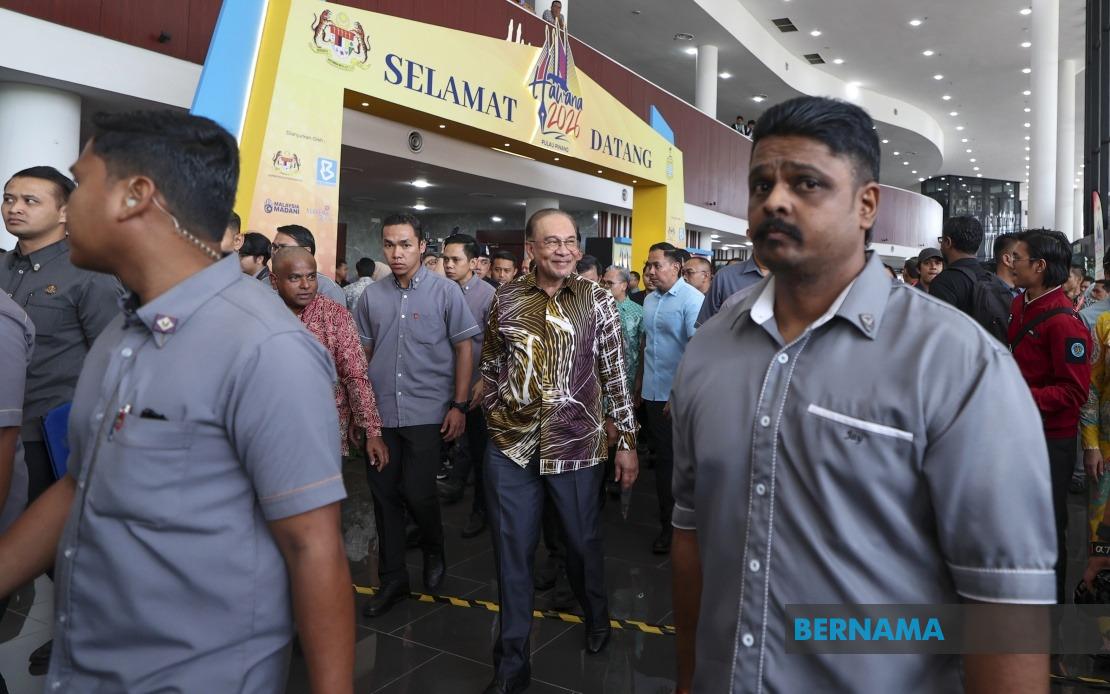
Prime Minister Datuk Seri Anwar Ibrahim arrived at the PICCA Convention Centre @ Butterworth Arena on June 20 to officially open the National Journalists' Day (HAWANA) 2026 celebration, one of the nation's premier events recognizing the journalism profession. His presence underscored the government's commitment to supporting and acknowledging the critical role media plays in maintaining public trust and shaping democratic discourse in Malaysia. The ceremony reflected broader regional recognition of journalism's importance, as the event drew international attention and participation from neighbouring countries throughout Southeast Asia.
Upon his arrival at 2.40 pm, the Prime Minister was welcomed by Penang Chief Minister Chow Kon Yeow, Communications Minister Datuk Fahmi Fadzil, and Communications Ministry secretary-general Datuk Abdul Halim Hamzah. Before proceeding to official proceedings, Anwar toured the venue's exhibition booths and HAWANA 2026 Photo Gallery, taking time to engage with displays showcasing journalistic achievements and industry developments. This informal segment of his visit allowed him to interact directly with exhibits highlighting the evolution and contemporary challenges facing Malaysian journalism.
The event assembled a constellation of senior figures from Malaysia's media establishment and government communications sector. Malaysian National News Agency (Bernama) chairman Datuk Seri Wong Chun Wai, chief executive officer and HAWANA 2026 Working Committee chairman Datin Paduka Nur-ul Afida Kamaludin, and editor-in-chief Arul Rajoo Durar Raj represented the national news agency. Project leadership included deputy editor-in-chief (News Service) Mohd Shukri Ishak, who directed implementation of the two-day gathering. Their collective presence signified Bernama's pivotal role as implementing agency for an event sponsored by the Ministry of Communications.
The gathering attracted significant international representation, particularly from ASEAN member states. Timor-Leste's Secretary of State for Social Communication Expedito Loro Dias Ximenes and the president of Agencia Noticiosa de Timor-Leste (TATOLI) Noemio Mateus Soares Falcao attended alongside Cambodia's Undersecretary of State at the Ministry of Information Prak Thaveak Amida. Laos sent Permanent Secretary of the Cabinet Office of its Ministry of Technology and Communications Phuangpasert Keosouvanh. This Southeast Asian cohort demonstrated how HAWANA functions as a regional platform transcending bilateral relationships, establishing opportunities for cross-border dialogue among journalism leaders and government communication officials.
Beyond ASEAN delegates, the celebration welcomed representatives from major international news organizations and journalism associations. Indonesia's Antara News Agency, the Vietnam News Agency (VNA), and Xinhua News Agency sent delegations, while professional bodies including the Indonesian Journalists Association (PWI) and the Ikatan Setiakawan Wartawan Malaysia-Indonesia (ISWAMI) participated. Their involvement highlighted how HAWANA resonates throughout regional and global journalism communities, positioning Malaysia as a meaningful player in facilitating dialogue on professional standards and journalistic ethics across borders.
Operating under the overarching theme 'Media Integrity Strengthens Credibility', HAWANA 2026 assembled approximately 1,000 media practitioners from within Malaysia and internationally. This scale made the event substantially more than a domestic awards ceremony; it functioned as a strategic gathering generating contemporary ideas about journalism's future direction. The size and composition of attendees reflected growing recognition that media challenges transcend national boundaries, requiring collaborative problem-solving among practitioners, regulators, and government communicators across the region.
During the official ceremony, the Prime Minister was scheduled to present two categories of recognition. The HAWANA Award and Special HAWANA Award honoured individuals demonstrating significant contributions to advancing journalism and developing public thought within Malaysia. Additionally, Anwar was to distribute contributions from the Kasih@HAWANA Fund, providing financial support to media veterans. This dual recognition mechanism balanced honouring contemporary achievement with supporting those who had devoted careers to journalism, reflecting appreciation for both present and historical contributions to the profession.
The event's framing around media integrity speaks to contemporary pressures facing journalism globally. In Malaysia's context, recent years have witnessed intensifying scrutiny of news organizations' sources, editorial independence, and relationship with government institutions. By anchoring HAWANA 2026 to the integrity theme, organizers addressed concerns that credibility requires consistent demonstration of professional standards, transparent editorial processes, and commitment to factual accuracy. For Malaysian media practitioners navigating an environment of competing narratives and political polarization, the emphasis provided a unifying framework emphasizing professional values transcending partisan divisions.
The gathering carries particular significance for Southeast Asian journalism at a moment when the region confronts shared challenges including misinformation, platform economics threatening traditional business models, and questions about editorial autonomy. By convening practitioners, government communicators, and international news organizations, HAWANA created space for discussing how journalism institutions can strengthen public confidence while maintaining editorial independence. The presence of Communications Minister Datuk Fahmi Fadzil signified that Malaysian government officials recognized journalism's essential democratic function and sought constructive engagement with the profession.
Bernama's role as implementing agency positioned Malaysia's national news organization as a facilitator of regional conversation. As a state-aligned entity balancing commercial and public service missions, Bernama's leadership in organizing an event celebrating media integrity navigated inherent tensions between government interests and journalistic independence. The international attendance suggested that regional peers viewed Malaysia's engagement in these discussions as contributing meaningfully to broader Southeast Asian efforts to strengthen professional standards.
The Prime Minister's direct participation in opening HAWANA 2026 conveyed that Malaysia's highest leadership valued the journalism profession's contributions to national development and democratic governance. His presence alongside regional government communication officials suggested Malaysia positioned itself as a leader in facilitating dialogue about media's role in contemporary Southeast Asia. For Malaysian journalists attending the event, the ceremonial acknowledgment provided symbolic affirmation of journalism's importance to national discourse, even as practitioners continued navigating complex relationships with political actors and government institutions.

